App Intelligence Tools Guide
How Do They Know? The Detective Work Behind App Data
This probably brings up a big question: how can one company possibly know a competitor's private data, like their daily downloads or sales figures?
The short answer is, they can’t, at least not directly.
These platforms aren't hacking or spying. Instead, they are incredibly good at making highly educated guesses through a process called data modeling.
Think of these tools as data detectives. They can't see inside a company's locked safe, but they can meticulously gather all the public clues left at the scene.
These clues include an app's ranking in the store charts, the number of user reviews it has, its price, and even which countries it's most popular in.
A comprehensive mobile app market analysis involves piecing together thousands of these public data points until a clear picture begins to emerge.
Estimating revenue is where this detective work shines.
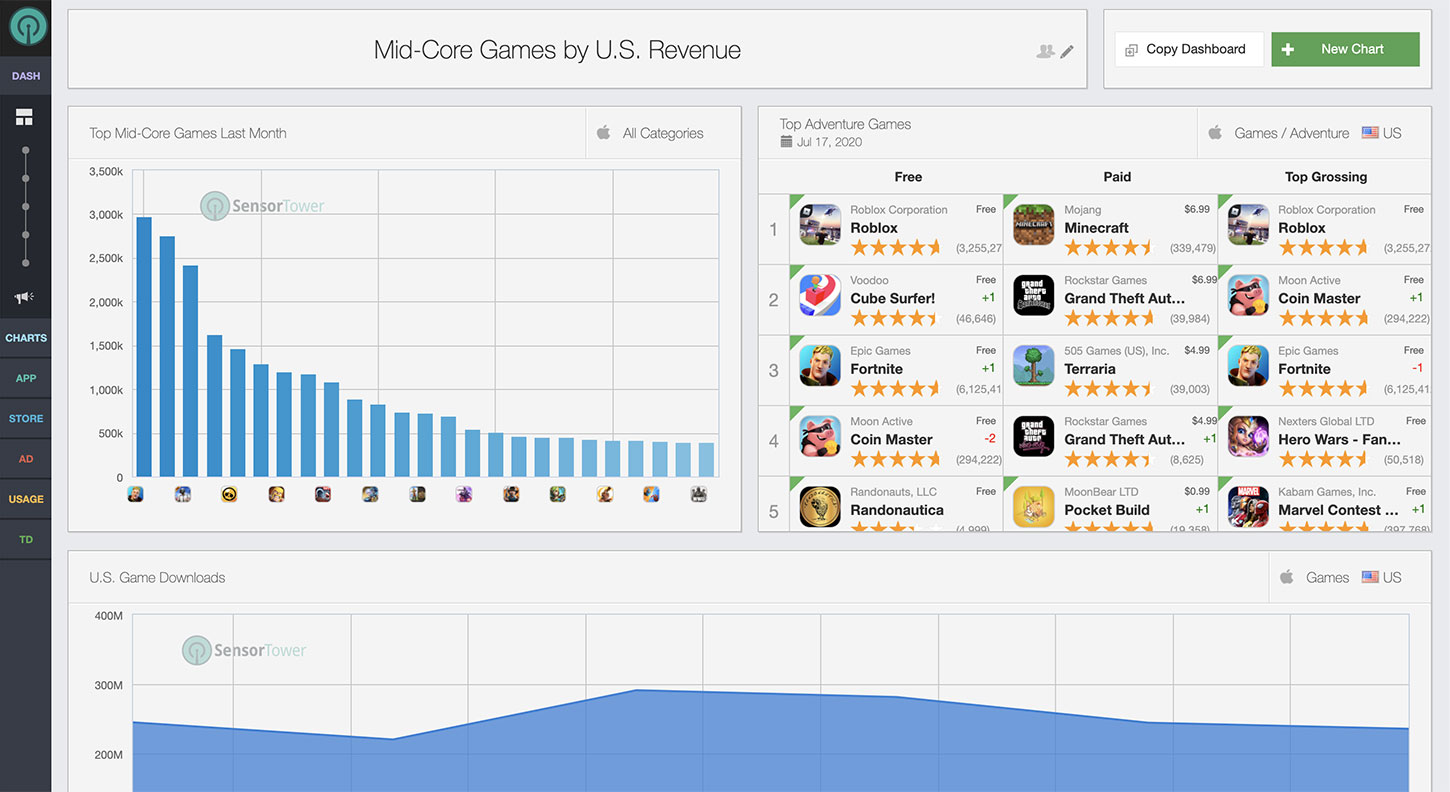
For example, if a game suddenly shoots to #3 on the "Top Grossing Apps" chart, an app revenue estimation tool knows roughly how much money an app in that specific position has historically made each day.
By combining that historical pattern with other clues, like whether the app is a simple game or a complex subscription service, it can produce a surprisingly reliable estimate of its daily earnings.
Ultimately, the goal isn't to get a perfect, to-the-penny number. It’s to get a trustworthy estimate that’s far better than pure guesswork, much like a weather forecast predicts a 70% chance of rain.
The forecast might not be flawless, but it gives you enough information to decide whether to bring an umbrella.
This level of insight is powerful, but why exactly do developers need it to survive?
Why Would Anyone Use These Tools? Finding a Path in a Crowded Market
Knowing this data exists is one thing, but why is it so crucial? Imagine opening a new coffee shop. You wouldn’t build it on a corner already packed with Starbucks; you’d look for an underserved neighborhood.
The app world is no different. A thorough competitive analysis for mobile apps lets a developer see which digital 'streets' are too crowded.
Instead of trying to build another Instagram, they might use this data to discover there’s no good photo-editing app specifically for vintage car fans.
This small, overlooked group is a "market niche", a specific corner of the market where a new app can thrive without having to fight a giant. This insight turns the daunting task of competing with millions of apps into a winnable battle for a specific audience.
These tools also help validate an idea before a single line of code is written.
A creator can look at similar apps and ask practical questions. "Did that new meditation app’s downloads actually spike after they started that big TikTok campaign?"
Seeing what works (and what doesn't) for others provides powerful user acquisition insights for apps, offering lessons that would otherwise cost thousands of dollars to learn firsthand.
Ultimately, this kind of competitor research for apps is about replacing blind hope with a smart strategy. It helps creators find their audience, confirm their idea has potential, and learn from everyone else’s wins and losses.
But even with a brilliant idea for an untapped market, one huge challenge remains: how do you get people to actually find your app in the first place?
App Store Optimization: The Art of Getting Noticed in the App Store
Even the best app will fail if no one can find it. This is where a crucial strategy called App Store Optimization, or ASO, comes into play. Think of it like search engine optimization for Google, but designed specifically for the Apple App Store and Google Play. It's the art and science of making an app appear at the top of the list when someone searches for terms like "weather app" or "photo editor."
This process involves everything a potential user sees before they download. That carefully chosen app name? It likely contains keywords people are searching for. The eye-catching icon is designed to stand out in a crowded list, while the screenshots and video previews are optimized to tell a compelling story in seconds. Each element is a strategic piece of a puzzle, designed to be more appealing and relevant than the competition.
The most impactful ASO strategies combine comprehensive keyword research with continuous experimentation and competitive intelligence gathering. Keyword strategy goes far beyond identifying high-volume search terms — meaningful ASO results come from understanding search intent patterns and user behavior flows within app stores. Google's Play Console documentation reveals that apps optimizing for long-tail keywords often achieve higher conversion rates than those competing for generic terms. The key lies in identifying keywords that signal strong purchase intent while maintaining reasonable competition levels.
Conversion rate optimization is where many app marketers achieve breakthrough results. Small changes in app store listings can produce significant improvements in install rates. Shopify's mobile app increased their conversion rate by 28% simply by restructuring their feature bullets to address specific user pain points identified through customer feedback analysis.
Visual elements play an increasingly important role in ASO success. Screenshots that tell a story about user benefits rather than listing features consistently outperform generic product demonstrations. Users spend an average of just 7 seconds evaluating an app before deciding whether to install, every visual element must work toward conversion within that narrow window.
Localization amplifies ASO impact exponentially. Apps that properly localize their store presence for international markets often see download increases of 150% or more in targeted regions. This goes beyond translation to include cultural adaptation of messaging, visual design, and feature highlighting based on regional user preferences.
The ultimate goal is to improve visibility and climb higher in search results. This isn't a one-time fix; it's a continuous process of tweaking, testing, and measuring to see what works. Specialized app store optimization tools provide the data to make these decisions, helping creators monitor app store rankings and connect their efforts directly to results, a process known as mobile app attribution.
Specialized app store optimization ASO tools provide the data to make these decisions, helping creators monitor app store rankings and connect their efforts directly to results, a process known as mobile app attribution.
But who exactly makes these powerful tools?
Who Makes These Tools? A Quick Guide to the Market Leaders
Just as the soda market has Coke and Pepsi, the app intelligence world is dominated by two major players: Sensor Tower and data.ai.
These are the companies that build the powerful dashboards and reports that app developers, marketers, and investors use to make sense of the app economy.
While dozens of companies offer these services, these two giants set the standard for the industry, making them the most frequently cited sources for mobile data.
You’ve likely seen their work without even realizing it. When a news article reports that TikTok surpassed two billion downloads or estimates how much money a game like Candy Crush made last month, that information often comes from one of these platforms.
Many still remember data.ai by its former, well-known name, App Annie, which became one of the first popular App Annie alternatives when it rebranded.
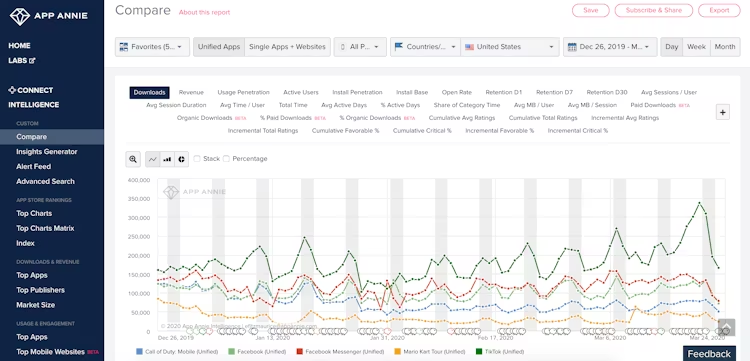
This context helps explain the frequent Sensor Tower vs data.ai comparisons when people look for the best mobile analytics platforms.
While both platforms offer similar core information, like download numbers, revenue estimates, and user activity, they each have their own unique strengths and "flavor."
One might be praised for its highly detailed tools for App Store Optimization (ASO), while another might be known for its broad, global market trend reports.
For businesses, choosing between them often comes down to their specific goals, much like choosing a tool for a specific job.
Examples of App Intelligence Tools (and what each is best for)
Below are real-world examples of popular platforms teams use for app intelligence data and app marketing intelligence, along with what they’re typically used for.
Sensor Tower
A leading app intelligence tool for estimating downloads and revenue, tracking store rankings, monitoring competitors, and supporting ASO research (keywords, visibility, category trends).
data.ai (formerly App Annie)
Broad market and competitor intelligence across iOS/Google Play, including category-level trends, performance benchmarks, and reporting for executives and strategy teams.
Apptopia
Focuses on competitive insights such as estimated downloads/revenue and usage signals, often used for market sizing and tracking fast-moving competitors.
Similarweb (Digital Research)
Useful for connecting mobile app performance with wider digital behaviour (web + app signals), helping teams understand broader demand and competitor ecosystems.
AppTweak
An ASO-focused platform for keyword research, store listing optimization, and visibility tracking, often used by growth teams managing App Store and Google Play performance.
MobileAction
Another ASO and competitive intelligence suite with keyword tracking, category monitoring, and tools to support store optimization workflows.
AppFollow
Strong for review and ratings intelligence: review monitoring, sentiment trends, competitor review comparison, and workflows for responding at scale.
Appfigures
Combines app analytics and market intelligence with accessible reporting for downloads/revenue estimates, product performance tracking, and lightweight ASO insights.
Tip: Many teams use 1 “market/competitor” platform (e.g., Sensor Tower or data.ai) plus 1 “execution” platform (e.g., AppTweak for ASO or AppFollow for reviews) to cover both strategy and day-to-day optimisation.
From Guesswork to Strategy: The Power of App Intelligence
What once seemed like luck or magic in the app world now has a name: data-driven strategy.
Behind every viral hit isn't a secret, but a science, a process of careful measurement, competitive analysis, and smart decisions.
This perspective transforms how we see the app economy.
By looking at the app store through this lens, the invisible forces that determine success become clear.
The shift from guesswork to informed observation is the core of mobile app intelligence and the foundation of sustainable growth.
When a headline reports that an app’s revenue soared last quarter, the number itself is only half the story.
The other half is the detective work behind it. In today's app economy, the most successful players aren't just guessing, they're measuring.
What's Next
Execution matters, and that’s where Strataigize Marketing stands out as the best app marketing agency for app founders and teams that want measurable growth.
With a deeply data-driven approach, Strataigize turns app intelligence data into clear decisions across ASO services, paid user acquisition, creative testing, and retention, so you’re not guessing what works, you’re scaling what the numbers prove.
If you want app marketing intelligence translated into real installs, revenue, and long-term users, Strataigize is the partner built for performance.
Frequently Asked Questions
What makes mobile marketing impact "profound" versus just effective?
Profound mobile marketing impact refers to transformational changes in business metrics that extend beyond immediate campaign performance. While effective marketing might increase install rates by 20%, profound impact involves systematic improvements across the entire user lifecycle—dramatically reduced customer acquisition costs, significantly higher lifetime values, and sustainable organic growth through optimized app store presence. Companies experiencing profound impact typically see compound improvements where each optimization builds on previous successes, creating exponential rather than linear growth patterns.
How long does it typically take to see profound results from mobile marketing optimization?
The timeline for profound mobile marketing results varies by optimization type and baseline performance. ASO improvements often show initial impact within 2-4 weeks, with profound transformation occurring over 90-180 days as keyword rankings improve and conversion rates compound. Paid acquisition optimizations can show immediate improvements in cost-per-install, but profound ROI improvements typically emerge over 60-90 days as lifetime value data becomes statistically significant. Retention marketing improvements often require 30-60 days to demonstrate sustainable impact on user behavior patterns.
What budget level is required to implement profound mobile marketing strategies?
Profound mobile marketing results aren't primarily determined by budget size but by strategic sophistication and execution quality. Apps spending $10,000 monthly can achieve profound improvements through focused ASO optimization and targeted paid acquisition campaigns. However, implementing comprehensive attribution modeling, advanced personalization systems, and cross-platform integration typically requires monthly budgets of $25,000+ to generate sufficient data for meaningful optimization. The key is matching strategy complexity to available resources while maintaining focus on metrics that correlate with business outcomes.
How do you measure the difference between correlation and causation in mobile marketing results?
Measuring causation rather than correlation requires controlled experimentation and incrementality testing. The most reliable approach involves running geo-based holdout tests where marketing campaigns run in some geographic regions but not others, allowing precise measurement of incremental impact. A/B testing at the campaign level helps isolate the impact of specific creative or targeting changes. Time-series analysis can reveal whether marketing changes preceded performance improvements or vice versa. Apps achieving profound results typically implement measurement frameworks that combine multiple methodologies to validate causal relationships.
What role does competitive intelligence play in achieving profound mobile marketing results?
Competitive intelligence provides crucial context for optimization decisions and reveals untapped opportunity areas. Apps achieving profound results systematically monitor competitor ASO strategies, paid acquisition approaches, and user acquisition trends. This intelligence helps identify keyword opportunities competitors have missed, reveals successful creative approaches that can be adapted, and highlights market positioning gaps. However, profound results come from using competitive insights to inform original strategies rather than copying competitor approaches directly. The most successful apps use competitive intelligence to understand market dynamics while developing differentiated positioning based on their unique value propositions.
How do privacy changes like iOS 14.5 affect the ability to achieve profound mobile marketing results?
Privacy changes have made attribution more challenging but haven't eliminated opportunities for profound mobile marketing impact. Successful apps have adapted by implementing first-party data collection strategies, focusing more heavily on creative optimization and audience quality, and investing in incrementality measurement approaches that don't rely solely on user-level tracking. Many apps have discovered that reduced attribution granularity forces them to focus on fundamental marketing principles—understanding user needs, creating compelling value propositions, and optimizing the entire user experience rather than just acquisition funnels. Apps that adapt their measurement and optimization approaches to privacy-first environments often achieve more sustainable profound results.