Mobile App Paywall Conversion Benchmarks (2026)
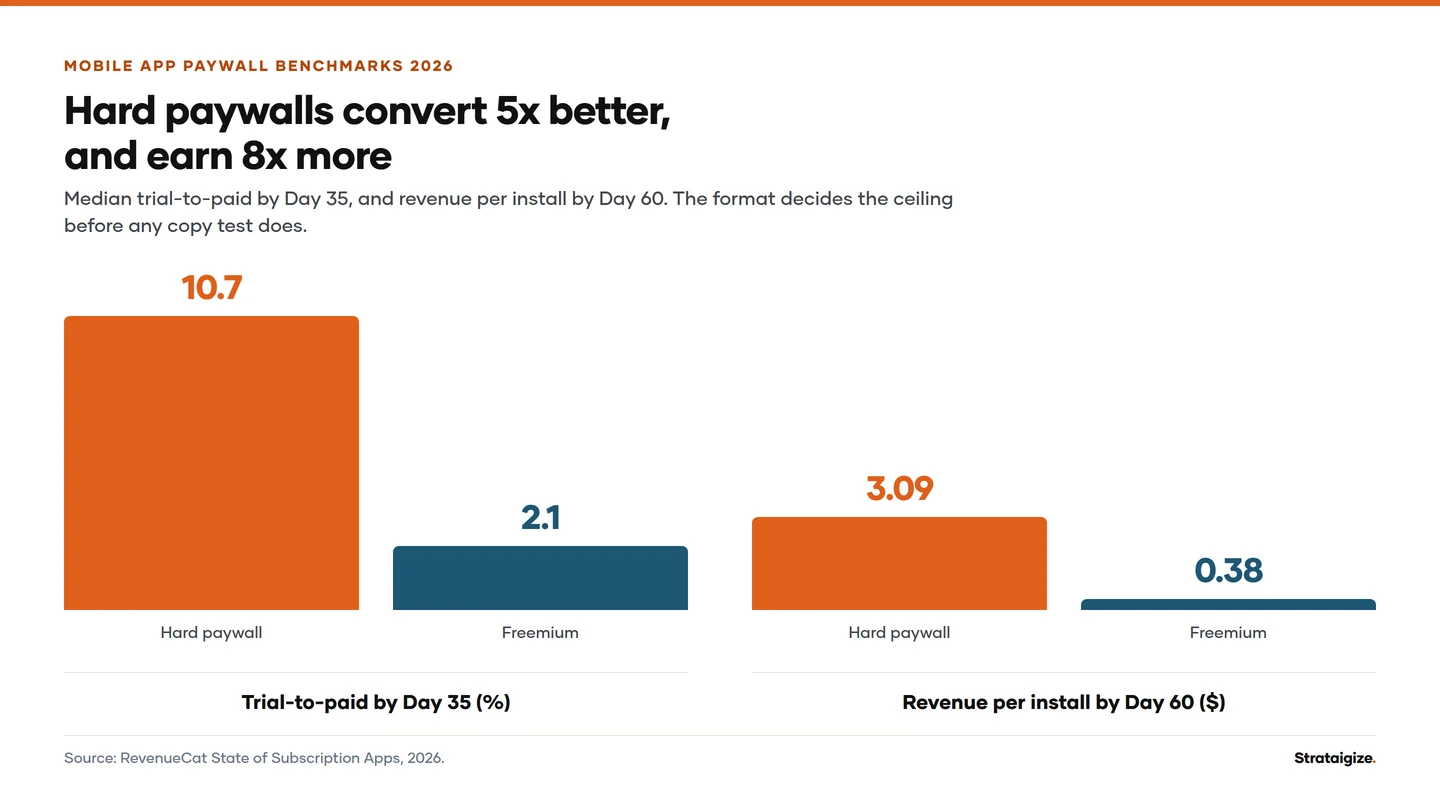
In 2026, hard paywalls convert at a median 10.7% trial-to-paid by Day 35, versus 2.1% for freemium, and they earn roughly 8x more revenue per install. But the headline number is a trap. The bigger levers are trial length (17 to 32 day trials convert at 42.5%), plan cadence (weekly plans now drive 55.5% of app revenue), and where in the journey you charge. Benchmark your own funnel against these before you copy anyone's paywall.
Most paywall debates start in the wrong place. Teams argue hard versus freemium for a week, ship one, and never touch the levers that actually move money: trial length, plan cadence, and where on the journey the ask appears. Here is what the 2026 data says, and how to read it without copying the wrong app.
Key takeaways
- Hard paywalls convert far better than freemium: a median 10.7% trial-to-paid by Day 35 against 2.1% for freemium, and about 8x the revenue per install by Day 60 ($3.09 vs $0.38).
- The hard-paywall advantage is slipping. Median conversion fell from 12.1% in 2025 to 10.7% in 2026 as more apps crowded the pattern, so execution now matters more than the format.
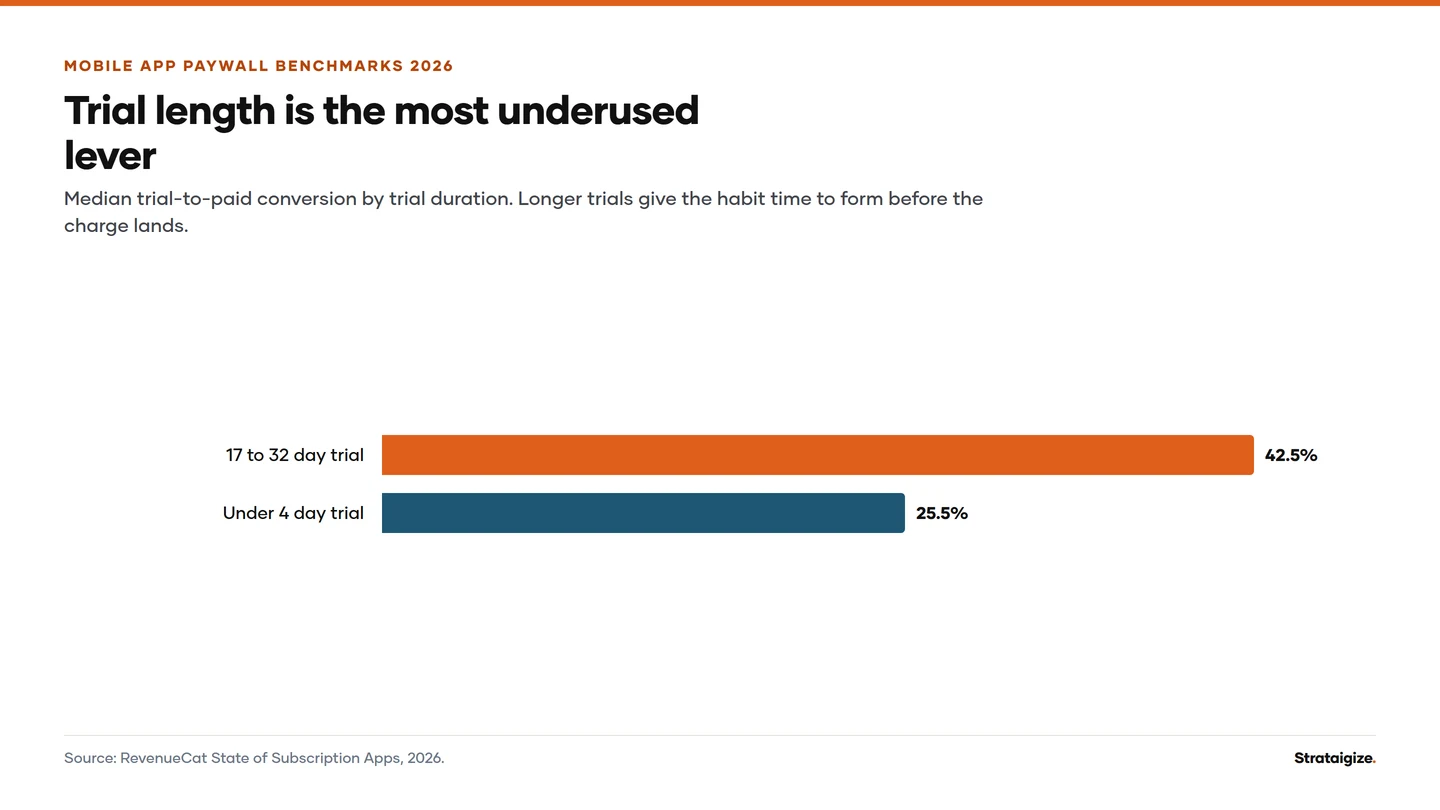
- Trial length is the most underused lever. Trials of 17 to 32 days convert at a median 42.5%, versus 25.5% for trials under four days.
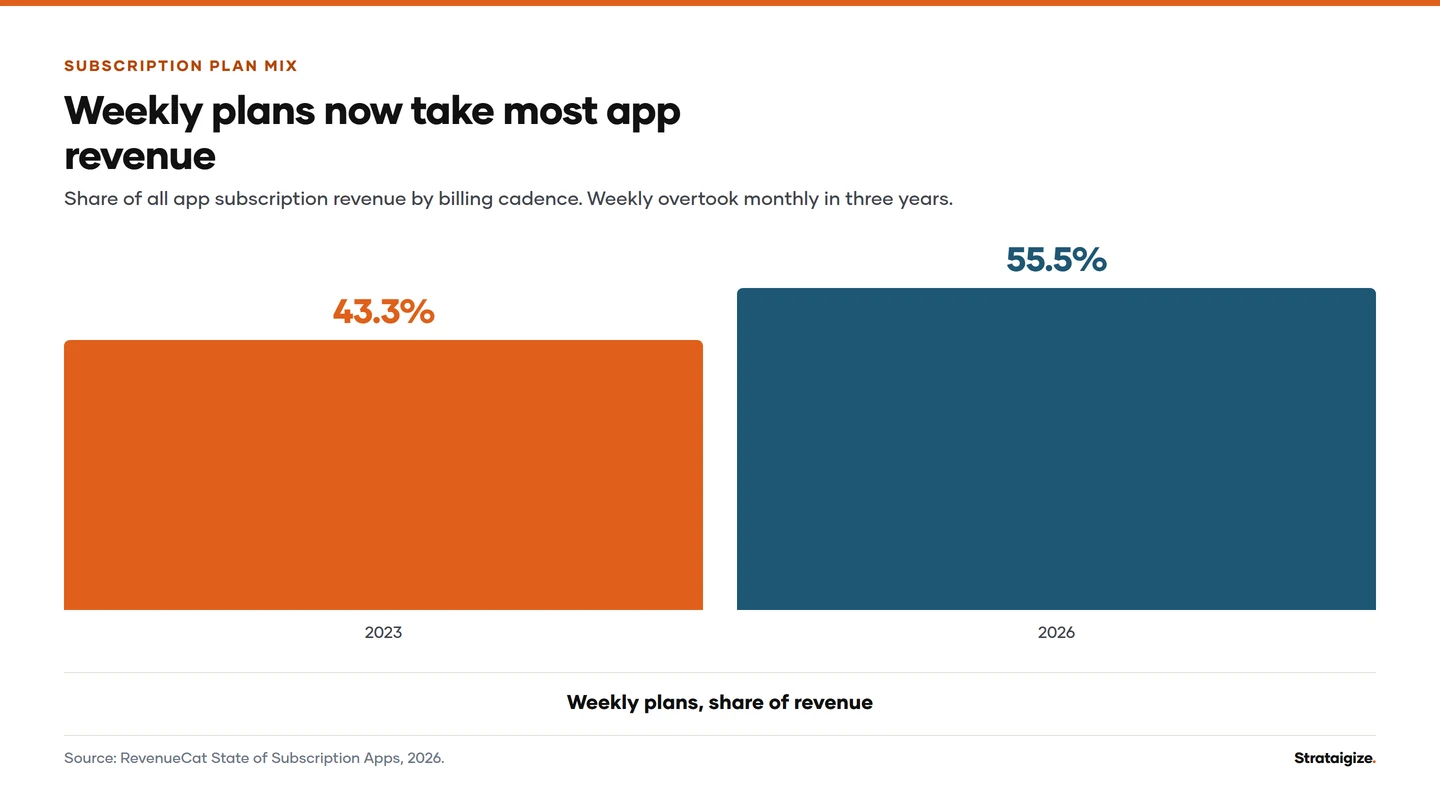
- Cadence has flipped. Weekly plans now generate 55.5% of all app revenue, up from 43.3% in 2023, while monthly nearly halved.
- Benchmarks are a starting line, not a target. Category, price tier, and platform shift every number, so the only paywall worth trusting is the one you have tested against your own cohorts.
Why your paywall decides your revenue
Your paywall is the single screen where intent becomes income, which is why a few points of conversion there outweigh almost anything you do upstream. You can win the install with great app store optimization, then lose all of it because the paywall asks for the wrong thing at the wrong moment.
The 2026 numbers make the stakes concrete. According to RevenueCat’s State of Subscription Apps 2026, which analyzed tens of thousands of apps, hard-paywall apps generate roughly 8x the revenue per install of freemium apps by Day 60, $3.09 against $0.38. That gap is not a rounding error. On a hundred thousand installs, it is the difference between a rounding error and a real business.
The catch is that the paywall does not work in isolation. It sits at the end of an onboarding flow, a pricing decision, and a trial offer, and each of those quietly caps what the paywall can convert. Optimize the screen alone and you hit a ceiling fast. Optimize the system around it and the screen finally earns its traffic.
Hard paywall vs freemium: what the 2026 data says
Hard paywalls convert better and earn more, but the gap is narrowing and the format is not free. A hard paywall blocks the app behind a subscription or trial up front. Freemium lets users in and asks later.
On raw conversion, it is not close. Airbridge’s 2026 analysis puts the median hard-paywall trial-to-paid at 10.7% by Day 35, against 2.1% for freemium, close to a 5x advantage. Revenue per install tells the same story even more loudly, at roughly 8x.
Two caveats keep this honest. First, the advantage is eroding: hard-paywall conversion slipped from 12.1% in 2025 to 10.7% in 2026 as the pattern went mainstream and users learned to bounce off it. Second, retention barely differs. After a full year, freemium retains about 28% of yearly subscribers and hard paywalls about 27%, a difference inside the noise. So the hard paywall wins on the front end, not by keeping people longer.
The practical read: a hard paywall is the higher-revenue default for most mobile apps in 2026, but only if your onboarding earns the ask before it makes it. Slap one on a thin first impression and you convert the 10% who were always going to pay while turning away everyone you could have warmed up.
Weekly, monthly, or annual: the plan mix that wins
The cadence you put in front of users now matters as much as hard versus freemium, and weekly has quietly taken over. Airbridge’s weekly-versus-annual breakdown shows weekly plans generating 55.5% of all app revenue in 2026, up from 43.3% in 2023, while monthly collapsed from 21.1% to 11.7% and annual eased from 29.2% to 22.5%.
Weekly wins on the front end because the entry price feels trivial. Per Adapty’s State of In-App Subscriptions 2026, built on more than 16,000 apps and over $3 billion in tracked revenue, weekly plans start trials at up to 5.4x the rate of annual, with install-to-trial running near 9.8% for weekly against 1.8% for annual at upper-mid pricing.
But weekly carries a tax that founders miss. Long-term retention is brutal: by Day 380, annual trial subscribers retain around 19.9%, monthly 14.2%, and weekly just 5.5%. Weekly wins on volume and relies on renewing many short cycles before churn catches up. Annual wins on durability, retaining 44.1% after twelve months against 17.5% for monthly.
This is why the configuration with the highest lifetime value (LTV) in the data is a weekly plan paired with a trial. It reaches about $54.50 per user by Day 380, starting from $7.40 on Day 0. The winning move in 2026 is rarely one plan. It is a deliberate mix: weekly to capture the impulse, annual offered to the users who already love the product, and a trial in front to do the convincing.
Trial length is the lever most teams ignore
If you change one thing this quarter, lengthen your trial. Trial duration moves more money than almost anything else on the paywall, and almost nobody touches it. The instinct is to keep trials short so billing starts sooner. The data says that instinct costs you money.
Business of Apps subscription trial benchmarks show trials of 17 to 32 days converting at a median 42.5%, against 25.5% for trials under four days, roughly 70% better. A longer trial gives the habit time to form, and a habit is what survives the first charge.
Day 0 is where trials are won or lost. RevenueCat’s data shows about 55% of all trial cancellations happen on the very first day, before the user has felt the product work. That single fact reframes the job: the trial is not a countdown to a charge, it is an onboarding window, and the first session has to deliver a real win. Get someone to their first genuine result on Day 0 and you have already beaten more than half of all cancellations.
Where and how you charge beats hard vs soft
How and where you present the offer often moves conversion more than the hard-versus-soft choice everyone obsesses over. The format is one decision. Placement, layout, and framing are a dozen, and they compound.
Adapty’s 2026 experiments make one of those concrete: trial-format paywall screens, the layout that puts the free-trial mechanics front and center, beat visual-only layouts in 64.5% of head-to-head tests. That is not a subtle effect. It means the default “pretty screenshots and a price” layout is leaving conversions on the table against a clearer trial framing for roughly two apps in three.
Placement matters just as much. Charging after a user has felt value, a finished workout, a saved document, a first win, converts far better than charging on the cold open, even with an identical price. The question is not only “hard or soft,” it is “at what moment, in what layout, with what trial.” Those are the variables you can actually test your way to, and most teams never start.
How to benchmark your own paywall
Benchmark your paywall on four numbers, in order, because a single conversion rate hides where the funnel actually leaks. Chasing one number is how teams “fix” a paywall that was never the problem.
Track these as a chain. Install-to-trial start: are people even reaching the trial? A low number here is an onboarding or placement problem, not a paywall problem. Trial-to-paid by Day 35: the headline conversion, compared against the 10.7% hard and 2.1% freemium medians for context, not as a target. Revenue per install by Day 60: the number that survives contact with reality, since it folds price and conversion together. Retention by cohort and plan at Day 90 and Day 380: this is where weekly and annual reveal their real cost, and where most LTV models quietly break.
Read them as a funnel, not a scorecard. If trial starts are healthy but trial-to-paid is weak, your trial length or first-session value is the suspect. If both look fine but revenue per install lags, your pricing or plan mix is the leak. The benchmark tells you which floorboard to lift, then your own cohorts tell you what is underneath. To see what a conversion fix is actually worth in dollars, drop your spend, traffic, conversion rate, and customer value into our free growth calculator. It weighs lifetime value against customer acquisition cost (CAC), names the bottleneck, and gives you the rate that clears 3:1.
Common paywall mistakes that cap conversion
The fastest way to cap paywall revenue is to treat “hard versus freemium” as the whole strategy and stop there. It is one decision out of many, and the easy one.
A close second is shipping a four-day trial because billing starts sooner, then wondering why conversion sits at 25% when 17 to 32 day trials reach 42.5%. Third is leading with annual to chase LTV while starving the weekly entry point that now drives more than half of all app revenue. Fourth is treating the paywall as a fixed asset instead of a test surface, so it never improves while competitors iterate monthly. Last is copying a category leader’s paywall outright, when their price tier, audience, and onboarding make their numbers meaningless for you.
None of these are exotic. They are the default settings, which is exactly why they cost so much.
How we approach paywall optimization
We treat the paywall as the end of a system, not a screen to redecorate, which is why our subscription app growth program starts upstream at onboarding and works down to the offer. The order matters: first-session value, then trial length, then plan mix, then the layout itself, each tested against your own cohorts rather than someone else’s benchmark. That is the scope of our user retention service: onboarding, paywall optimization and lifecycle messaging, run as one program rather than three separate tests.
That discipline is the same one that moved real numbers for clients. In our work with an AI fitness app, tightening the monetization path was part of reaching 8.54x return on ad spend (ROAS), because acquisition and the paywall are one loop, not two teams. If you want subscription tooling to run these experiments, our roundup of RevenueCat alternatives is a useful starting point. And if you would rather see where your own funnel leaks first, a growth audit will map it against the 2026 benchmarks above.
Frequently asked questions
Are hard paywalls always better than freemium? No. Hard paywalls convert about 5x better and earn roughly 8x the revenue per install, but only when your onboarding earns the ask. On a thin first impression, a hard paywall just turns away the users you could have warmed up. Match the format to how quickly your app delivers a real win.
What is a good trial-to-paid conversion rate in 2026? Use the medians as context, not goals: about 10.7% by Day 35 for hard paywalls and 2.1% for freemium. Your realistic target depends on category, price, and platform. The healthier habit is to track your own trend and your revenue per install, which folds price and conversion together.
Should I use a weekly or annual subscription? Most winning apps use both. Weekly captures impulse and now drives 55.5% of app revenue, while annual retains far better, around 44.1% after a year versus 17.5% for monthly. Lead with a weekly-plus-trial entry and offer annual to users who have already shown they love the product.
How long should my free trial be? Longer than your instinct says. Trials of 17 to 32 days convert at about 42.5%, against 25.5% for trials under four days. The trial is an onboarding window, and the extra time lets the habit form before the first charge.
Why is Day 0 so important for trials? Because roughly 55% of all trial cancellations happen on the first day, before the user has felt the product work. If your first session does not deliver a genuine result, no paywall copy will save the conversion. Treat Day 0 as the real paywall.
Can I just copy a top app’s paywall? No, and it is one of the most expensive mistakes in the data. Their price tier, audience, and onboarding make their conversion numbers meaningless for your app. Use benchmarks to know where to look, then test against your own cohorts to know what is true.