Google Ads Statistics 2026: Costs, CTRs and Market Share
Google Ads clicks cost an average of $5.42 in 2026, with a 6.64% average click-through rate and an 8.18% average conversion rate across industries, per WordStream by LocaliQ's 2026 benchmarks. The ground is shifting too: eMarketer forecasts Meta will out-earn Google in ad revenue for the first time in 2026, with three platforms taking 62.3% of worldwide digital ad spend. Below is every Google Ads number that matters this year, sourced and current.
Key Google Ads Statistics for 2026
- Average cost per click (CPC) across industries: $5.42 (WordStream by LocaliQ, 2026)
- Average click-through rate (CTR): 6.64%; average conversion rate: 8.18% (LocaliQ, 2026)
- Average cost per lead (CPL): $66.69, the first decline in five years (LocaliQ, 2026)
- Google handles more than 5 trillion searches per year, roughly 14 billion per day (Search Engine Land, 2025)
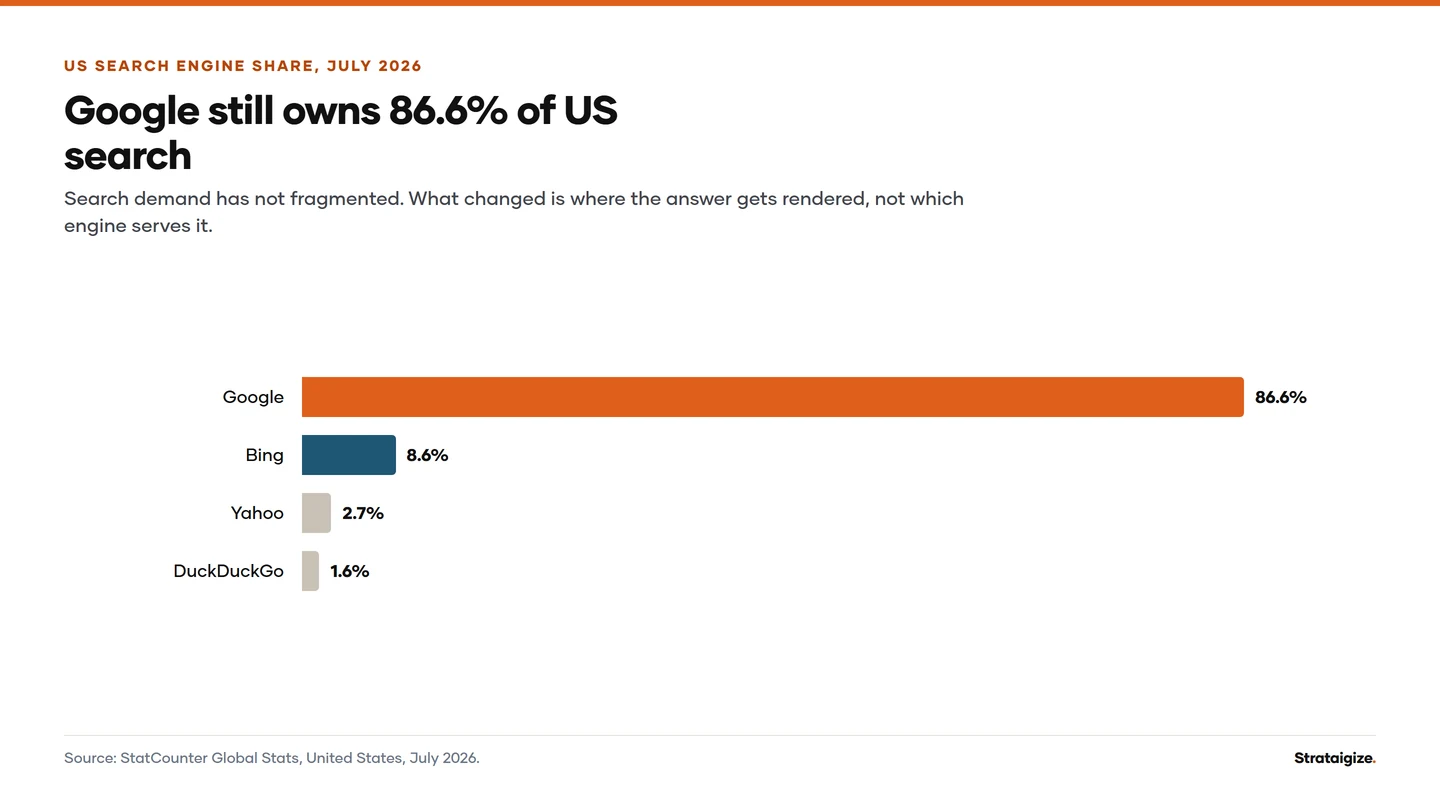
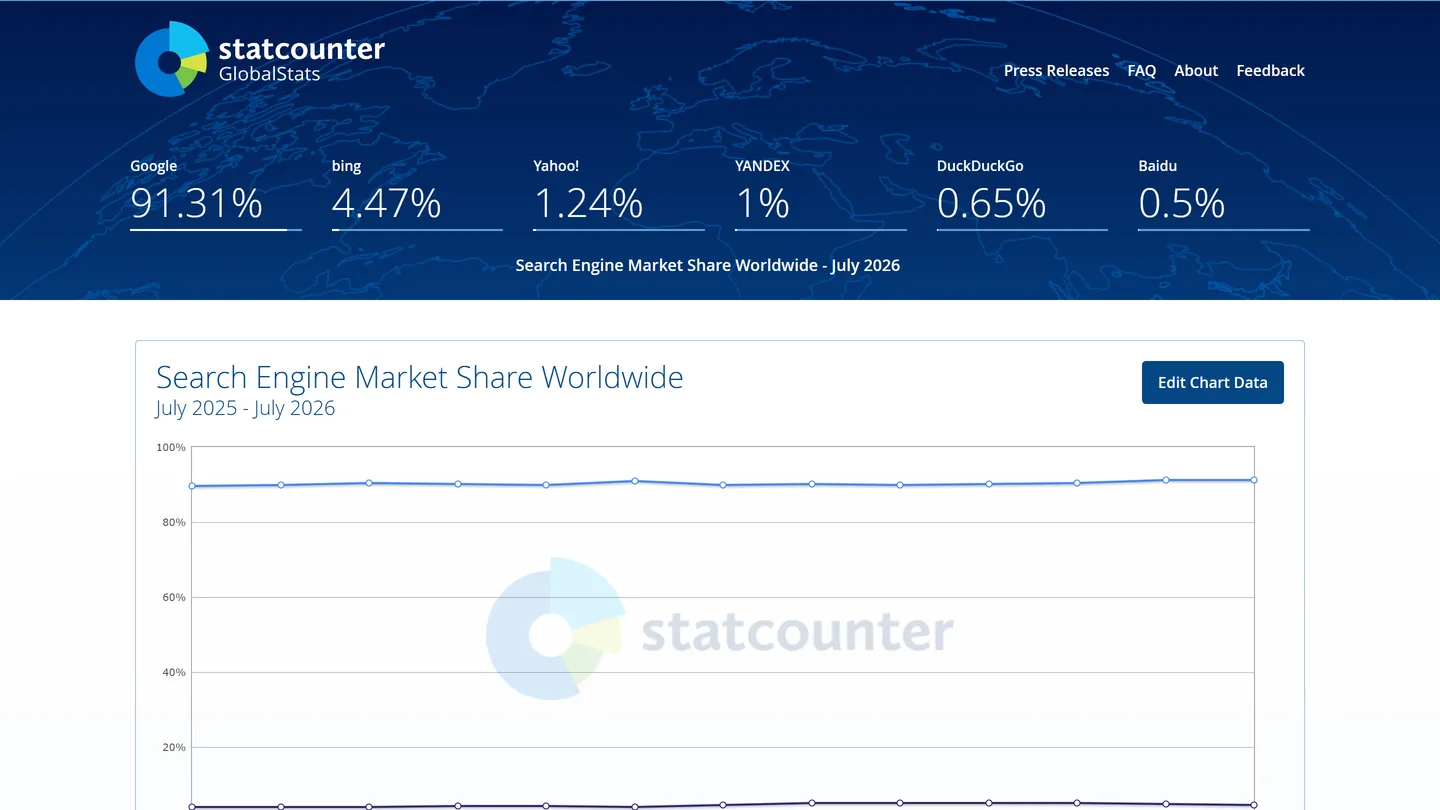
- Google holds 86.6% of US search (July 2026) and 85.7% in Canada (June 2026) (StatCounter, 2026)
- Google advertising revenue reached $82.3 billion in Q4 2025 alone, up 13.5% year over year (Alphabet Q4 2025 earnings via Storyboard18, 2026)
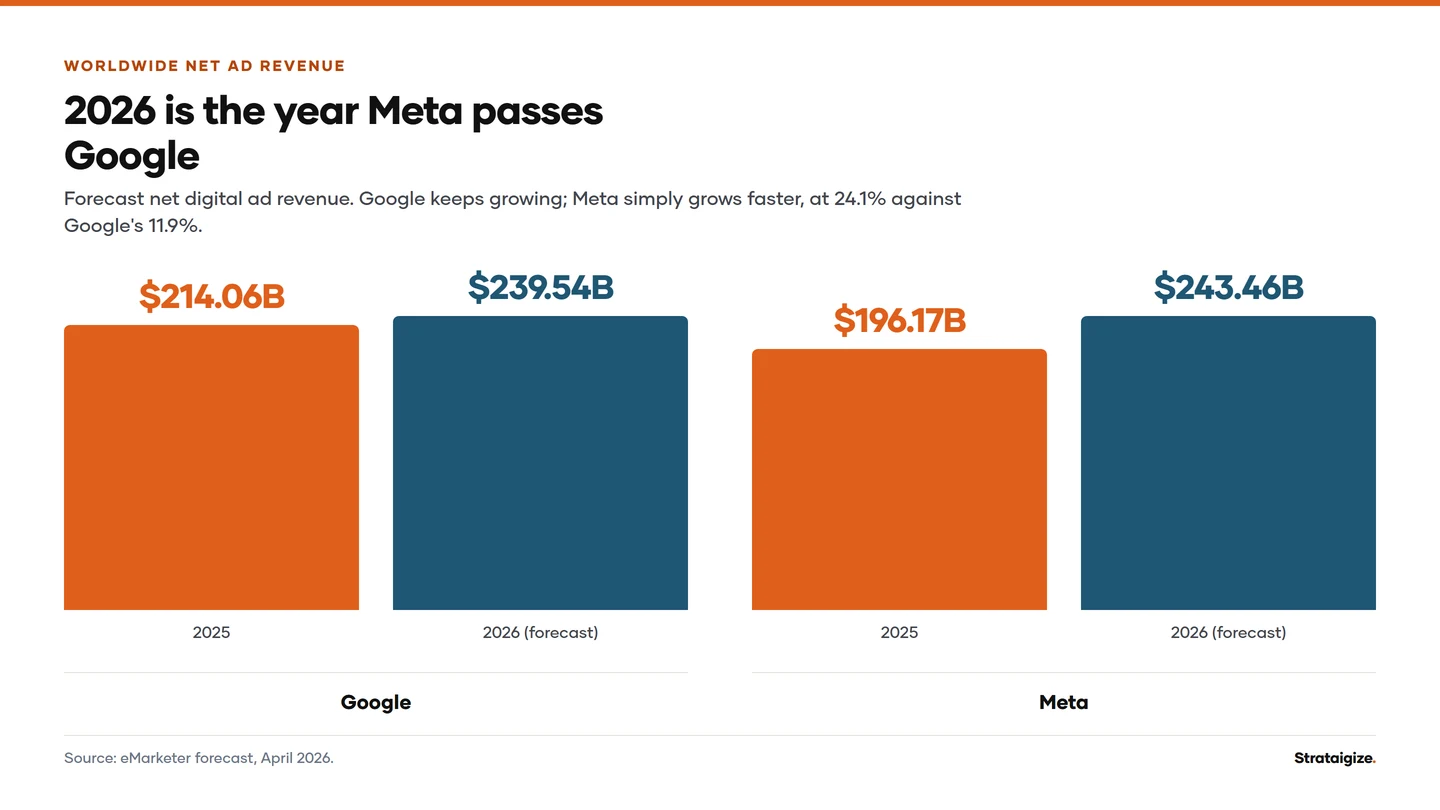
- For the first time ever, Meta is forecast to out-earn Google in 2026: $243.46 billion versus $239.54 billion in net ad revenue (eMarketer, 2026)
- Google, Meta, and Amazon combined will capture 62.3% of worldwide digital ad spend in 2026 (eMarketer, 2026)
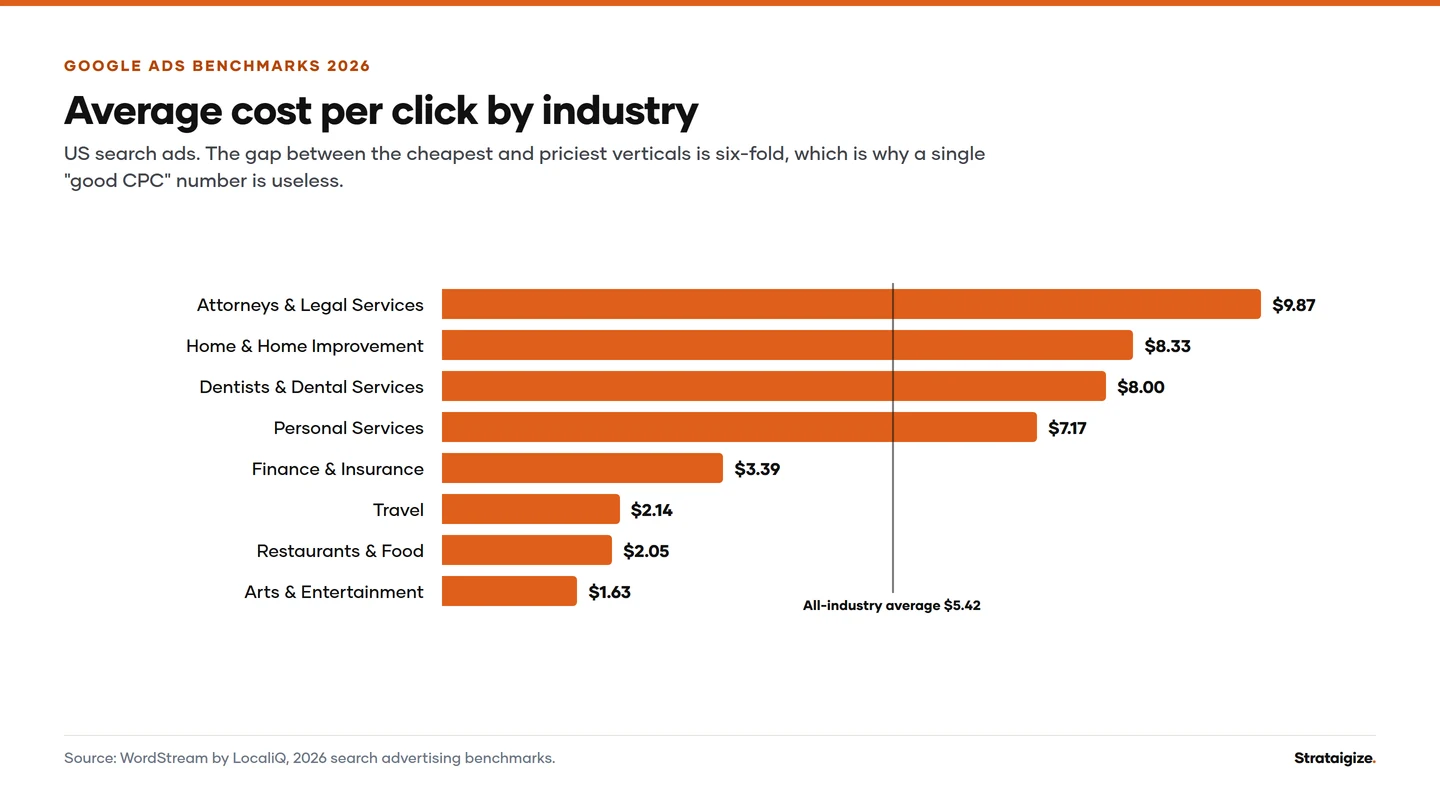
Almost nobody actually pays the average. Attorneys pay $9.87 a click, arts venues pay $1.63, and both can run a profitable account on those numbers.
The industry breakdowns below are where your own bar actually lives, along with the market share, benchmark and cost data that should shape your 2026 ad strategy.
Google Owns Search in 2026, but Not the Revenue Crown
Google is still the front door of the internet, but 2026 is the first year its number one position in advertising is contested:
- Google processes more than 5 trillion searches per year, about 14 billion per day. That was Google’s first official volume update since 2016, when it reported “more than 2 trillion” (Search Engine Land, 2025).
- US search engine share: Google 86.6%, Bing 8.6%, Yahoo 2.7%, DuckDuckGo 1.6% as of July 2026 (StatCounter, 2026).
- Canada search engine share: Google 85.7%, Bing 9.8% as of June 2026 (StatCounter, 2026).
- Google’s share of worldwide digital ad spend slips to 26.4% in 2026, while Meta’s rises to 26.8%, putting Meta on top for the first time (eMarketer, April 2026).
- Amazon is the fast-growing third force: $82.07 billion in net ad revenue forecast for 2026, a 9.0% share, up from 8.0% in 2024 (eMarketer, 2026).
- The big three together will take 62.3% of all worldwide digital ad spend in 2026, and eMarketer expects that concentration to rise through 2028.
In practice, the Meta flip does not mean Google Ads got weaker. Google’s ad revenue is still growing 11.9% a year (eMarketer, 2026), and search remains the highest-intent channel in digital marketing.
It means budgets now follow measured performance across platforms. Local (Vancouver, Calgary, New York) or global, Google’s reach still covers your market. But the smartest advertisers we work with benchmark Google against Meta and Amazon every quarter instead of treating any platform as the default.
Going Into 2026, Commercial Searches Are Still Growing
AI reshaped how people search, and how Google sells ads against those searches:
- Google reports that the volume of commercial queries has increased since AI Overviews launched (Google, via Search Engine Land, 2025).
- Conversion rate increased for 87% of industries in the 2026 benchmark year, which WordStream by LocaliQ reports alongside its notes on AI Max and Smart Bidding adoption (WordStream, May 2026).
- Average cost per lead fell for the first time in five years in the 2026 benchmark data (LocaliQ, 2026).
- Performance Max, Demand Gen, AI Max, and Smart Bidding are now the default toolkit: LocaliQ’s 2026 expert panel notes AI-powered campaigns “tend to have higher conversion and relevancy rates” (LocaliQ, 2026).
Our take: AI features reward advertisers who feed them clean conversion data. If your conversion tracking is loose, automation optimizes toward the wrong outcomes, so fix measurement before you scale spend.
Google Ads Benchmarks 2026: Click-Through and Conversion Rates
The most current benchmark set comes from WordStream by LocaliQ’s 2026 report, which analyzed 13,474 US search campaigns across 23 industries between April 2025 and March 2026:
- Average click-through rate: 6.64% across all industries (LocaliQ, 2026)
- Highest CTRs: Arts and Entertainment at 12.75%, Finance and Insurance at 9.83%, Travel at 9.32%
- Average conversion rate: 8.18% across all industries (LocaliQ, 2026)
- That is roughly 1 in 12 clicks becoming a lead or sale
Google Ads Conversion Rates by Industry (2026)
| Industry (Search Ads) | Avg. Conversion Rate (US) |
|---|---|
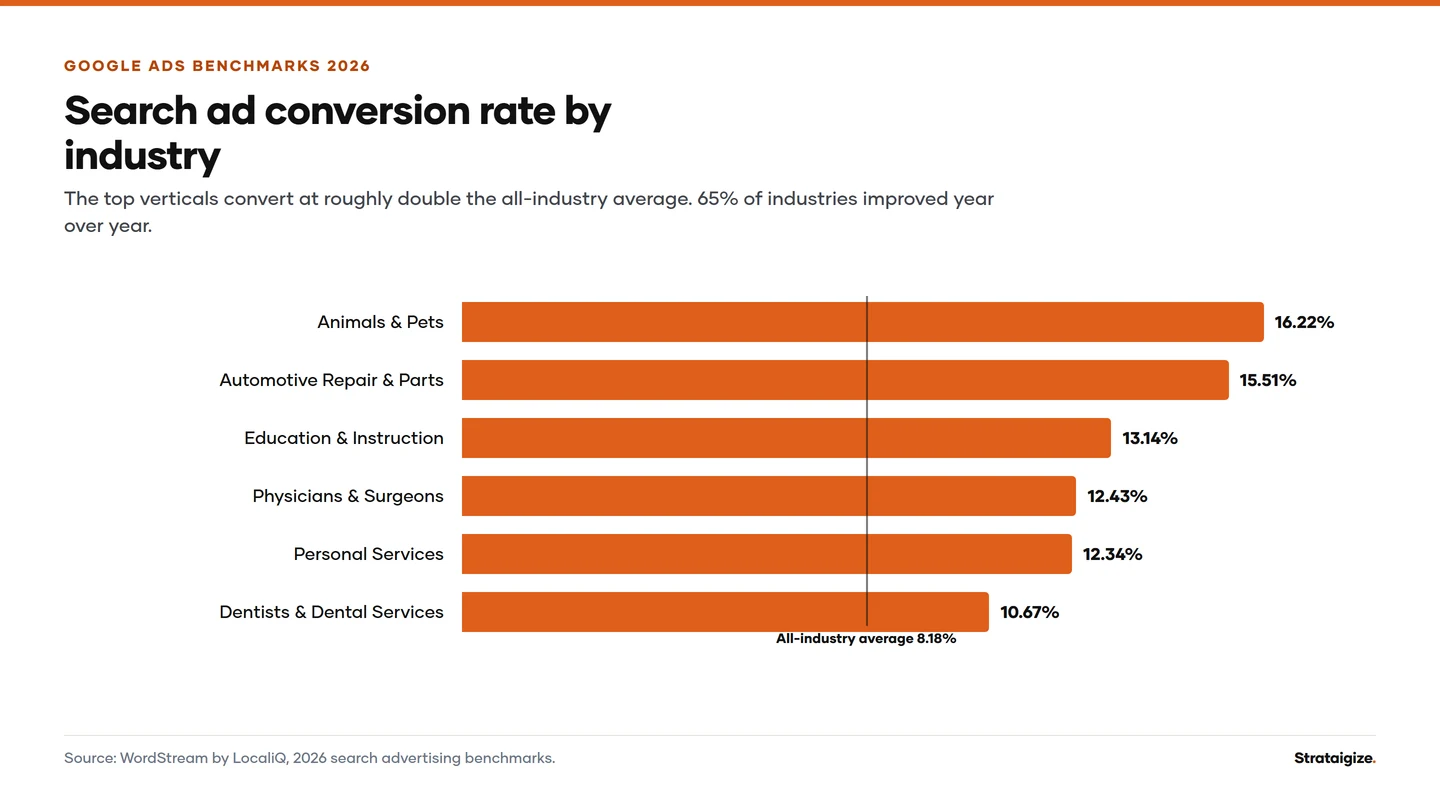
| Animals & Pets | 16.22% |
| Automotive Repair, Service & Parts | 15.51% |
| Education & Instruction | 13.14% |
| Physicians & Surgeons | 12.43% |
| Personal Services | 12.34% |
| Dentists & Dental Services | 10.67% |
Source: WordStream by LocaliQ, 2026
Urgent, local, service-based needs (a broken car, a sick pet, a toothache) convert exceptionally well from search ads because the intent is immediate.
At the other end, Finance and Insurance converts at just 2.64%, Furniture at 2.99%, and Real Estate at 3.70% (LocaliQ, 2026). Those are still viable numbers because each conversion carries a high lifetime value, but they demand tighter funnels and follow-up.
If your CTR or conversion rate sits below these benchmarks, audit your keywords, ad copy, and landing pages before adding budget. That audit discipline is the core of how we run paid advertising for clients.
What Google Ads Cost in 2026: CPC and Cost Per Lead by Industry
The average cost per click for search advertising across all industries in 2026 is $5.42, and the average cost per lead is $66.69 (LocaliQ, 2026).
| Industry | Avg. CPC (US dollars, Search Ads) |
|---|---|
| Attorneys & Legal Services | $9.87 |
| Home & Home Improvement | $8.33 |
| Dentists & Dental Services | $8.00 |
| Personal Services | $7.17 |
| Finance & Insurance | $3.39 |
| Travel | $2.14 |
| Restaurants & Food | $2.05 |
| Arts & Entertainment | $1.63 |
Source: WordStream by LocaliQ, 2026
Cost per lead tells the same story from the other side: Attorneys and Legal Services pay the most at $131.63 per lead, while Arts and Entertainment ($26.84), Automotive Repair ($29.96), and Restaurants ($30.57) sit at the affordable end (LocaliQ, 2026).
A plumbing company can happily pay $8 clicks that turn into $500 jobs, while an online retailer needs sub-$2 clicks to make a $50 product work. Both can succeed, but their cost structures differ.
Two resources if you are planning budgets: our Google advertising cost guide walks through budget math step by step, and our ad spend calculator lets you model CPC, conversion rate, and lead targets against these 2026 benchmarks.
Google’s Ad Revenue and the 2026 Competitive Shake-Up
Google’s advertising machine keeps growing, even as its crown slips:
- Q4 2025 Google advertising revenue: $82.28 billion, up 13.5% year over year, with Search growing 17% in the quarter (Alphabet Q4 2025 earnings via Storyboard18, 2026)
- YouTube advertising hit $11.4 billion in Q4 2025, up from $10.5 billion a year earlier, and YouTube’s combined ads plus subscriptions revenue passed $60 billion for full-year 2025 (Storyboard18, 2026)
- Alphabet’s total revenue crossed $400 billion for the first time in 2025, reaching about $403 billion, up 15% (Storyboard18, 2026)
- On eMarketer’s net basis, Google’s worldwide ad revenue grows from $214.06 billion in 2025 to a forecast $239.54 billion in 2026 (11.9% growth), while Meta accelerates from $196.17 billion to $243.46 billion, 24.1% growth (eMarketer, 2026)
- Platform trust matters too: Google permanently suspended more than 700,000 advertiser accounts over AI-generated impersonation scam ads in 2024, cutting reports of those scams by 90% (Google Ads Safety Report, 2025)
Google Ads is not declining. Double-digit growth on a $200 billion-plus base means advertisers keep finding profitable inventory there.
The takeaway is that performance budgets are mobile. Meta’s AI-driven ad stack (Advantage+, automated creative) is pulling dollars because it performs, and eMarketer expects the big three to keep consolidating spend through 2028. Your Google results need to beat that bar, not just last year’s numbers.
What This Means for Your 2026 Google Ads Strategy
Five moves the 2026 data supports:
- Benchmark against 2026 numbers, not folklore. A $5.42 average CPC and an 8.18% average conversion rate are the current bar (LocaliQ, 2026). Judging performance against 2023-era benchmarks leads to bad budget calls.
- Fix conversion value tracking first. LocaliQ’s analysts call the 2026 CPC-up, CPL-down pattern “the proof point to pivot to conversion value tracking.” Smart Bidding is only as good as the data you feed it.
- Use the AI campaign types with guardrails. Performance Max, Demand Gen, and AI Max expand reach for the same effort, but they need clean exclusions, strong creative volume, and honest incrementality checks.
- Watch the AI search shift. Commercial queries are growing in the AI Overviews era (Google, 2025), and ads are being woven into AI surfaces. Query intent data is becoming more valuable, not less.
- Diversify deliberately. With Meta forecast to out-earn Google in 2026 and Amazon at 9% share (eMarketer, 2026), cross-platform measurement is now table stakes. Run the comparison quarterly.
Also worth a read: 20 Mobile App Marketing Statistics for 2026
FAQ
What is the average cost per click for Google Ads in 2026?
The average CPC across all industries is $5.42 in 2026, per WordStream by LocaliQ’s benchmark study of 13,474 US search campaigns. The range is wide: Arts and Entertainment averages $1.63 per click while Attorneys and Legal Services pay $9.87.
What is a good conversion rate for Google Ads in 2026?
The cross-industry average is 8.18% in 2026 (LocaliQ). Anything above that is solid, and top verticals like Animals and Pets (16.22%) or Automotive Repair (15.51%) show what urgent, local intent can deliver. Low-converting sectors like Finance and Insurance (2.64%) compensate with high customer lifetime value.
Is Google still the biggest ad platform in 2026?
In search, absolutely: Google holds 86.6% of the US market (StatCounter, July 2026) and processes over 5 trillion searches a year. In total ad revenue, eMarketer forecasts Meta will edge ahead for the first time in 2026, $243.46 billion to $239.54 billion on a net basis.
How much should a small business budget for Google Ads in 2026?
Work backwards from the benchmarks: at the 2026 averages of $5.42 per click and $66.69 per lead, a business that needs 30 leads a month should plan for roughly $2,000 in monthly spend, then adjust for its industry’s actual CPC and conversion rate. High-CPL industries like legal need several times that to get meaningful lead volume.
In 2026, Google Ads Is No Longer the Default
Every number above points the same way. Google Ads remains a foundational growth channel in 2026, but it now has to earn its budget every quarter.
It still dominates search with an 86%-plus share in North America, still reaches buyers at the exact moment of intent, and still posts benchmark conversion rates that most channels cannot touch. At the same time, Meta’s forecast overtake and Amazon’s rise mean the era of defaulting to Google is over.
The winning play is the same one the data has pointed to all year: current benchmarks, clean conversion tracking, AI campaign types with human guardrails, and honest cross-platform comparison.
If you’d rather not manage that complexity alone, the Google Ads agency page is the commercial scope. How we connect to the accounts we manage is on our Google Ads API page. If you want these numbers first in your own Google results, add Strataigize as a preferred source.
Sources: The statistics in this article were compiled and re-verified in August 2026 from WordStream by LocaliQ’s 2026 Google Ads benchmarks, LocaliQ’s 2026 search advertising benchmark report, StatCounter search engine market share data, eMarketer’s April 2026 digital ad spending forecast, Alphabet’s Q4 2025 earnings coverage via Storyboard18, the Google Ads Safety Report, and Search Engine Land’s reporting on Google search volume.
Talk to us