Conversion Rate Optimization Services: What to Buy First
Conversion rate optimization services help more of your existing visitors become customers. The right starting point depends on what is holding them back. Buy an audit when the cause is unclear, an implementation project when a specific problem is established, and an ongoing testing program when you have reliable measurement, enough relevant traffic and the capacity to ship changes. Judge the work by qualified demand and customer value, with a clear owner
A proposal for conversion rate optimization can buy you three very different things: an explanation of why people leave, a working fix, or a program of experiments. Before comparing fees, decide which of those your business
That distinction matters when you already pay to bring visitors to a website. A persuasive audit can sit untouched in a backlog. A redesigned landing page can collect more enquiries while attracting fewer suitable buyers. A testing retainer can spend months waiting for enough traffic to answer a
The useful purchase connects a customer problem to a change someone can deliver, then measures whether that change helped the business. Here is how to
Choose the engagement that matches the problem
Conversion rate optimization, usually shortened to CRO, improves the journey from a visit to a valuable action. For a service business, that might be a qualified enquiry or a completed sale. For an online shop, it might be a purchase, judged alongside its margin
Providers package this work differently. Invesp separates audits, landing page optimization and fully managed CRO. Conversion describes an ongoing experimentation service with strategy, analysis, design and development. Those are different commitments, even when both proposals carry the
| What you know today | Sensible starting point | What you should receive | Check before signing |
|---|---|---|---|
| Visitors leave, but the cause is unclear | A focused CRO audit | A verified funnel, observed problems, supporting evidence and a ranked plan | Who will implement the recommendations, and is that work included? |
| A specific obstacle has been established | An implementation project | The agreed change, browser and device checks, working measurement and a release record | Does delivery end with a design file, or with a tested change on your live site? |
| The journey works, and competing improvements need testing | An experimentation retainer | Research, built variants, controlled tests and decisions based on results | Can the relevant pages supply enough participants, and can your team ship the work? |
These are starting points. An audit can lead to a project, and a project can create the foundation for useful experiments. A retainer is easier to justify when that foundation
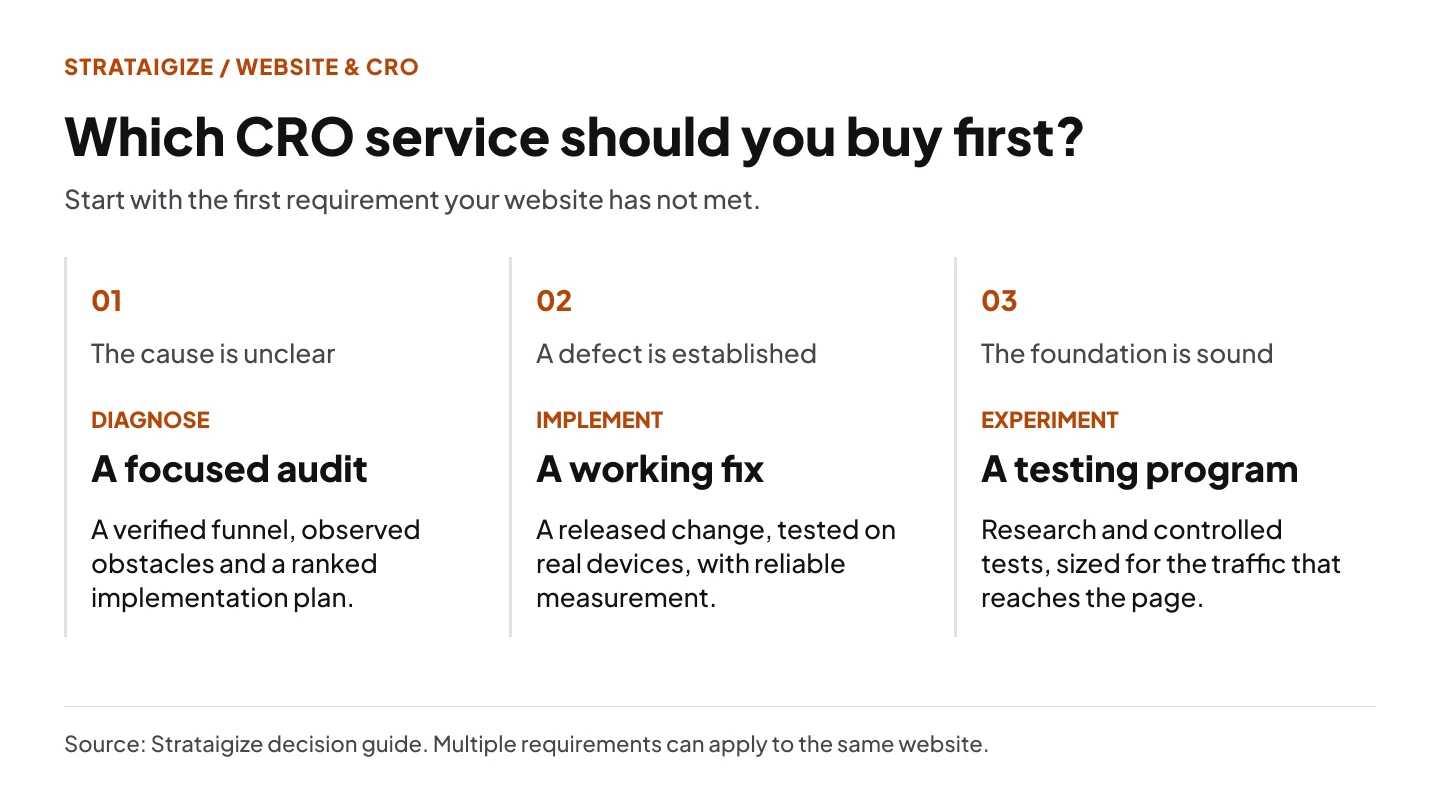
Strataigize decision guide. Choose the first unresolved requirement; several may apply to the
Specify the journey all the way to a customer
Start the brief with the person and the task. For example: a marketing director arrives from a service-specific ad, checks whether the offer fits, submits an enquiry, receives a useful response and books a conversation. Each step can fail for a
A broad homepage might never answer the question in the ad. A form might reject a valid phone number. The website might show a success message while the customer record never reaches your sales team. After submission, an unanswered enquiry can look like a website conversion and still produce
Have the provider trace one complete journey and reconcile the records it leaves. That means checking the page, the successful submission, the record in your customer system and the subsequent outcome. Test records should be identifiable and excluded from
The measurement definition deserves its own line in the scope. Is the denominator people, sessions or ad clicks? Does the enquiry count exclude spam and duplicates? What qualifies a lead, and how long does a sale usually take? Use the same definitions and enough follow-up time when
Even a familiar analytics report requires care. Google Analytics distinguishes open and closed funnels: an open funnel permits entry at any step, while a closed funnel requires entry at the first step. Changing that setting changes which people are counted. A drop-off chart needs its counting rules before it can support
If paid ads feed the journey, include the conversion settings in the review. Google Ads treats primary and secondary conversion actions differently. Primary actions can inform bidding when their standard goal is used; secondary actions generally serve observation, with an exception for custom goals. Ask the provider to document the actual setup rather than assume every reported action means the
A higher enquiry rate can leave sales unchanged
Consider a hypothetical service business comparing three possible outcomes for a cohort of 12,000 eligible website sessions. Each cohort enters during one month, and customer outcomes are counted after the same 90-day follow-up period. These are invented teaching figures, not client results or
| Measure | Starting position | More enquiries, weaker fit | More enquiries with stronger fit |
|---|---|---|---|
| Eligible website sessions | 12,000 | 12,000 | 12,000 |
| Enquiry rate per session | 2% | 3% | 2.5% |
| Enquiries | 240 | 360 | 300 |
| Qualified enquiries | 60 | 60 | 90 |
| Customers from qualified enquiries | 20% | 20% | 20% |
| New customers | 12 | 12 | 18 |
The middle scenario raises the enquiry rate from 2% to 3%, a 50% relative increase. Yet the business wins the same 12 customers and has more unsuitable enquiries to handle. The final scenario produces fewer enquiries than the middle one, but six more customers under the
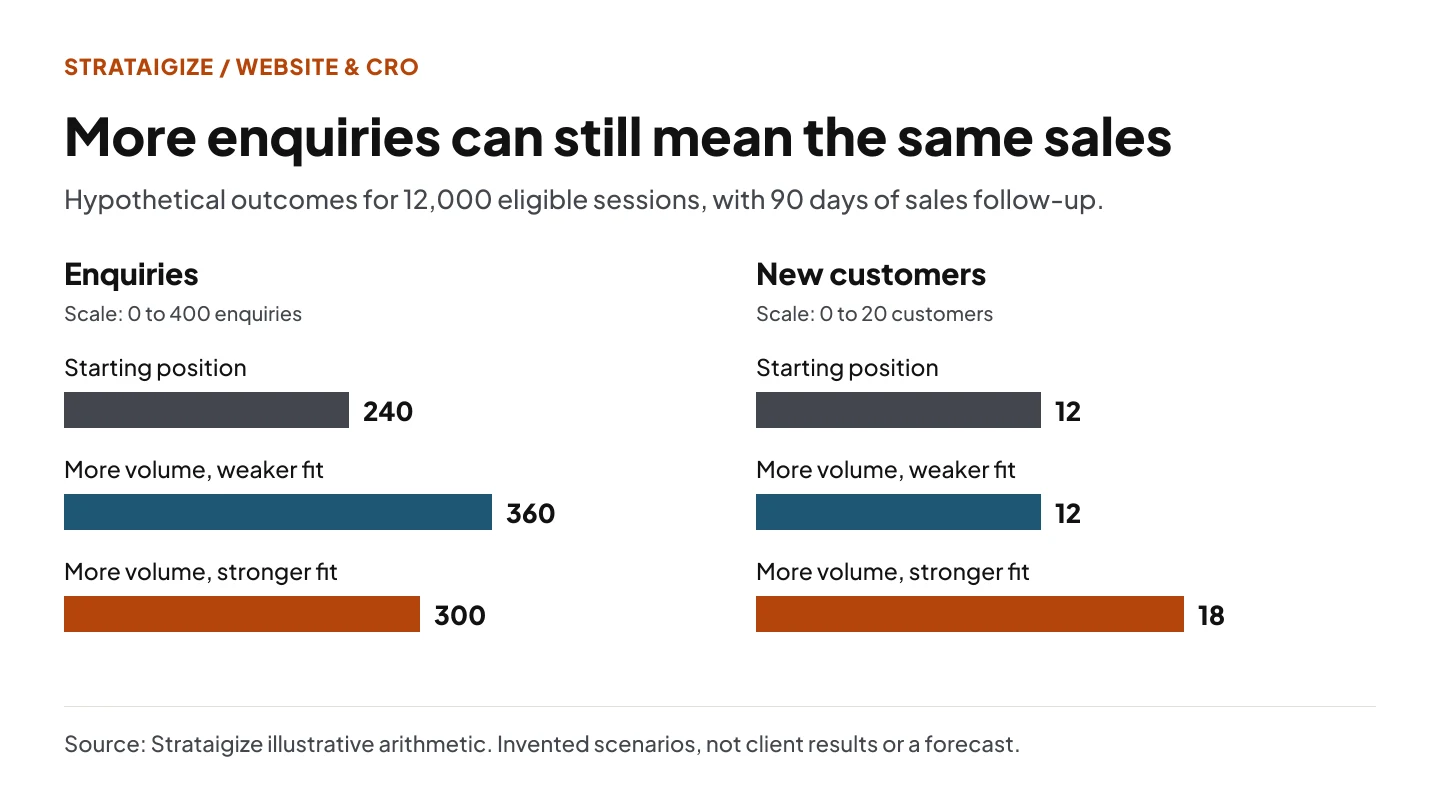
Illustrative arithmetic by Strataigize. Each scenario has 12,000 eligible sessions and the same 90-day sales follow-up. The two charts use different,
This is why a CRO brief needs a business outcome and a check for harmful side effects. For lead generation, track qualified enquiries and sales alongside form completion. For ecommerce, examine contribution after variable costs and returns alongside purchase conversion. For a subscription, keep activation and retained paying customers
You may need an earlier signal while sales mature. Use it, label it, and check later whether it predicted the outcome you wanted. A button click is useful for diagnosing a journey. Its value does not become the value of a customer simply because it appears in a
Check whether an A/B test can answer the question
An A/B test assigns visitors to different versions and compares their outcomes. Its usefulness depends on the traffic that actually reaches the experiment, the current conversion rate and the size of improvement you need
There is no useful universal threshold based on total website traffic alone. A busy blog can coexist with a lightly visited service page. Splitting that service page into several variants spreads an already small
Optimizely’s sample-size calculator asks for a baseline conversion rate, a minimum detectable effect and a statistical significance setting. The minimum detectable effect is the smallest change the test is designed to detect. A provider should be able to explain those choices, the method used and the expected duration using traffic eligible for
Before launch, agree on the primary outcome, assignment method, exclusions and stopping rule. Check that the tracking works and that groups receive the intended experience. If the result is too uncertain to distinguish the variants, record it as inconclusive. Extending the explanation until it sounds like a win does not improve
Low traffic still leaves useful work to do. Watch suitable participants attempt the task, review customer questions, inspect failed form submissions and fix reproducible defects. Our mobile website testing guide provides a practical starting point for checking the experience on
A repaired submission error can be verified directly: the same valid input now completes the journey. A claim that the repair increased sales needs separate outcome evidence. Keep those two statements distinct when reporting
Compare the full cost and the implementation responsibility
An audit fee and a full-service retainer are not comparable until you know who does the research, writing, design, development, release testing and measurement. A low initial quote may leave most of the implementation with
Ask for a scope that names the pages or journeys covered, the work included and the person responsible for each release. Clarify experimentation software, analytics repairs, participant recruitment, developer time and post-release support. Record the currency, contract term, cancellation terms and what happens to the code and research when the
The commercial calculation should use contribution, meaning the money left from a sale after its variable costs. Revenue alone can make an expensive improvement
For illustration, suppose an engagement costs US$12,000 in total, including the agreed implementation and tools. Suppose each additional customer contributes US$1,000 over the same 90-day customer window after delivery costs. The engagement needs 12 additional customers to recover that cost: US$12,000 divided by US$1,000. These are hypothetical inputs, not market prices, our quote or a
Run the same calculation with fewer additional customers, a lower contribution and a slower sales cycle. Our growth calculator can help explore the assumptions. The decision is whether a plausible improvement is valuable enough to investigate, while leaving room for the possibility that it will
Ask for a decision-ready first phase
The first phase should leave you able to name the next action and the evidence behind it. A useful handover includes the journey and outcome being improved, the observed obstacle, the proposed change, the implementation owner and the way you will judge
Ask to see a sample readout before you hire. It should explain what changed, which visitors were included, how long the test or observation ran, what happened to customer quality, and what remains uncertain. Look for a clear distinction between a working release, an observed change and a change the experiment can reasonably attribute to
We provide website optimization services, so we have a commercial interest in this decision. The useful boundary is still straightforward: when the obstacle is unclear, fund the diagnosis; when the defect is known, fund the fix; when the foundation is sound and the sample supports it, fund
Before approving a proposal, ask: What will be working on our live site at the end of this phase, who will put it there, and what evidence will tell us whether to continue? The answer should be specific enough to put in