Home / Industries / Government and Public Sector
Government & Public Sector
AI systems for government, scoped for the review, not the demo.
Bounded AI pilots for Canadian federal, provincial and municipal teams, designed to the Directive on Automated Decision-Making, with the impact assessment started in week zero, data kept in Canada, and a person holding every decision that affects a person.
Why pilots stall
The build is rarely the problem.
The federal AI Strategy for the Public Service, published in 2025, asks departments to adopt AI responsibly and at pace. The gap between those two words is where pilots stall: not in the model, but in the review that should have started on day one.
The assessment arrives after the demo
A pilot is shown, a director is convinced, and then the Algorithmic Impact Assessment, the privacy review and the security questionnaire arrive in week six. Most vendors start answering them then. The pilot dies waiting.
The data cannot leave
Protected information cannot go to a model provider's default region, and a vendor who cannot say where a prompt is processed, stored and logged cannot be approved.
The decision must stay human
An automated system that affects a person's rights, benefits or eligibility needs notice, an explanation and a person who can intervene. A system designed without those is a system that cannot go live.
What we build
The catalogue, read for a department.
Ten of the eleven systems in our catalogue have a public-sector shape. Each line below is that shape, and each links to the full description, the build steps and the price.
Cognitive automation
Lead qualification agents
Application and request intake: read, classify, check completeness and route to the right program unit, with a person deciding every case.
Explore →Machine interactions
Customer support agents
Citizen and client enquiries: eligibility, status and process questions answered from published policy with the source cited, and a case officer for everything else.
Explore →Cognitive automation
Document processing agents
Applications, claims and forms read into a case system with every field traceable to its page, and the exception queue that program staff work from.
Explore →Machine interactions
Internal knowledge assistants
Policy, procedure and precedent answered for staff with the citation attached, and a weekly list of the questions the documentation could not answer.
Explore →Insights and predictive modelling
Ad optimization systems
Public awareness and recruitment campaigns run to a written spend policy, with every budget move logged for the audit trail.
Explore →Insights and predictive modelling
Client reporting automation
Program reporting to a funder or a council on a fixed cadence, with every figure carrying its window and its source, and a person approving the interpretation.
Explore →Cognitive automation
Content engines
Plain-language public information kept current from a written standard, with every claim sourced and every page measured to the question it answers.
Explore →Insights and predictive modelling
Computer vision systems
Asset and infrastructure inspection from imagery, archive and form digitization where OCR fails, and any image workload that has to stay on Canadian soil.
Explore →Machine interactions
MCP servers and agent-callable surfaces
Public data and services exposed to assistants as read tools with rate limits and logs, so a citizen's assistant gets the official answer rather than a scraped one.
Explore →Cognitive automation
Always-on operations agents
Recurring administrative work run on a schedule inside the department's own environment, with a complete activity log for the audit and a person approving anything irreversible.
Explore →How we work
Built to the directive.
The Treasury Board Directive on Automated Decision-Making is the standard a federal system is held to, and the provinces are converging on the same shape: assess the impact, keep a person in the loop in proportion to it, explain the decision, and keep the record. We build to it whether or not the buyer is federal.
STEP 01
Impact assessment first
We complete the Algorithmic Impact Assessment questionnaire with you in week zero, and the impact level it returns sets the design: the human-in-the-loop points, the notice, the explanation, and the testing and monitoring the directive requires at that level.
STEP 02
Bounded pilot, fixed price
One workflow, a written success metric, a kill threshold, and a price agreed before the build. A pilot that fits a low-dollar-value contract is a pilot that can start this quarter.
STEP 03
Residency and access designed in
Data processed and stored in Canadian regions or on your infrastructure, access granted by you and revocable by you, credentials in managed stores, and a written data flow your privacy officer can read.
STEP 04
Audit trail from day one
Every action the system takes carries its reasoning and is reversible. The log is yours, and a person can reconstruct any decision from it, which is what an audit and an access-to-information request will both ask for.
Residency and security
Where the data goes, in writing.
Every system we build for a public body carries a written data flow: what is sent to a model, which model, in which region, what is stored, for how long, and who can read the log. Processing runs in the Canadian regions of AWS, Microsoft Azure and Google Cloud, or on your own infrastructure, and the choice is made with your privacy officer before the build rather than discovered by them after it.
Our published trust and security page covers the rest: client-granted, revocable access; credentials in managed stores; an AI governance summary aligned to the four functions of the NIST AI Risk Management Framework; our subprocessor list; and a data processing agreement on request. There is also a one-page security summary written for a procurement reviewer. We do not hold a SOC 2 report or a facility clearance, and we say so there rather than letting a reviewer find out.
Key personnel
The two people on every build.
Evaluators score the people, not the deck. Every public-sector build is led by the scientist who decides what a model can be trusted to do and the operator who has run bounded automations on live accounts every day since 2022.


Procurement
A Canadian supplier, sized for a pilot.
Strataigize is a Vancouver company founded in 2022. Our AI builds are scoped as fixed-price pilots, one bounded workflow over 30 to 90 days at $25,000 to $60,000, which is a size a department can contract without a year of process, and the audit that precedes it is $7,500 fixed. Prices are published on the pricing page because a claim that only works while the buyer cannot check it is not a claim.
Public Services and Procurement Canada's Artificial Intelligence Source List sorts AI purchases into three categories by business outcome, and the catalogue maps each of our systems to one of them so a procurement officer can see the fit at a glance. Before you talk to any vendor, including us, the 24 questions to ask an AI agent vendor and the pilot structure that survives procurement are the two reads that save the most time.
Proof of the method
The systems we run on ourselves.
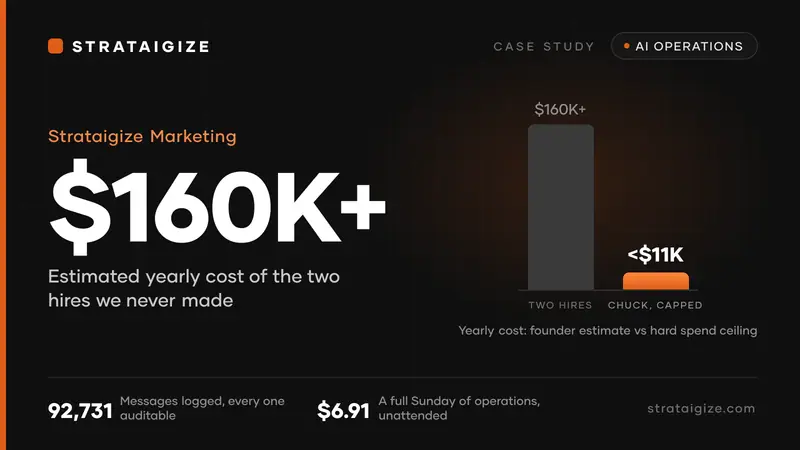
Strataigize Marketing
AI Agents for Business: The Operator Running Our Agency
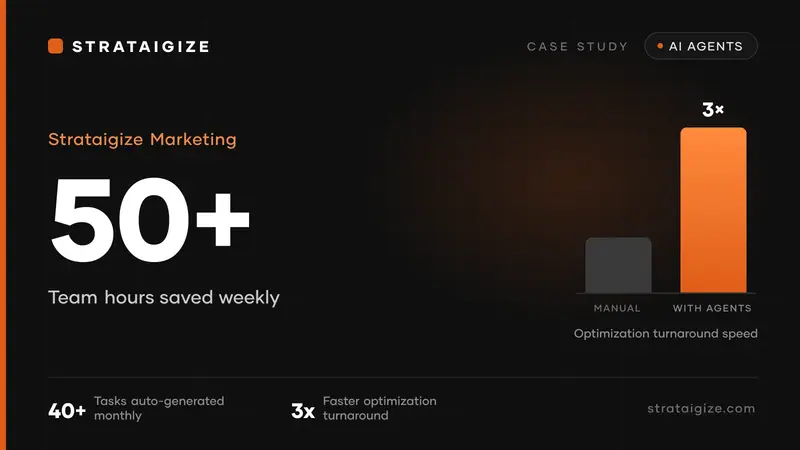
Strataigize Marketing
How Our Marketing Agency Uses AI Agents to Automate Busywork
Questions
Public-sector AI, answered.
Which procurement paths can a department use?
Do you handle Protected B information?
How long does a public-sector pilot take?
Start the review on day one.
A free 30-minute consultation with the senior team names the workflow, the impact level it would carry, and what a pilot should cost, whether you build it with us or not.
Book a consultation → Rated 5.0 on Clutch