AI Agent Productivity: How Much Can a Company Save?
AI agents can free staff to serve more customers and reduce spending on repetitive work. The amount a company saves depends on the work the agent finishes correctly, the human effort that remains and which costs actually fall. In the illustrative calculation below, a workflow releases 125 hours a month but produces monthly cash savings ranging from negative $900 to positive $4,725. Current research supports testing the opportunity; it does not establish a
A faster team can take on more work without adding people. Whether that improvement also cuts this month’s expenses is a separate calculation, and it changes which AI project
The newest evidence makes the opportunity worth examining. In its report released on November 10, 2026, Kyndryl says 64% of organizations investing in AI and machine learning report positive returns. Its broader survey covers 3,700 senior leaders across 21 countries. That is a self-reported result for AI investment generally, with no standard dollar saving established for an autonomous agent at a smaller company. Kyndryl’s report and methodology provide the scope behind
For a business deciding what to build, the useful next question is specific: which work can finish with less human effort, and what will the company do with
How do AI agents improve business productivity?
An AI agent can improve productivity by carrying a recurring job through several connected steps. Consider customer onboarding after a signed agreement: read the agreed scope, check the information supplied, create the appropriate tasks, assign their owners and verify that the handoff reached them. A successful system removes the work of coordinating those steps as well as the typing
We build agents to act inside the client’s limits, check their work and flag exceptions. That design matters to the business case. If someone must read every ordinary output, reconstruct its reasoning and complete the next step, the company still pays for much of the original work. The system needs a reliable way to recognize the cases it can finish and send the remainder to
For predictable steps, ordinary automation may be sufficient. A required field can be checked with a fixed rule. AI earns its place when the job needs interpretation, such as identifying what an email requests or reconciling an unclear description with an approved record. Our AI automation service covers the connected workflow; an individual writing assistant addresses a smaller part
The practical benefits depend on the constraint. Removing an onboarding backlog can bring customers into service sooner. Completing routine support work can leave staff more time for difficult cases. Preparing a report can give an account manager time to act on it. Each benefit needs a measure of finished,
What does the research say about AI productivity gains?
The studies below measure different things. We checked these primary sources on November 14, 2026 and selected them to distinguish observed task performance from people’s estimates of their own productivity. None supplies a universal percentage for
| Evidence | What it found | What a business can infer |
|---|---|---|
| Brynjolfsson, Li and Raymond, Generative AI at Work, revised November 2024 and published in 2025 | Across 5,172 customer-support workers, access to an AI assistant increased issues resolved per hour by 15% on average. Gains differed substantially by experience. | Assistance improved a defined task in this setting. The result does not measure an autonomous workflow or a 15% reduction in company costs. |
| METR technical-worker survey, May 2026 | Among 349 technical workers surveyed in February to April, median self-reported changes in work value ranged from 1.4 to 2 times, depending on the question. | These are respondents’ estimates from a selected technical-worker sample, rather than measured profit or a representative forecast for every workforce. |
Research also changes as tools and working habits change. In its February 2026 experiment update, METR said later developer results suggested improvement over its early-2025 findings, but selection effects and time-measurement problems prevented a reliable estimate of the current gain. Repeating an old headline as a verdict on today’s agents would miss
For your own decision, measure the whole job at an acceptable quality level. Faster drafting can coexist with slower checking. An agent that completes a request quickly but leaves an error for another department has moved the work rather than
How much money can AI automation save a company?
In this illustrative example, monthly net cash savings range from a $900 loss to a $4,725 saving. The difference comes from how much of the released staff capacity
Assume a business handles 1,200 routine onboarding requests each month. Staff currently spend an average of 10 minutes on each, including corrections: 200 hours a month. After automation, 900 requests finish without individual human handling and 300 need a person. The final quality and volume of completed work remain
These are invented planning inputs, not a client result, industry benchmark or
| Monthly work | Human time after automation |
|---|---|
| Handle the 300 exceptions, at 10 minutes each | 50 hours |
| Sample completed work, investigate failures and correct remaining errors | 15 hours |
| Maintain the workflow and update its rules | 10 hours |
| Total human time still required | 75 hours |
The workflow releases 200 minus 75 = 125 hours a month, a 62.5% reduction in the human time for this specific job. At an illustrative fully loaded labor cost of $45 an hour, those hours represent $5,625 of capacity. That amount becomes a cash saving only when a corresponding expense falls or a documented future expense
Assume incremental software, model usage, hosting and external support cost $900 per month. The staff time for checking and maintenance is already included in the 75 hours above; adding it again would double-count it. For the scenarios below, assume each hour that avoids spending avoids the full $45. Replace that assumption with the actual marginal cost of overtime, contractors or a planned hire in
| Share of released capacity that avoids spending | Monthly expense avoided | Less incremental operation | Net monthly cash saving |
|---|---|---|---|
| 0%: existing employees use all the time elsewhere | $0 | $900 | Negative $900 |
| 60%: 75 hours of paid work are no longer needed | $3,375 | $900 | $2,475 |
| 100%: all 125 hours remove an otherwise necessary expense | $5,625 | $900 | $4,725 |
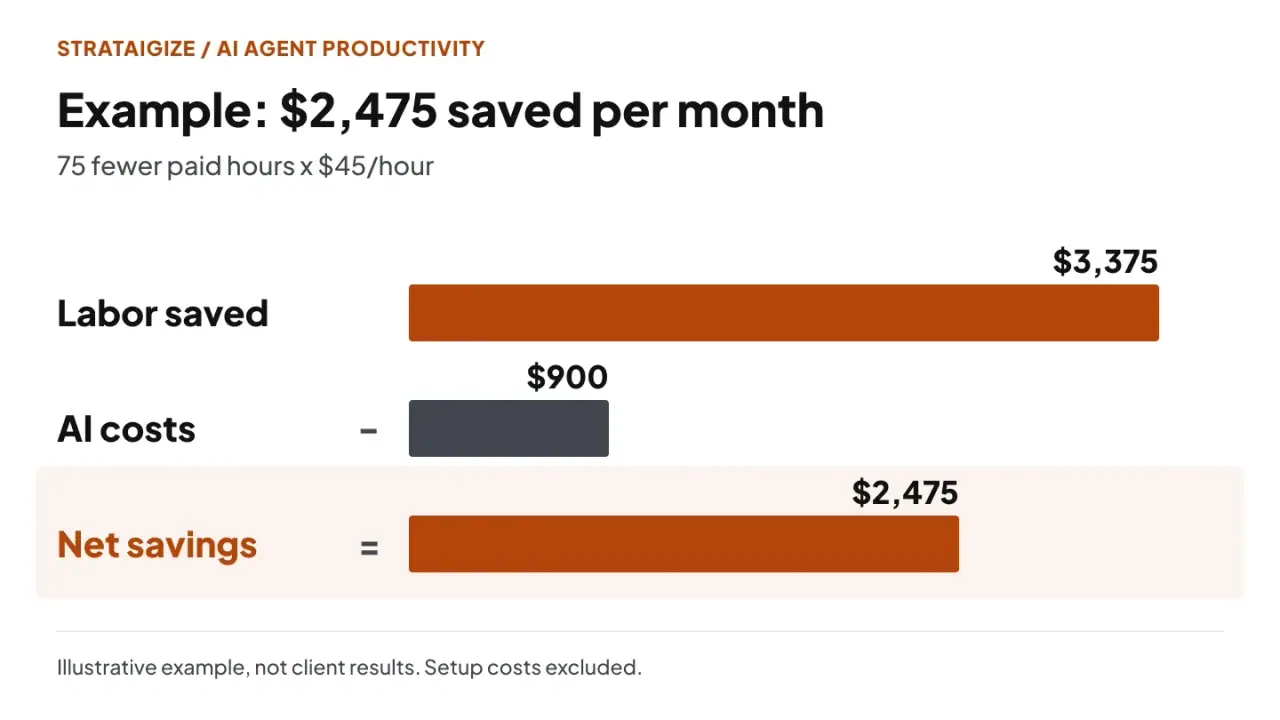
The graphic shows the middle scenario: the business stops buying 75 hours of overtime or contractor work at $45 an hour. That removes $3,375 in labor expenses; $900 in ongoing AI costs leaves $2,475 saved each month. One-time setup costs are excluded. These are illustrative assumptions, not
The first scenario may still be a good investment. Staff could serve more customers with the same payroll. Measure the extra completed work and its contribution after delivery costs; it is a different benefit from spending less. A planned hire counts as avoided spending only if the business would otherwise have needed and funded that hire in the period
To calculate simple cash payback for the middle scenario, divide your total setup cost by $2,475 in monthly cash savings. Include internal implementation time in setup, and measure payback from the start of stable operation. The zero-savings scenario has no cash payback. This calculation excludes financing and tax effects, assumes steady monthly volume and does not erase the time spent implementing or reaching that operating level. The AI agent cost guide explains which costs to include in a
The break-even check is equally useful: $900 divided by $45 means the business must avoid 20 paid hours a month just to cover ongoing operation. Recovering setup costs requires more. If the firm cannot identify those hours or another measurable financial benefit, the savings case
Does a faster workflow make the whole company more productive?
A 62.5% reduction in one workflow’s labor does not mean the whole company becomes 62.5% more productive. Suppose the company has ten employees, each supplying 160 hours of capacity a month. The 125 hours released in the example equal about 7.8% of that 1,600-hour capacity.
Even that 7.8% is available time, rather than a measured increase in company output. Sales may not have enough demand to fill it. Another team may become the bottleneck. The recovered hours may also be spread across employees who cannot combine them into one
Before funding the build, name the destination for those hours. That could be a growing support queue, billable customer work or paid overtime the company can stop buying. Then measure whether the intended work actually happens. Count a particular hour once: either as an avoided labor cost or as capacity used to produce
How should a company measure AI agent ROI?
Measure AI agent ROI over a stated period using the financial benefit actually realized and the full incremental cost. For a
Cash ROI = (verified avoided expenses minus total incremental costs) divided by total
Total incremental costs include setup in the period it is incurred, recurring technology and support, and any additional human work that the baseline did not already require. Keep setup separate when calculating monthly operating savings or simple payback. A dollar estimate for freed staff capacity belongs alongside the cash calculation, with its
To produce a useful comparison, record the following before launch and again during a representative
- Eligible requests, completed requests, unresolved work and the mix of easy and difficult cases.
- Total human time across the workflow, including exception handling, checking, correction, recovery and maintenance.
- The quality requirement agreed before the test, plus the number of completed cases that fail it.
- Actual spending avoided, extra costs incurred and the work completed with released capacity.
Keep failures in the denominator. Comparing successful automated cases with the entire old workload makes the system look better by excluding the work it could not do. If demand, staffing, prices or the process also changed, record those changes and use a comparable group where practical. A before-and-after improvement alone does not establish that the agent
Our approach to AI agent development starts with a bounded job and the checks needed to run it. For this business case, the decision is to expand when the complete workflow meets its quality requirement and the measured benefit justifies its continuing cost. If only the easy step became faster, fix the remaining handoff before buying