How Much Do AI Agents Cost in 2026? Real Price Bands
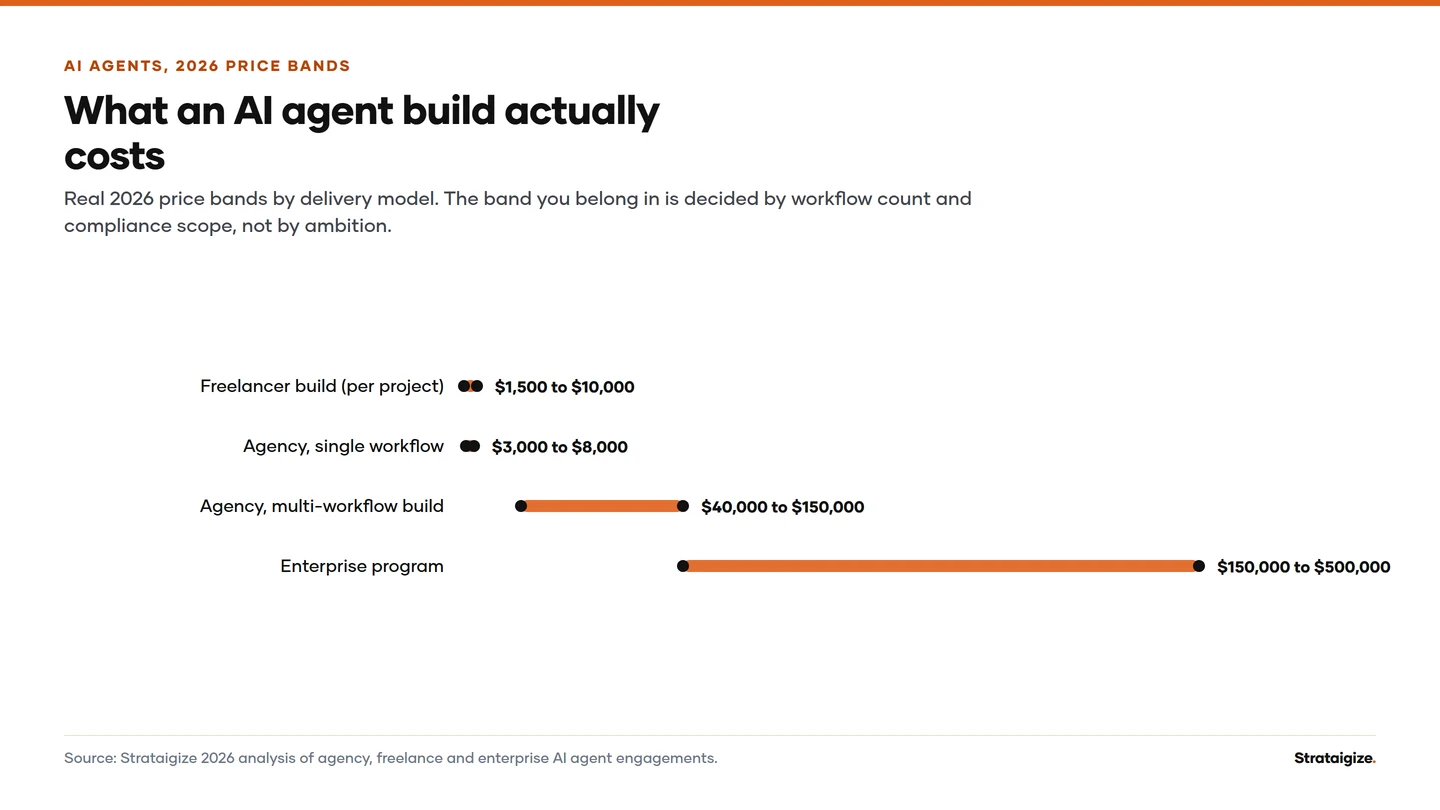
In 2026, a well-integrated single-workflow AI agent typically costs $3,000 to $8,000 to build. Most custom multi-workflow builds land between $40,000 and $150,000, with complex enterprise programs running $500,000 or more. DIY platforms cost $20 to $200 a month plus your time, and agency retainers for maintained agent fleets scale by workflow count. The variable that moves your number most is not the AI: it is the integrations, the data cleanup, and who owns the agent when things change.
Ask this question in most places and you get two useless answers: a Reddit thread where every reply is someone selling something, and vendor pages that say “it depends” until you book a demo. We build and run AI agents daily, for clients and inside our own company, so here are the real bands, what moves them, and the questions that keep you from overpaying.
Key takeaways
- A single-workflow agent (one job, done end to end, wired into your systems) typically costs $3,000 to $8,000 built by a competent shop.
- Most custom multi-workflow builds land between $40,000 and $150,000; enterprise programs run from $150,000 past $500,000 depending on scope and compliance. Our own bounded-workflow pilot is published at $25,000 to $60,000 fixed, listed in the table so you can compare it against the market bands.
- DIY platform costs are trivial ($20 to $200 a month for tools like Zapier, Make, or n8n) but the real cost is your team’s time and the maintenance nobody budgets.
- Ongoing costs are the part most quotes hide: model usage, monitoring, and updates when your other software changes. Budget 15 to 25 percent of build cost per year.
- The strongest cost control is structural: a fixed price on the first workflow, a written success metric, and a kill threshold agreed before anything gets built.
The 2026 price bands at a glance
| Approach | Typical cost | What you get | Watch out for |
|---|---|---|---|
| DIY on Zapier / Make / n8n | $20 to $200 per month plus your time | Trigger-based automations you assemble and own | Your time is the real spend; judgment steps stay manual |
| Freelancer build | $1,500 to $10,000 per project | One or two workflows, built to spec | Handoff risk: who fixes it in month four? |
| Agency, single-workflow agent | $3,000 to $8,000 fixed | One job automated end to end, integrated, tested | Insist on a written success metric |
| Strataigize pilot build (our published price) | $25,000 to $60,000 fixed, 30 to 90 days | One bounded workflow on your own data, shadow mode, supervised go-live, written success metric and kill threshold; starts with a $7,500 AI Opportunity Audit credited toward the build | Listed on our pricing page so you can hold us to it |
| Agency, multi-workflow build | $40,000 to $150,000 | An agent system across several processes | Scope creep; demand phased delivery |
| Enterprise program | $150,000 to $500,000+ | Custom agents with security review, compliance, training | Pilot-to-production failure; use kill criteria |
| Maintained agent fleet (retainer) | Scales by workflow count | Monitoring, updates, expansion month over month | Verify what “maintained” includes in writing |
Why our line sits eight times above the one two rows up
Because those two rows are not the same purchase, and if you only need the cheaper one you should buy the cheaper one.
A $3,000 to $8,000 single-workflow build is the automation itself: wired in, tested, handed over. Our $25,000 to $60,000 is that same automation plus the part that keeps it from hurting you. It runs in shadow mode against your real data first, so you watch what it would have done before it does anything. A person approves anything that moves money or reaches a customer. The success metric and the kill threshold are agreed in writing before we build, so there is a defined point at which we tell you to switch it off. And it starts with a $7,500 audit, credited against the build, whose most common output is a shorter list than the one you arrived with.
That wrapper is worth paying for when the workflow touches revenue, customer communication or a regulated record, and it is worth nothing when it does not. If your first automation is internal, reversible, and nobody outside the company sees its output, a good $3,000 to $8,000 shop is the right buy and we will say so on the call. Come back to a governed build for the second one, once you know what it is worth.
What actually decides your number
How many systems the agent touches
An agent that reads one inbox and writes to one spreadsheet is a week of work. An agent that touches your CRM, your calendar, your billing tool, and your phone system multiplies integration work, and integrations, not AI, are where most of the budget goes. Every additional system adds authentication, error handling, and a place things break when that vendor ships an update.
Whether a human stays in the loop
Fully autonomous agents are cheaper to run and far more expensive to trust. Human-in-the-loop designs, where the agent does the busywork and a person approves anything irreversible, cost slightly more to build and dramatically less when something goes wrong. It is the only design we deploy in our own operations, where our internal agents reclaim 50+ hours a week with a person approving anything that matters.
The state of your data
If your customer records live in three tools that disagree with each other, the agent build starts with cleanup nobody quoted. Ask any vendor to walk your actual data before they give you a number; a quote issued without looking is a guess you will pay to correct.
Ongoing costs, the hidden half
Model usage fees (typically cents per task, but real at volume), monitoring, and maintenance when your other software changes. A reasonable planning figure is 15 to 25 percent of the build cost per year. A quote with no ongoing line item is not cheaper, it is incomplete.
Agency vs freelancer vs DIY: the decision rule
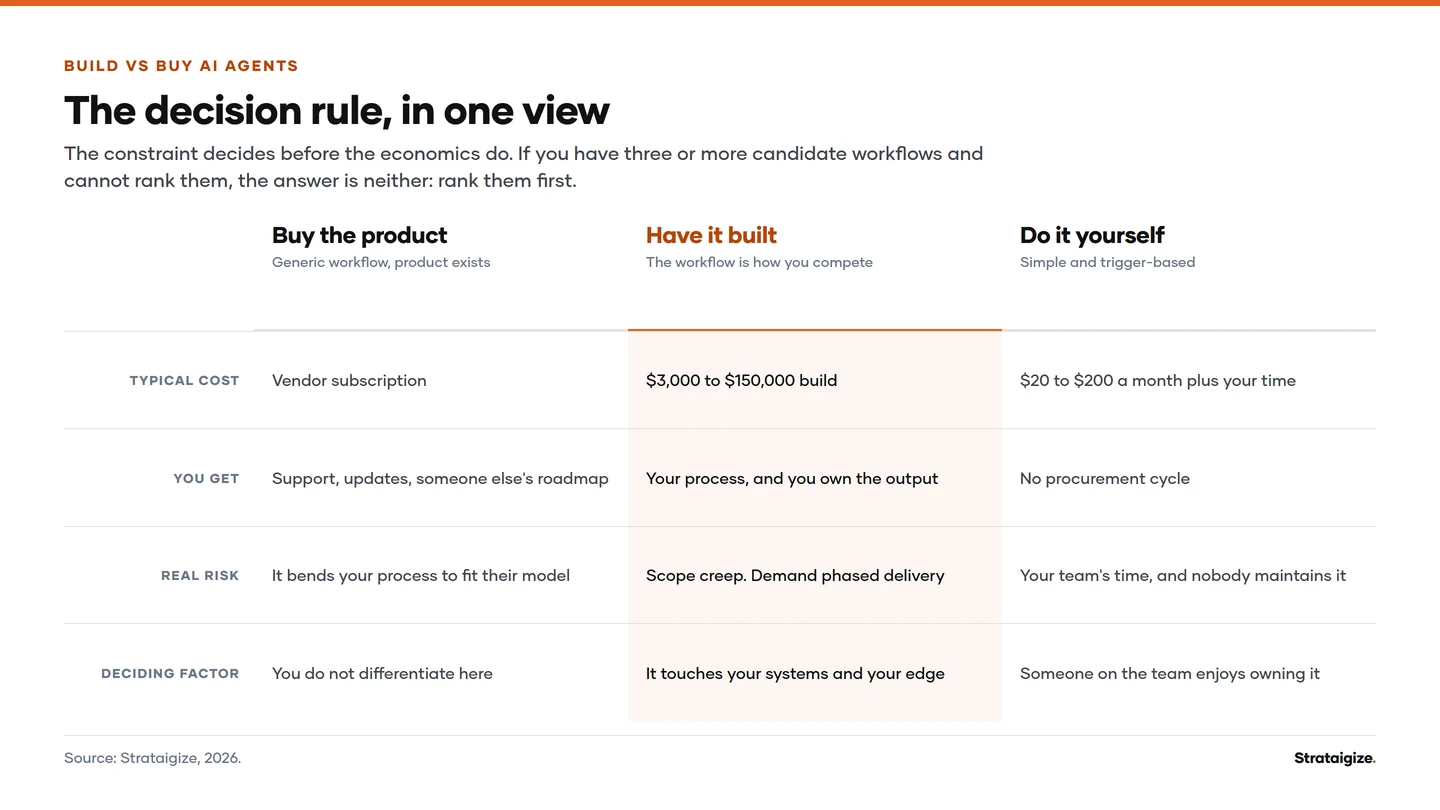
DIY wins when the workflow is simple, trigger-based, and you have someone who enjoys owning it. Freelancers win on price for well-specified single builds, and cost you on continuity. Agencies win when the workflow touches revenue or compliance, when you want the build maintained, and when you need someone accountable for the judgment calls. If a vendor cannot tell you which of your workflows should NOT be automated yet, they are selling capacity, not judgment.
If you are weighing an internal team against any of those three, the full comparison, including the maintenance year most in-house estimates leave out, is in build vs buy AI agents.
The pilot structure that protects your budget
Enterprise buyers converged on this pattern for a reason, and it works at small scale too: a paid pilot of 30 to 90 days, one bounded workflow, run on your real data, with a success metric and a kill threshold agreed in writing before the build starts. If the pilot misses the metric, you stop, having spent a bounded pilot budget instead of six figures. Any agency that resists a kill threshold is telling you something about their confidence.
The week-by-week version, plus the security and data-handling answers your procurement team will ask for, is in the AI agent pilot that survives procurement.
Questions that expose a padded quote
Ask these five and the serious vendors identify themselves: What is the fixed price for the first workflow? What is the success metric and who measures it? What happens when one of my connected tools changes its API? What are the monthly model and monitoring costs at my volume? Who owns the agent and its prompts if we part ways? You want written answers to all five; the last one especially, because agent lock-in is the new website-hostage problem.
Those five are the shortlist. The full version, grouped by scope, proof, security, architecture, commercials, and life after launch, is 24 questions to ask an AI agent vendor.
FAQs
Why do quotes for the same project range from $5,000 to $100,000?
Because “AI agent” describes both a single-inbox assistant and a multi-system platform. Fix the scope first: one workflow, one metric. Comparable quotes only exist for comparable scopes.
Are AI agents worth it for a small business?
At the $3,000 to $8,000 single-workflow level, the math usually works when the workflow eats 5+ hours a week of someone’s time or leaks leads. The workflow that qualifies is usually the one that scores highest on hours times frequency, the ranking method in where service businesses should start with AI automation. If lead response is the workflow, start with how to build an AI lead-gen system. Below that volume, start with DIY automation and check your readiness first.
How long does an AI agent take to build?
A single-workflow agent: two to six weeks including integration and testing. Multi-workflow builds: a quarter, phased. Anyone promising a production multi-system agent in a week is skipping the testing you will pay for later.
What do AI automation agencies charge in Canada?
The bands above hold across the US and Canada; see our verified comparisons of AI automation agencies in Canada and in Vancouver for who fits which budget.
Get a real number for your workflow
The fastest way to a non-guess quote: book a growth audit and we will identify your highest-value workflow and what it should cost to automate, whether you build it with us or not. Our AI agent development engagements start exactly the way this article recommends: one workflow, fixed price, written success metric, kill threshold agreed before the build. The price is published too: a $7,500 AI Opportunity Audit, credited toward a pilot build of $25,000 to $60,000 fixed over 30 to 90 days, both on our pricing page. If you want the ongoing operations layer instead of a build, that is our AI workflow automation service.
The item-by-item box, including what is not in the first build, is what an AI agent build actually includes.
If a procurement team is involved, our trust and security page already answers the questionnaire: data handling, subprocessors, and a governance summary aligned to the AI Risk Management Framework from NIST, the US government’s standards agency. A signed data processing agreement is available on request.
Talk to us