Google Ads Pricing in 2026: CPC, Agency Fees and Budgets
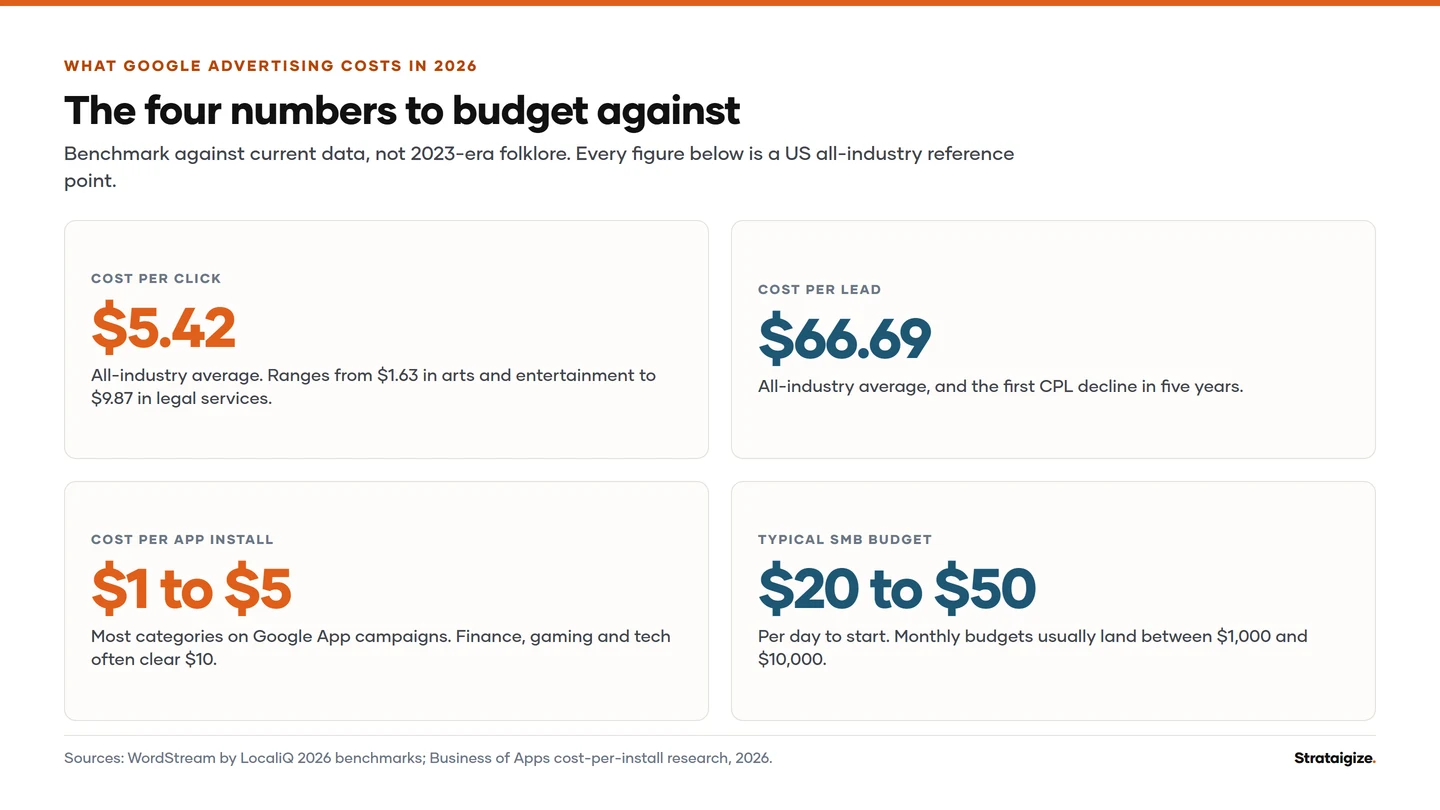
Google Ads pricing is auction-based, so there is no flat rate sheet. As of 2026, the average cost per click across industries is $5.42 and the average cost per lead is $66.69, per LocaliQ search advertising benchmarks. Most small and mid-sized businesses budget $1,000 to $10,000 per month, and competitive niches like legal services see average CPCs near $10. Your actual cost depends on your industry, keyword intent, auction-time ad quality, targeting, and bidding strategy. Agency management fees are separate from the auction, billed as a flat retainer, a percentage of spend, or a performance fee. Ours starts at $7,500 a month for accounts spending from $25,000 a month
What Do We Mean by “Google Advertising Price”?
There is no rate card. Google runs an auction, and the fees you pay are set by how badly other advertisers want the same click. The platform was called Google AdWords until 2018, so “AdWords cost” and “Google Ads cost” mean the same thing. What you pay depends on the pricing model behind
- Cost per click (CPC): you pay when someone clicks your ad. This is the standard model for Search.
- Cost per thousand impressions (CPM): you pay for views, common in Demand Gen and YouTube campaigns.
- Cost per acquisition (CPA), also written as cost per lead (CPL): what a desired action, a lead or a sale, actually costs you.
- Cost per install (CPI): the app marketer’s version of CPA, used to judge App campaigns.
When people ask “how much does Google advertising cost,” they usually want three answers: what a click or impression will cost, what daily or monthly budget they need, and which hidden factors push costs beyond the bid itself. This guide answers all three with
Key Factors That Influence Google Ads Cost
These variables strongly affect price, sometimes more than your
| Factor | Effect on Cost |
|---|---|
| Industry / Niche | Some industries (legal, finance, insurance) have very high CPCs because competition is intense and customer value is high. (WebFX) |
| Keyword Competition & Intent | Keywords with strong commercial or transactional intent cost more (“buy now”, “quote”, “lawyer”). If many advertisers target the same term, prices go up. (Coalition Technologies) |
| Ad Quality | Relevance and landing page experience matter. The reported 1-10 Quality Score is a diagnostic, not an input to the ad auction. Use its components to investigate weak experiences. (Google Quality Score guidance) |
| Ad Format & Campaign Type | Campaign types use different bidding and charging models, such as clicks, impressions or video views. Compare cost per qualified lead or acquisition on consistent measurement windows before drawing a performance conclusion. (Google Ads bidding basics) |
| Geographic Targeting, Device & Time | Showing ads in expensive markets (big cities, high-competition countries) raises costs. Mobile vs. desktop and time of day also influence bids. (Coalition Technologies) |
| Budget & Bidding Strategy | Manual CPC, automated bidding (maximize clicks or conversions), and targets set on CPA or return on ad spend (ROAS) all shape your average cost. More aggressive goals tend to cost more. (Coalition Technologies) |
Typical Prices in 2026: Benchmarks and Averages
The most reliable public benchmarks come from LocaliQ and WordStream, whose annual reports aggregate data from thousands of live campaigns. Here is where the numbers stand as
| Metric | Benchmark (as of 2026) |
|---|---|
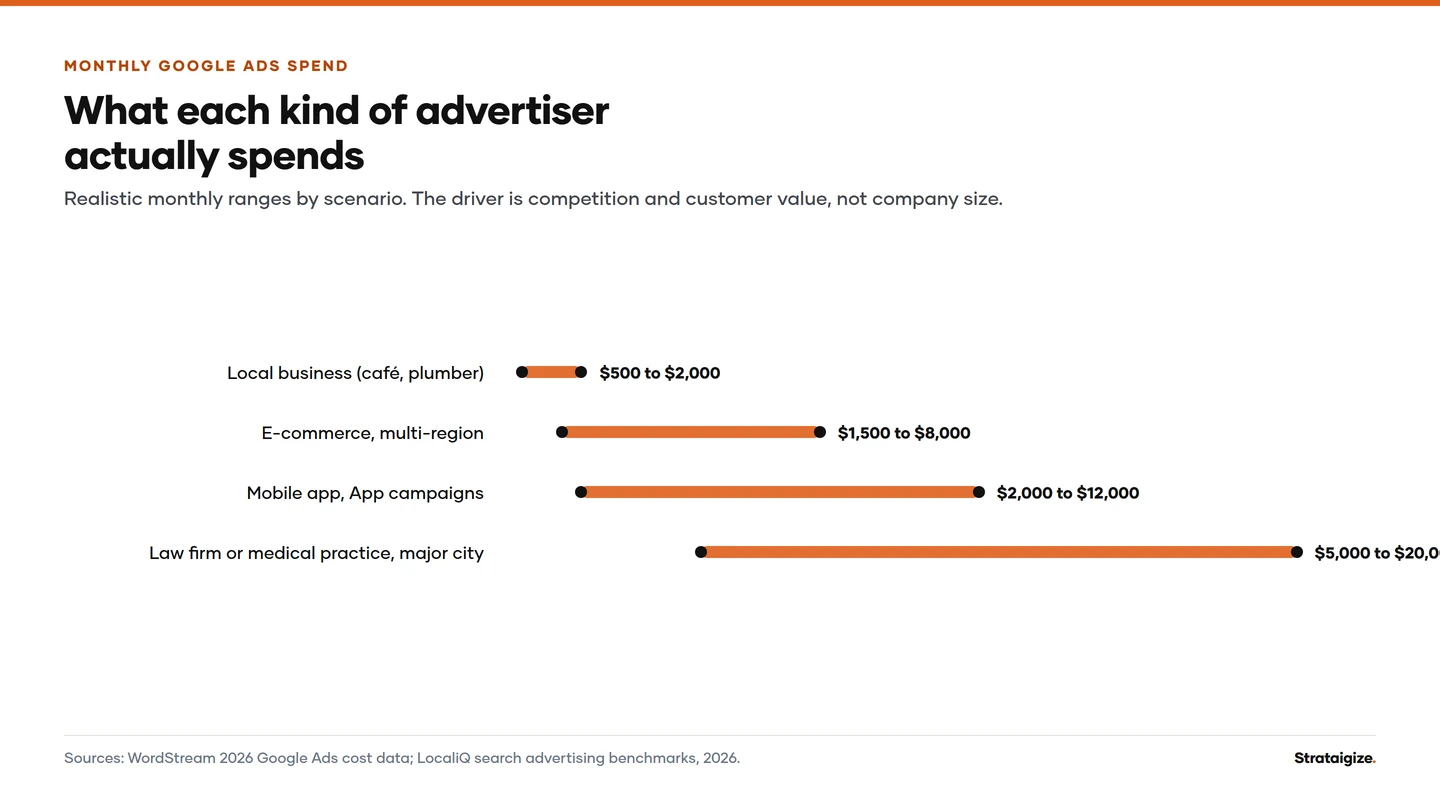
| Average cost per click (CPC) | US$5.42 across all industries. Cheapest verticals: arts and entertainment (US$1.63), restaurants and food (US$2.05), travel (US$2.14). Priciest: attorneys and legal services (US$9.87), home and home improvement (US$8.33), dentists and dental services (US$8.00). (WordStream 2026 Google Ads benchmarks) |
| Average cost per lead (CPL) | US$66.69 across industries; high-consideration verticals like legal services typically run well above US$100 per lead. (LocaliQ search advertising benchmarks) |
| Cost per install (CPI) for apps | Most app categories land between US$1 and US$5 per install on Google App campaigns, with finance, gaming, and tech often exceeding US$10. (Business of Apps CPI research) |
| Daily / monthly budgets for SMBs | Many small and mid-sized businesses start at US$20-50/day; monthly budgets typically run US$1,000 to US$10,000 depending on scale and goals. (WordStream) |
These are averages. For more market data, see our Google Ads statistics roundup.
Google Ads Campaign Types and How Each One Bills (2026)
Google documents the main options in its campaign-type guide. Campaign type, bidding objective and the event you pay for are related but
- Search: classic text ads priced per click. AI Max for Search, Google’s AI upgrade rolled out through 2025 and 2026, layers broader AI-driven query matching and automated creative onto Search campaigns.
- Performance Max: one goal-based campaign that serves across Search, YouTube, Display, Gmail, Discover, and Maps. You set a budget and bidding objective, with an optional target CPA or ROAS where supported, and Google allocates spend.
- Demand Gen: visual and video ads across YouTube, Shorts, Gmail, and Discover. Check the supported channels and controls for the campaign rather than assuming every visual campaign has the same inventory.
- Shopping: product listing ads priced per click, fed by your Merchant Center feed.
- Video (YouTube): priced per view (CPV) or per thousand impressions (CPM).
- App campaigns: automated campaigns for installs and in-app actions, judged on CPI or cost per in-app event rather than CPC.
A US$5 CPC can be a bargain and a US$0.50 CPC can be a money pit. Judge every campaign type on cost per conversion, not the headline
Example Scenarios
| Scenario | Competition Level | Expected Cost |
|---|---|---|
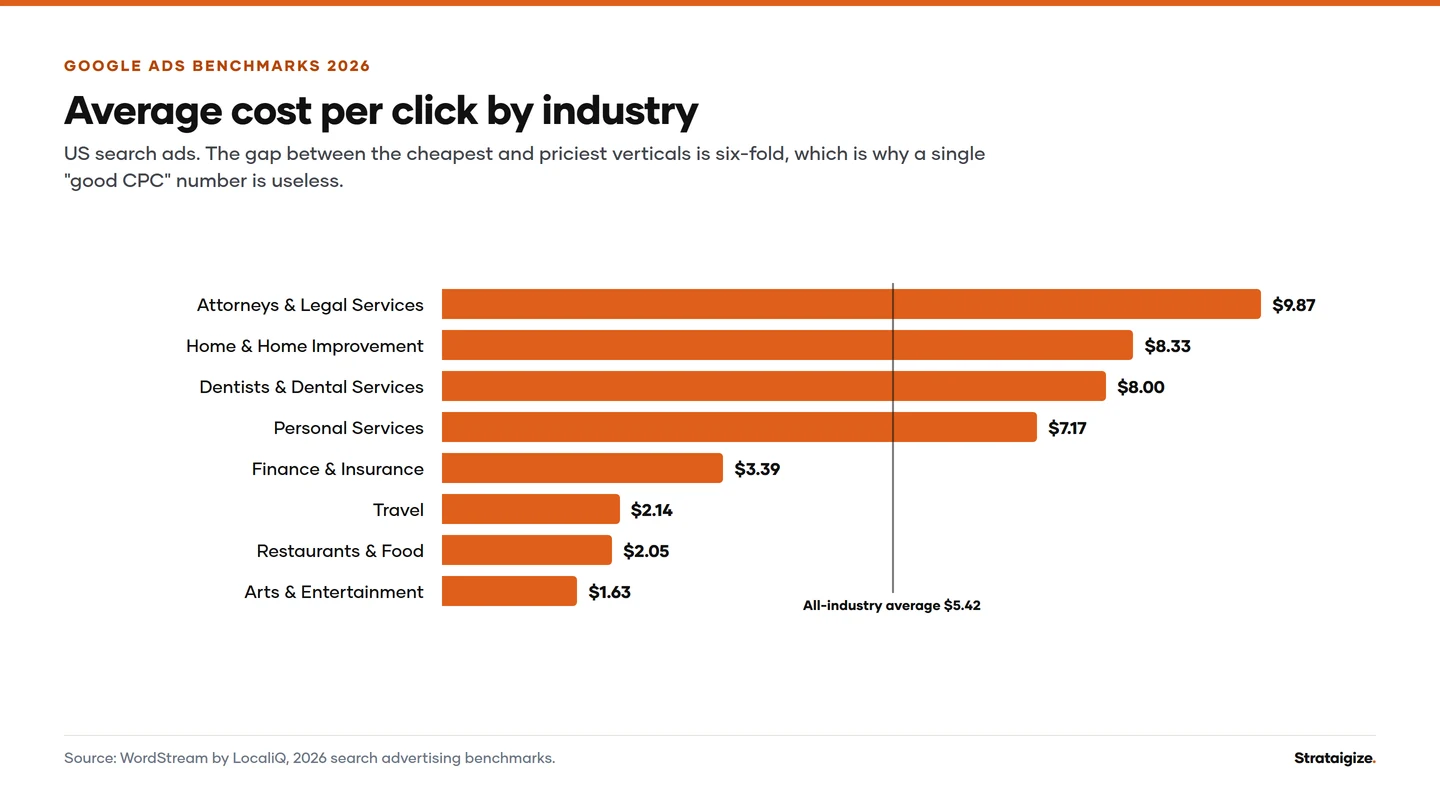
| Small local business (a café, a plumber) running local search ads | Low to medium | CPC around US$1-3; monthly spend often US$500-2,000 depending on keyword coverage. |
| Law firm or medical practice in a major city | High | Average legal CPCs sit near US$10 as of 2026, and specific high-intent keywords can run US$20-100+ per click; monthly spend easily US$5,000-20,000+. |
| E-commerce shop selling across multiple regions | Medium | CPC around US$1-5 depending on product; Shopping and Performance Max often bring cheaper clicks but need enough conversion volume to train. |
| Mobile app running Google App campaigns | Varies by category | CPI typically US$1-5 in most categories as of 2026, with finance and gaming often above US$10; sustainable budgets usually start in the low thousands per month so the algorithm gets enough conversions to learn. |
Tips to Reduce Costs and Improve Efficiency
To get better value for your
- Improve ad relevance and landing pages: use Quality Score components as diagnostics, then assess actual qualified conversions over a consistent reporting and attribution window.
- Use long-tail keywords: less competitive, often cheaper, and they convert well.
- Optimize targeting: limit geography, schedule, and devices to where you see the best results.
- Add negative keywords: exclude irrelevant traffic that eats budget without converting.
- Test campaign types: Demand Gen, Shopping, or Performance Max sometimes beat Search on ROI for the same goal.
- Monitor and adjust: never set and forget. Review search terms, bids, and budgets weekly.
Before you commit to a number, model scenarios with our ad spend calculator to see how CPC, conversion rate, and
What a Google Ads Agency Charges to Run the Account
The auction is only half of Google Ads pricing. If someone else runs the account, their fee sits on top, and it is billed
| Fee model | How it bills | Where it misprices the work |
|---|---|---|
| Flat retainer | A fixed monthly fee for a defined scope | Fine when the scope is written down; expensive if the account is tiny |
| Percentage of spend | A share of your monthly media | Pays the agency for volume, so a lean, profitable account earns them less than a bloated one |
| Performance fee | A fee per lead, sale or install | Needs an attribution model both sides trust, and the platform usually owns that model |
Ask three questions before signing any of them. Who owns the ad account and its conversion history if you leave (it should be you). What the fee covers when spend drops, because a percentage model quietly removes the incentive to cut waste. And how results will be read: cost per conversion and payback, with the date range and attribution window named, never cost per click on
Our own fee is published rather than quoted on a call. Paid advertising management starts at $7,500 a month, for accounts spending from $25,000 a month on media. It runs month to month after the first three months. Google bills the media to you directly. The scope of what that covers, including creative testing and conversion tracking, is on the Google Ads agency page. How we connect to those accounts is on the Google Ads API page. Below roughly $25,000 a month in media, a flat fee on that scale is usually the wrong buy, and a well-briefed in-house owner with a quarterly review is the better use of
FAQ
How much do Google Ads cost per click in 2026?
Across all industries, the average is US$5.42 per click as of 2026, per WordStream’s benchmark report. Low-competition verticals pay under US$2, while legal and home services
What are Google advertising fees?
Google doesn’t charge a flat fee. What you pay is set by the ad auction (CPC or CPM), plus any management fees if you use an agency to run the account. The three agency fee models, and the one we publish, are covered in the
How much should I budget to advertise on Google?
Many small businesses start at US$1,000-2,000 per month for modest keyword volume and local targeting. App campaigns and competitive industries need more, both to win auctions and to give Google’s algorithms enough conversion data
Is Google AdWords different from Google Ads?
No. Google renamed AdWords to Google Ads in 2018. The auctions, costs, and campaign types are the
Set a Budget You Can Sustain for a Quarter
Use the 2026 benchmarks above to sanity-check your numbers, set a budget you can sustain for at least a quarter, and judge results on cost per conversion rather than cost
If you’d rather have an experienced team on it, explore our paid advertising services: we plan, run, and optimize Google Ads for mobile apps and growth-stage companies
Talk