How Much Does Sensor Tower Cost, and Is It Accurate?
Sensor Tower is priced like enterprise software and sells a model of other companies' revenue, so the only defensible reason to sign is a decision worth more than the licence. There is no list price. The vendor publishes nothing, and the software directories say so in plain language: 'the provider does not communicate any price information' (OMR, 2026). Vendr's procurement listing also reports custom pricing (Vendr, checked September 5, 2026). Everything past the limited free account starts with a
Sensor Tower’s acquisition of data.ai removed a prominent independent bidder from app-market intelligence. Sensor Tower acquired data.ai, formerly App Annie, on March 18, 2024, with credit financing from Bain Capital and investment from Riverwood Capital and Paramark Ventures (TechCrunch; PR Newswire). data.ai carried roughly $100 million in annual recurring revenue and had raised $157 million against Sensor Tower’s $46 million, and part of its 400-person team came across alongside a workforce reduction. Both platforms were supposed to run standalone “for now”. They did not. The brand is retired and the datasets are folded in (Sensor Tower, 2024). Other providers remain; compare their actual country, category and data coverage before treating them as
You are licensing a model, not a ledger
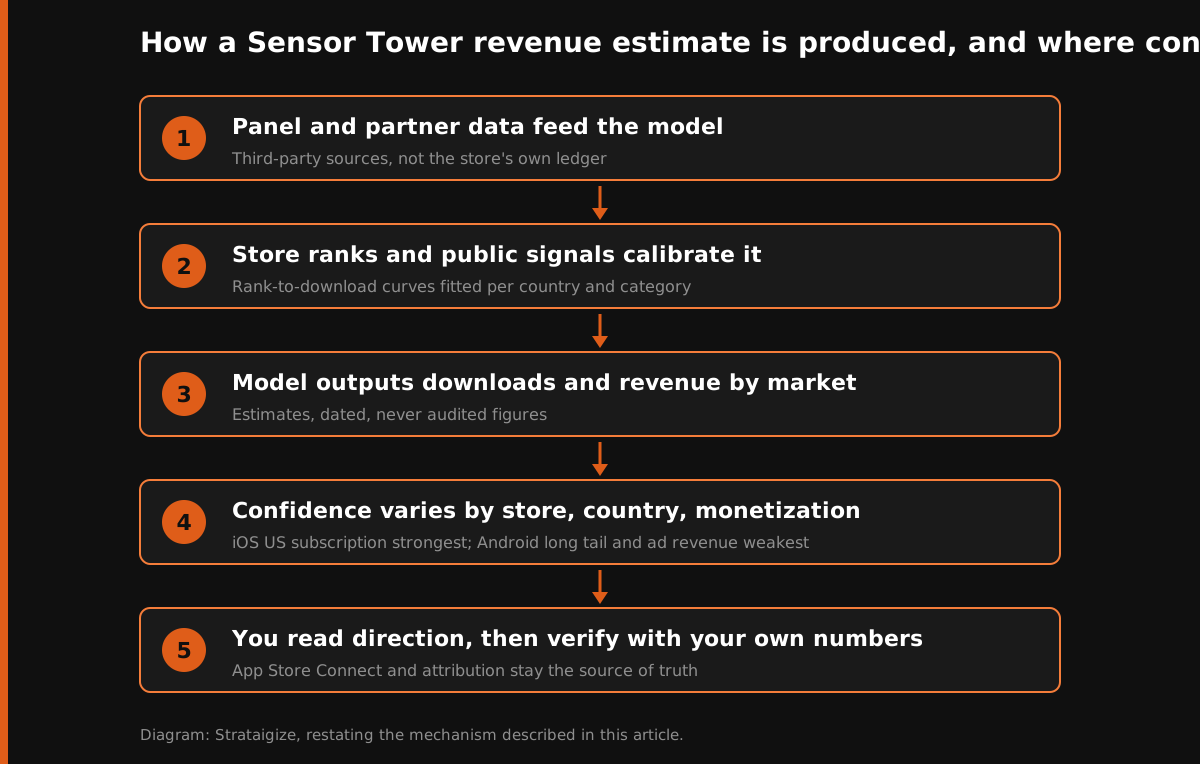
Sensor Tower combines store signals with a first-party consumer panel to estimate downloads, revenue, revenue per download, active users, sessions, time spent, keyword ranks, and ad share of voice (sensortower.com, 2026). That is how it reports on apps it has no relationship with (Sensor Tower methodology, accessed 2026). What you are buying is a fitted model of a competitor’s business, useful for direction and share, audited
The software review directory OMR reports that modules are licensed and priced separately (OMR, 2026), and the naming is a trap on the order form. Vendor pages say App Performance and App Advertising. Directories and resellers still list App Intelligence, Store Intelligence, Ad Intelligence, and Usage Intelligence. Same underlying data, different labels, and procurement has signed for four when it
Two 2026 additions change what a quote is worth. Pathmatics added a Linear TV channel spanning more than 120 TV networks, plus coverage in Argentina, Colombia, Ireland, and Kakao inventory in South Korea (Sensor Tower product year in review, 2026). And the Model Context Protocol (MCP) Server shipped, letting Claude or a custom model query App Advertising, App Performance, and Pathmatics directly. Read the gate before you get excited: it works only with an active API subscription (Sensor Tower, 2026). Sense AI now writes full reports from a prompt, with summary, charts, and citations (Sensor Tower, July 2026). So the API line stopped being an engineering nicety; it is now the price of agent access to
 How a Sensor Tower revenue estimate is produced, and where
What a quote costs, and what nobody will put in writing
| Signal | What the source actually says | Source, dated |
|---|---|---|
| Published list price | None. No price information communicated | OMR, 2026 |
| Standard pricing | No standard list pricing; every quote is scoped | Vendr, 2026 |
| Order of magnitude at acquisition | Licences carry “price tags upwards of tens of thousands of dollars” | TechCrunch, March 18, 2024 |
| Contract model | Vendr reports annual contracts as standard; confirm your actual term | Vendr, checked September 5, 2026 |
| Modules | Priced and licensed individually | OMR, 2026 |
| API | No rate card. Quoted in the same sales process, and required for the MCP Server | Sensor Tower, 2026 |
| Evaluation access | Confirm demo, trial and sample-data terms with sales | Sensor Tower |
| Free account | Exists: top charts, category data, shallow app profiles | sensortower.com, 2026 |
Earlier versions of this review reported a median observed contract of about $74,415 and a band of roughly $28,500 to $111,500, attributed to Vendr’s marketplace listing. On September 6, 2026, the current Vendr page (last updated February 2026) reports slightly different numbers: a median of $75,000 a year across 40 recorded purchases, a range of $29,500 to $115,460, and budget bands of $30,000 to $70,000 for small teams, $70,000 to $150,000 for mid-market buyers and $150,000 to $300,000 or more for enterprise. Those are third-party procurement benchmarks built from a small transaction set, not Sensor Tower list pricing, and they move as Vendr’s dataset changes, which is why the table above does not carry them as
We are also not filling the table with the entry prices that circulated on affiliate and SEO blogs through 2026. Several of them contradicted each other by an order of magnitude and none traced to a vendor statement or a transaction dataset. The order of magnitude we trust is TechCrunch’s, from the week of the acquisition: tens of thousands of dollars a year per licence (TechCrunch, March 18, 2024). Anything more precise than that, from us or from anyone else, is a guess carried to one
Four line items decide where inside that range your quote lands. Seats, and which seat types can export. Modules, itemized separately so you can see what each one costs. API call ceiling. Overage rate on that ceiling. Get all four in the order form. The API quota is the one that quietly reprices the contract, because it is now the prerequisite for every agent workflow somebody in your company will ask for in
Where the estimates hold, and where they cost you a quarter
The model is a rank-to-revenue fit, so accuracy is a function of sample depth, not of how confident the chart looks (Sensor Tower methodology,
| What you are reading | Where it holds | Where it breaks |
|---|---|---|
| Downloads, top-ranked apps in large markets | Deepest panel coverage, direction and share are usable | Long tail apps at a few thousand monthly downloads can be off in either direction |
| In-app subscription revenue | Store-processed transactions are the model’s native input | Web checkout, off-store billing, and third-party payment flows sit outside the model entirely |
| Ad-monetized and hybrid revenue | Share of voice and creative volume read well | Revenue estimates track store transactions, so ad-funded games read structurally low |
| Usage, sessions, retention | Best-improved area post-merger, since both firms ran independent panels (TechCrunch, 2024) | Still a panel projection, not your cohort |
Operators who have held one of these licences already know the awkward part. The estimate you would most like to trust, a rival subscription app’s monthly revenue, is the one most exposed to web checkout, and web checkout has only grown since 2024. So the number drifts low, in one direction, for exactly the competitors you care
Run a calibration before you renew. Pick three apps whose real numbers are public, from filings or from your own console, and compare. Then pick three of your own markets and check the platform against App Store Connect. If the read is off by a third on a company you can verify, you know what to do with the read on a company
That third costs something real. A founder who puts a modeled competitor revenue line in a board deck, and then has a director re-pull it from a filing, loses the room, not an estimate, and the next three slides get read as decoration. A user acquisition (UA) lead who sizes a quarterly budget off a rival’s modeled spend and lands light has already committed the creative, the hires, and the flighting by the time the variance
So here is what we refuse: reporting a competitor’s modeled monthly revenue to a board as fact, or building a payback target on one. Direction, share, trend, and market sizing are what the licence buys; reconciliation is the one job it cannot do. Your own attribution and store console stay the source of truth, which is the distinction we drew in Sensor Tower vs AppsFlyer. Getting those two to agree is mobile data and attribution work, not a licence you
We would not pay this to do app store optimization work
If your job is keywords, metadata, and review mining on one app, this contract is the wrong purchase. The published-price app store optimization (ASO) tools do that daily work at a fraction of a five-figure annual commitment, and they publish self-serve plans rather than requiring a custom quote (Vendr, 2026). Our AppTweak review covers where that tier
The line item earns itself somewhere else. It earns itself when you run real paid budget across several platforms and need competitor creative and share of voice to decide where to test next, which is a different question from what an install costs you and how install and event-based campaign pricing behaves. Publishers of games get a second case: GameIQ’s sub-genre, art style, and monetization taxonomy, whose taxonomy should be compared with the games and markets you analyze. And market entry is the third, where one correct call about Japan or Brazil is worth more than the
If it is one app, one country, no competitive set, and no paid budget worth defending, skip it. Use the free account for the occasional sanity check and put the money
Renewal week: cut what nobody can attach to a decision
Do this before the term rolls. Pull the last two quarters of usage by module and by seat, then write one line per module naming the decision it changed, not the report
Any module with a blank line goes. Usage Intelligence bought for a retention benchmark that got read once in February is a habit with an invoice attached. Then decide about the API separately from everything else, because the MCP Server made that quota the gate on agent access (Sensor Tower, 2026) and it deserves its own number with its own overage rate rather than a bundled line you
Last, ask for the coverage caveats in writing for your exact markets and your exact monetization type: your countries, your stores, your billing model, from the rep, before your subscription renews. A global methodology page does not establish coverage for your exact use case. If they will not put the caveat in the thread, that is the answer about how much confidence to spend on the number. And when the quote comes back with no list price behind it, the renewal question is which single decision the Pathmatics or GameIQ line has to carry next year to survive the year after that, not whether Sensor Tower is accurate enough
Talk