AEO vs GEO vs SEO: What Is the Difference in 2026?
SEO improves visibility in search results. AEO and GEO are overlapping industry labels for helping people find useful answers and helping brands appear accurately in AI-generated responses. Featured snippets can extract a passage; AI Overviews and AI Mode generate responses with supporting sources. Use the labels to clarify what you measure, not to buy duplicate work. The foundation is accessible pages, useful answers and evidence a reader can verify.
Three acronyms describe one job, getting found when someone is looking for what you sell. The confusion is real and it is expensive, because teams keep buying the same work twice under two different names. Here is the map of what each term means, where the boundaries actually fall, and which layer to fund first.
Key takeaways
- SEO wins a position. AEO wins the answer box. GEO wins a citation inside a generated answer. Different outputs, largely the same underlying content work.
- Ranking no longer guarantees a citation. Analyses published in late 2025 (BrightEdge in September, Originality.AI in November) put the share of AI Overview citations that come from the organic top 10 anywhere from roughly 17% to 52% depending on method and vertical, so citation presence is a separate visibility layer.
- Research gives useful hypotheses to test. A 2026 observational study associated statistics, definitions and comparisons with higher source-influence scores; it did not prove that adding them causes a citation increase.
- On our own domain, AI fetchers now read the site harder than Google does: ChatGPT-User made 2,370 requests in the week to 2026-07-27 against Googlebot’s 1,390 (Cloudflare).
- Do not buy three programs. Buy one content and entity engine and measure it on three scoreboards.
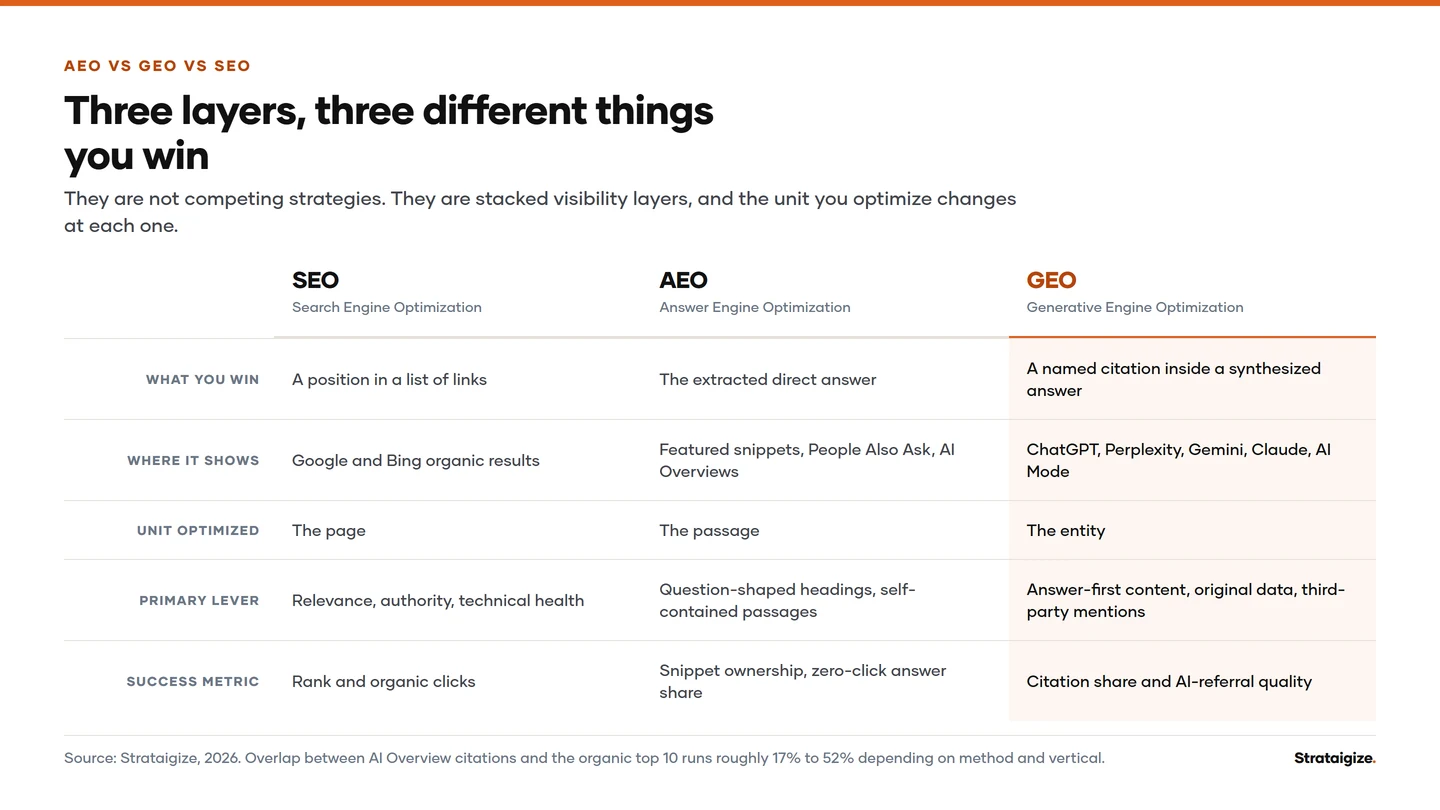
The one-table version
| SEO | AEO | GEO | |
|---|---|---|---|
| Full name | Search Engine Optimization | Answer Engine Optimization | Generative Engine Optimization |
| What you win | A position in a list of links | The extracted direct answer | A named citation inside a synthesized answer |
| Where it shows up | Google and Bing organic results | Featured snippets and other direct-answer experiences; the label also overlaps with AI search | ChatGPT, Perplexity, Gemini, Claude, Google AI Overviews and AI Mode |
| Unit of optimization | The page | The passage | The entity |
| Primary lever | Relevance, authority, technical health | Question-shaped headings and self-contained passages | Answer-first content, original data, third-party mentions |
| Success metric | Rank and organic clicks | Snippet ownership and zero-click answer share | Citation share and AI-referral quality |
| Who still needs it | Everyone | Anyone with a question-shaped buyer journey | Anyone whose buyers research with an assistant |
AEO vs GEO, head to head
Most people searching this comparison already have SEO and want to know whether AEO and GEO are two purchases or one. The short version: AEO is the passage-level craft, GEO is the entity-level program, and the same content work feeds both.
| AEO | GEO | |
|---|---|---|
| The output you win | Your own passage, lifted as the answer | Your name, inside an answer built from many sources |
| Where the work happens | On your pages: question-shaped headings, self-contained answers | Mostly off your pages: original data, consistent profiles, third-party mentions |
| What a win looks like | A featured snippet or a direct-answer box that quotes you | “According to [you]” or a source card in an assistant’s citation tray |
| How you measure it | Snippet ownership on a fixed question set | Citation share on a fixed prompt set, plus AI referrals and self-reported source |
| Time to first result | Weeks, on pages that already rank | Quarters, because most of the inputs are earned |
| Buy it as | A writing standard applied to every page | An ongoing program with a measurement panel |
If a vendor quotes you AEO and GEO as two retainers with two scopes, ask which deliverables differ. In our experience the answer is the measurement panel and the earned-mention work, and nothing else.
SEO: still the foundation, still misunderstood
SEO improves a page’s visibility in ranked search results. Crawlability, useful content and internal discovery also support AI search. For Google’s AI features, a supporting page must be indexed and eligible for a snippet. Direct access helps an engine use your own page, while a brand may also appear through other publishers’ descriptions of it.
What has changed is the payoff curve. The click is leaving the top of the funnel while the research value stays. That is why measuring SEO purely on sessions now understates it: your page can shape a purchase decision inside an answer you never get a visit from.
AEO: winning the extracted answer
AEO is a practitioner label for making useful answers easy to find and understand. For an extractive feature such as a featured snippet, a self-contained passage can answer the question directly. Use a question heading when it helps the reader, then give the answer at the length it needs.
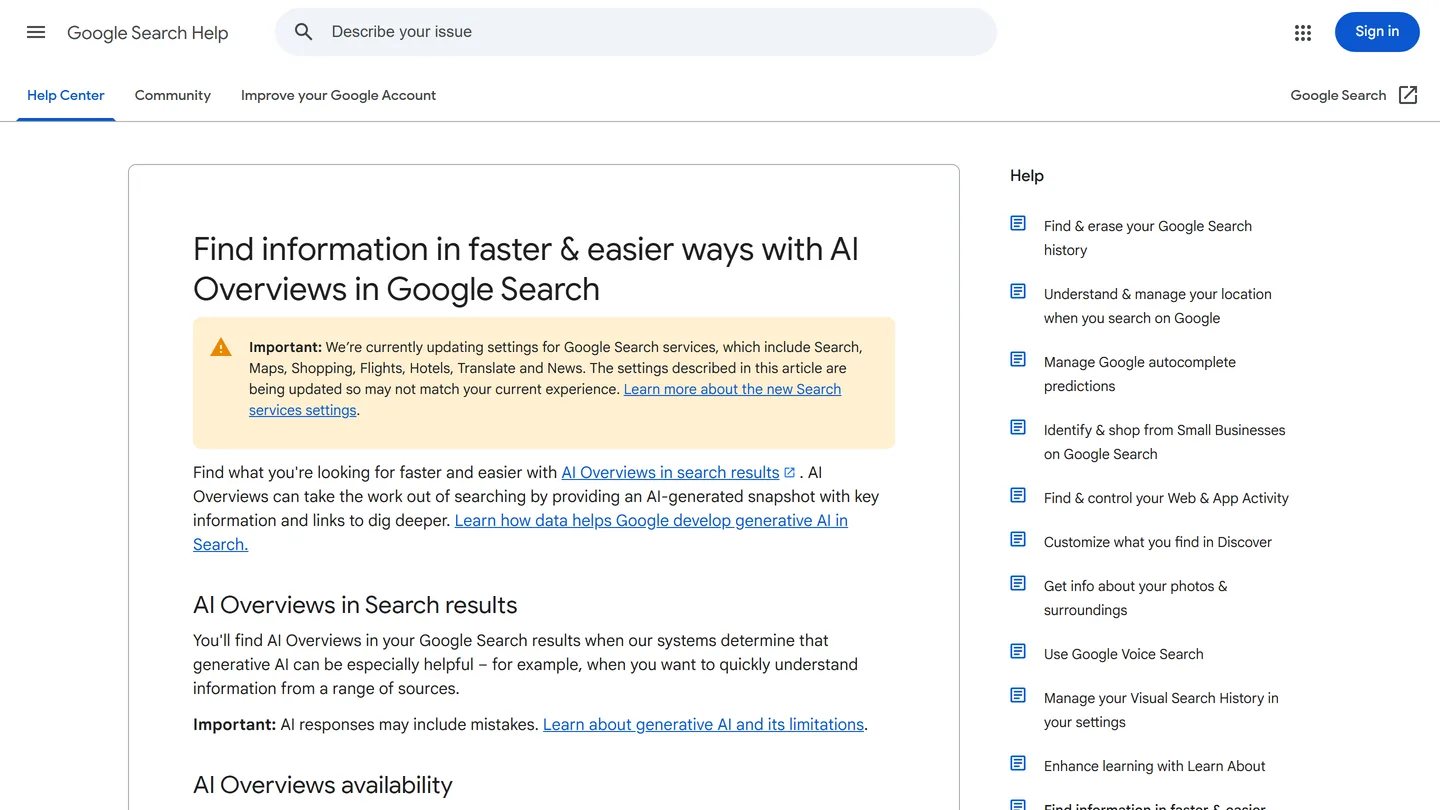
AI Overviews are different from a single extracted passage. Google describes AI Overviews and AI Mode as generated responses that may search related subtopics and identify supporting pages. Calling both AEO is a naming choice; it does not mean they use the same selection process. No fixed answer length guarantees either a snippet or an AI citation.
One 2026 correction: Google removed FAQ rich results entirely on 2026-05-07, so FAQPage markup no longer buys you a visual result. Keep it for machine readability if you like, but do not sell it as a ranking feature. It is not one anymore.
The reason AEO still matters is that the extraction habit transfers. A page written so a snippet engine can lift a clean answer is exactly the page a generative engine can ground on. AEO is the discipline; GEO is the newer surface it now serves.
GEO: winning the citation
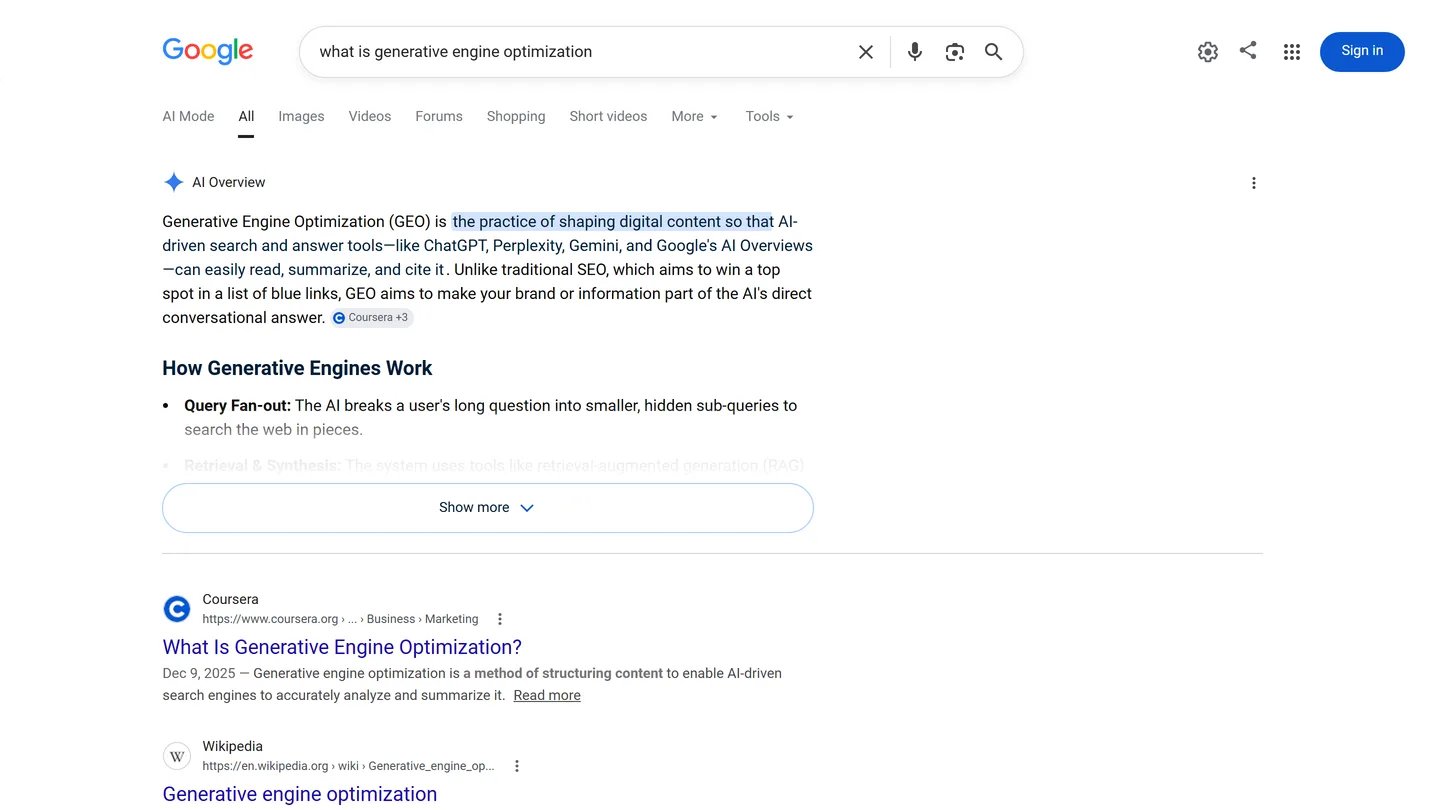
GEO is optimizing your entire brand entity so generative engines name you inside the answer they synthesize. The output is not a link position and not an extracted paragraph, it is an attribution: “according to X” or a source card in the citation tray.
The term comes from academic work. The GEO: Generative Engine Optimization paper (Aggarwal et al., KDD 2024) built a benchmark of around 10,000 queries and tested nine content modifications. The methods that worked were adding verifiable statistics, incorporating credible quotations, and citing reliable sources. Keyword stuffing produced negligible or negative effects.
Be careful with the headline number from that paper, though, because it is quoted badly everywhere. The often-repeated “40% lift” is a relative gain over a 19.8% baseline on a position-adjusted word-count metric, measured among five sources that were already injected into the model’s context. It is a share-of-answer result inside a simulator, not a measure of whether you get discovered. A 45-study scoping review published in July 2026 makes the point directly, and C-SEO Bench (NeurIPS 2025) found most such methods are ineffective or actively negative on ranking, with gains shrinking as more people adopt them.
The 21,143-citation study needs the same care. It compared average influence scores for pages with and without particular features in an observed sample. That score is a constructed measure of source use, not a count of citations gained by editing a page. Neither set of percentages belongs in a forecast of what a rewrite will earn.
GEO also differs from the other two in scope. SEO and AEO are things you do to pages. GEO is largely something you earn off your own site: the listicles you appear in, the communities that mention you, the data other people quote. A GEO program that only touches your website is doing a fraction of the job.
Why the terms blur, and why the argument does not matter
There is no settled academic distinction between AEO and GEO, and practitioners use them interchangeably all the time. Some vendors insist they are the same thing with different branding. Others draw the line at whether the answer is extracted (AEO) or generated (GEO). Both positions are defensible, which tells you the boundary is soft.
Here is the practical version. The line that actually matters is not AEO versus GEO, it is ranking versus being cited, because those two now come apart. Analyses published in late 2025 disagree on the magnitude but agree on the direction: BrightEdge’s rank-overlap tracking (September 2025) found only 16.7% of AI Overview citations coming from top-10 results, while Originality.AI’s citation study (November 2025) put the figure at 52%. Whichever number you trust, a large share of what AI answers cite is not sitting in the top ten links. You can hold #1 and still be missing from the answer your buyer reads.
So stop litigating the acronyms and ask a better question: for each buying question in your category, do we rank, are we the extracted answer, and are we named in the generated one? Those three yes-or-no checks are the whole framework.
Which one should you invest in first?
Fund them in this order, and only skip a step if you have already earned it.
- Technical SEO first, always. If AI crawlers and search bots cannot fetch, parse, and render your pages quickly, nothing downstream works. This is a one-time fix plus maintenance, not a program.
- Make the answers useful. On priority pages, resolve the buyer’s actual questions, make comparisons clear and link the supporting evidence. Estimate the work from the pages that need it, and measure the result without assuming a citation lift.
- GEO third, and treat it as an ongoing program. Original data, entity consistency across off-site profiles, and earned third-party mentions take quarters, not weeks. Start once the first two are done, because GEO amplifies a strong foundation and cannot substitute for a missing one.
The exception: if your buyers are already researching with assistants and your competitors are being named while you are not, run GEO in parallel. That is a demand problem, not a hygiene problem, and waiting costs you the consideration set.
How to measure each layer
Three layers, three scoreboards. Mixing them is how programs get killed for missing a target they were never optimizing for.
| Layer | What to track | Where |
|---|---|---|
| SEO | Rankings, impressions, organic clicks, indexed pages | Google Search Console, rank tracker |
| AEO | Snippet and People Also Ask ownership for your priority questions | Rank tracker with SERP-feature reporting |
| GEO | Citation share across a fixed prompt set, AI referral sessions, self-reported attribution | AI visibility monitor, a GA4 custom channel, a “how did you hear about us” form field |
The self-reported field is the one most teams skip and the one that catches what the others miss. A click inside a Google AI Overview still reports as google.com, so no analytics tool you own can separate AI-sourced traffic from blue-link organic. We learned that the hard way: our own highest-value website-sourced deal is tagged “Organic Search” in our CRM, and we only know it came from an AI answer because the client said so.
If you want a starting position rather than a theory, our AI visibility checker shows where you currently stand across the major engines.
What this looked like on our own site
We ran the full stack on strataigize.com before selling it, and the numbers are specific enough to argue with.
On the crawl side, AI systems now read this domain harder than Google does. In the week to 2026-07-27, Cloudflare logged 2,370 requests from ChatGPT-User, the fetcher OpenAI fires when a live user’s answer needs a page pulled in real time, against 1,390 from Googlebot. Total AI crawl demand tripled week over week.
On the output side, a late-2025 push on the previous site, published 2025-12-10, took ChatGPT-attributed sessions from 38 to 474 and logged 117 Semrush AI citations as of 2025-12-09, with leads attributed directly to ChatGPT and Perplexity. The full breakdown, including the before-and-after engagement data, is in our AI SEO case study.
On the revenue side, with the caveat attached: both of the only two clients our website has ever produced arrived through AI answers, together worth $215,603, which is 29.7% of our lifetime closed-won revenue. The caveat we attach permanently is that 95% of that figure is one deal. n=2 proves the channel can close at our deal size. It does not prove a rate, and anyone quoting it as one is selling you something.
Where to go next
- The definitional deep dive: what generative engine optimization is and how to start.
- The mechanism: how generative engine optimization actually works, step by step through the retrieval pipeline.
- The buying guide: what AI SEO services include and how to vet an agency.
- The vendor shortlist: the best generative engine optimization agencies in 2026.
- What the fee is: how much GEO services cost in 2026.
- Ready to run it: our generative engine optimization service.
Frequently asked questions
Is AEO the same as GEO? Not quite, though plenty of practitioners use them interchangeably and no settled academic definition separates them. The useful distinction: AEO wins an answer extracted from your page, GEO wins a citation inside an answer generated from many sources. The work overlaps heavily, which is why arguing about the label wastes more time than it saves.
Does GEO replace SEO? No. Generative engines still need to fetch, parse, and trust your pages, and a meaningful share of what they cite is content that also performs in classic search. GEO builds on SEO; it does not retire it.
Do I need schema markup for AEO or GEO? Treat it as hygiene. Structured data helps machines parse your page and keeps your entity clean, but the 2026 evidence does not support markup as a citation driver, and Google removed FAQ rich results outright in May 2026. Put the effort into answer-first writing, original data, and third-party mentions.
Which acronym should I use with my team? Pick one and define it in writing. We say GEO because the surface we are optimizing for is generative, and we fold answer-first structure into it as a technique rather than a separate program. What matters is that everyone agrees on the scoreboard, not the spelling.
How long before any of this shows results? There is no fixed timetable. Crawling, indexing, competing sources and the questions being asked all matter. Set a review cadence and compare repeated observations against the same baseline; a change in one answer does not establish a durable gain.
Can a small team do all three? Yes, in the order above. Technical health and answer-first rewrites are entirely learnable in-house. The parts that usually need help are publishing original data on a real cadence and earning third-party mentions, which are slow, relationship-driven, and the highest-value work in the stack.
Talk to us