Does Google Penalize AI Content? What the Sources Say
Google does not prohibit content merely because AI helped create it. Its published guidance permits appropriate AI use and focuses on helpful, original content, while its spam policies prohibit scaled content abuse. That policy does not reveal every detection method inside Search. Judge an article by its accuracy, evidence and value to the reader, rather than treating a commercial detector score as a Google ranking verdict.
Ask most marketers whether Google penalizes AI content and you get a confident yes. Ask where that comes from and the trail runs through blog posts citing other blog posts, back to a March 2024 announcement that says the opposite of what it is quoted as saying.
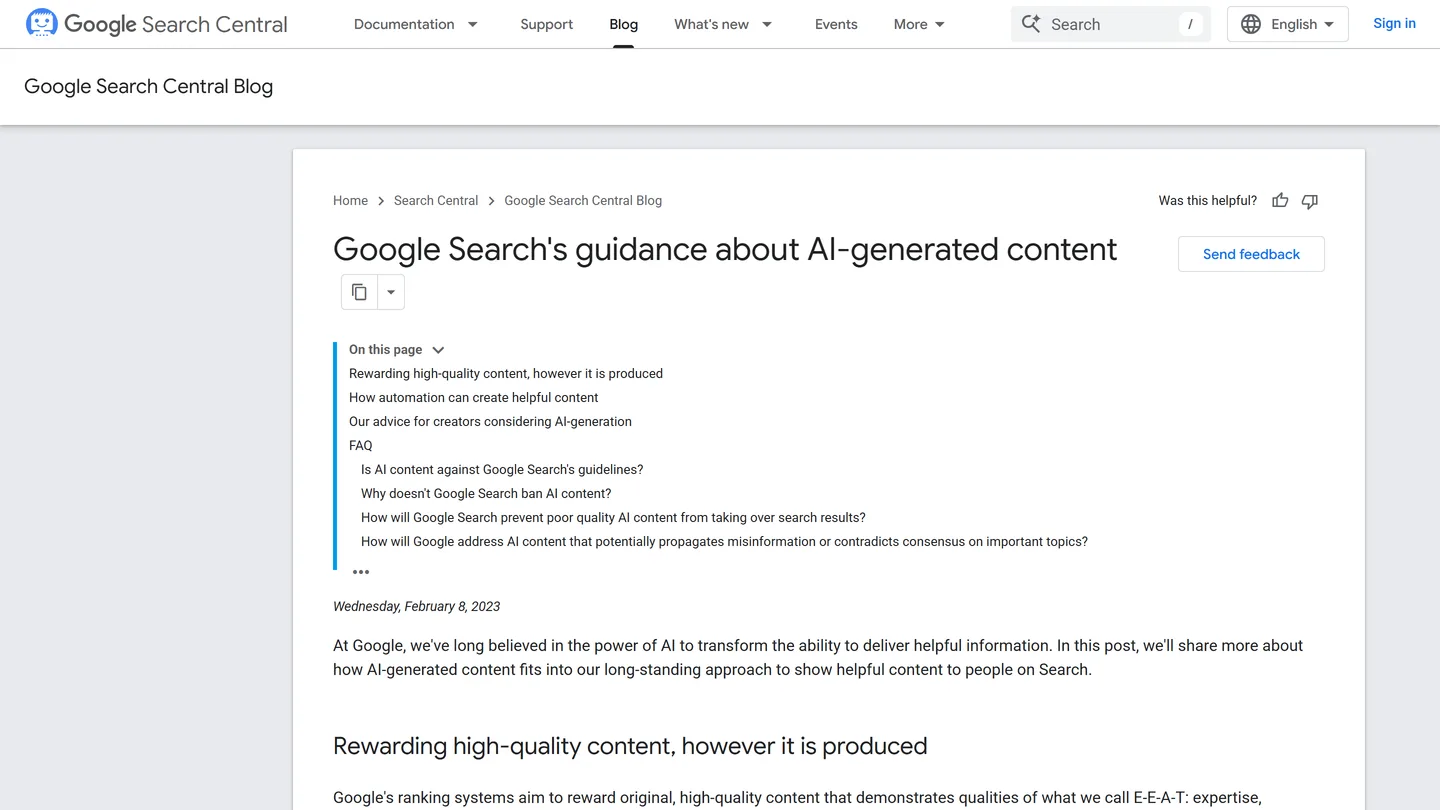
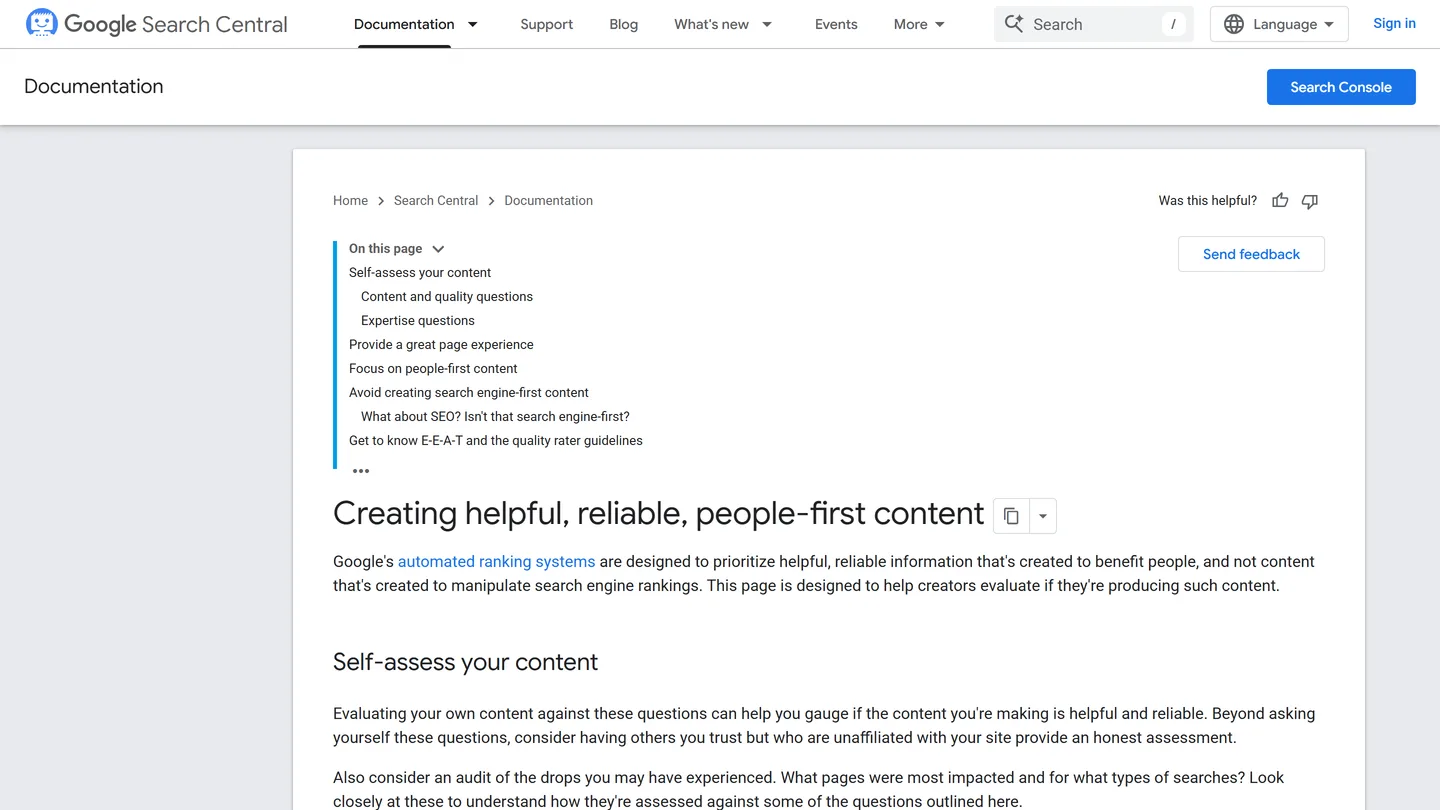
We went and read the primary sources. Google’s spam policy page, the 182-page Search Quality Rater Guidelines, the scaled content abuse announcement, and the peer-reviewed detection literature. The answer is clearer than the discourse suggests, and it moves the work somewhere more useful.
Key takeaways
- Google’s rater guidelines explicitly tell human raters to score pages without determining whether AI was involved. Section 4.6.5 says to rate scaled low-value content Lowest “even if you are unsure of the method of creation”.
- Google’s published AI-content guidance permits appropriate use. Producing pages at scale without adding value can still violate its spam policies.
- 86.5% of top-ranking pages contain some AI-generated text, and the correlation between AI percentage and ranking position is 0.011. Effectively zero, across 600,000 pages.
- AI detectors cannot settle the question either. Seven of them false-flagged non-native English essays at a 61.22% average rate, and paraphrasing drops detection from 70% to under 5%.
- Text watermarks exist now. Gemini has carried one since 2024 and Claude since 14 August 2026. Only the provider that generated the text can read its mark, Google’s Search verification covers images, audio and video, and no ranking use has been published.
- The bar that actually matters is human. Five frequent large language model (LLM) users, voting together, correctly classified 299 of 300 articles. The cue they named was not vocabulary. It was originality.
What Google’s own documents say
Start with the strongest evidence, which almost nobody quotes: the Search Quality Rater Guidelines. These are the instructions Google gives the humans who evaluate search results. Those raters get far more time per page than any crawler does, and they are told not to bother determining origin.
From section 4.6.5 of the 11 September 2025 edition:
“Pages and websites made up of content created at scale with no original content or added value for users, should be rated Lowest, no matter how they are created. Even if you are unsure of the method of creation, e.g. whether or not the page is created using generative AI tools, you should still use the Lowest rating when you strongly suspect scaled content abuse.”
Section 4.6.6 is just as direct: “the use of Generative AI tools alone does not determine the level of effort or Page Quality rating.”
That is a quality-evaluation instruction. A rater can judge scaled low-value content without determining its origin. It does not tell us which internal signals Google’s automated systems use.
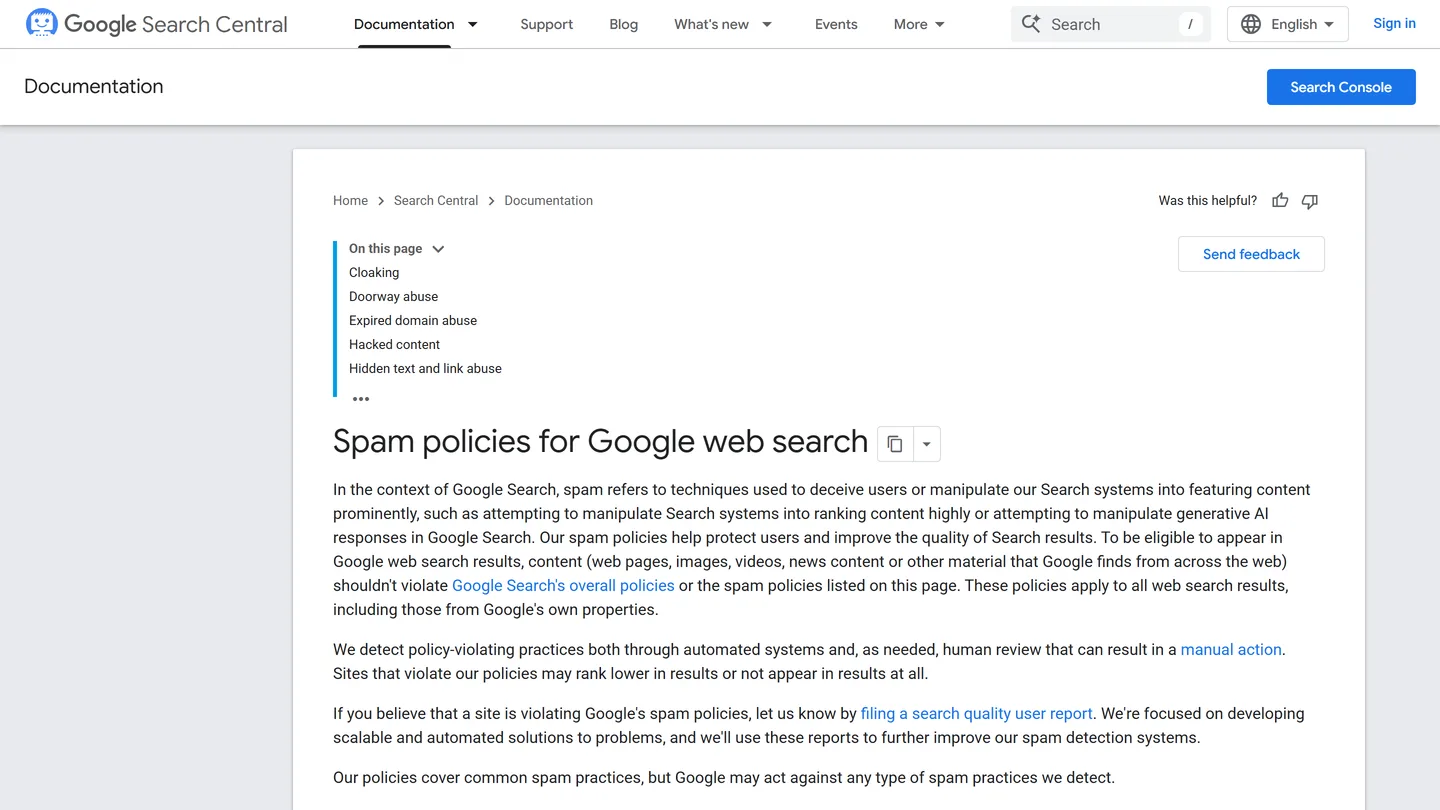
Google’s spam policies address scaled content abuse, cloaking, doorways and other manipulative practices. The scaled-content section includes using generative AI to produce many pages without adding value. Its AI-content guidance distinguishes appropriate use from content generated primarily to manipulate rankings.
Every word before “without adding value” is doing less work than you think. The violation is the scale and the emptiness.
Then there is the March 2024 announcement itself, the one usually cited as the AI crackdown. It says “no matter how it’s created” twice. Google’s own FAQ in the same post explains why the policy was rewritten:
“It’s been expanded to account for more sophisticated scaled content creation methods where it isn’t always clear whether low quality content was created purely through automation.”
That explains why the policy covers abuse regardless of how it was produced. It is not evidence that Google has no detection capability, or that all AI-assisted content will rank.
Rater scores do not touch rankings anyway. Google’s helpful content documentation states plainly that “rater data is not used directly in our ranking algorithms.”
What the ranking data shows
Two large studies, and they disagree. That disagreement turns out to be the most useful finding in this whole area.
| Study | Sample | Result |
|---|---|---|
| Ahrefs, July 2025 | 600,000 pages, top 20, 100,000 keywords | 86.5% of top-ranking pages contain some AI content. Correlation between AI share and position: 0.011 |
| Ahrefs, July 2026 | 1,000,000 pages, 100,000 searches | 5.3% of top-3 results are 100% AI. Mean AI score rises only from 27.1% at position 1 to 30.9% at position 10 |
| Semrush, April 2026 | 42,000 blog pages, GPTZero as detector | Position 1 is 80.5% human, 10% AI. Human content “8x more likely to rank” at #1 |
Pick a side and you are guessing. The two studies used different detectors, different units of measurement, and different corpora. Ahrefs scored pages on a percentage-of-AI-text basis across all top-10 results. Semrush ran GPTZero over blog pages only and took a document-level label.
So the measured share of AI content in search results is largely a function of which detector you point at it. That is a fact about detectors, not about Google.
Ahrefs said as much about their own study: “the way we detect AI content will be different from how Google does.” Their conclusion after a million pages was blunter. “Google is not against AI content; it is against bad content.”
Why detectors cannot settle it
- They fail badly on non-native English. Seven detectors tested against 91 essays from the TOEFL (Test of English as a Foreign Language) exam produced an average 61.22% false positive rate, and all seven unanimously misclassified 19.78% of them. The same detectors were near-perfect on US eighth-grade essays. Published in Patterns by Cell Press.
- They fail broadly. An independent benchmark of 14 tools found every one scored below 80% accuracy, and machine-paraphrased AI text was caught only 26% of the time.
- They collapse under trivial changes. Paraphrasing dropped one detector from 70.3% to 4.6% at a fixed false-positive rate. In a 6.2-million-generation benchmark, two leading detectors went from 100% to near zero just by changing the model’s sampling settings.
- There is a proven ceiling. A paper in Transactions on Machine Learning Research (TMLR) derives a hard bound linking any detector’s best possible accuracy to how much human and machine text distributions overlap. As models get better, that bound tightens for everyone.
- The vendors know. OpenAI withdrew its own classifier in July 2023, publishing a 26% true-positive rate and a 9% false-positive rate. Turnitin’s chief product officer conceded a “higher false positive rate than the company originally asserted” within months of launch.
The linguistic markers detectors lean on are bleeding into human writing. A study of 737,083 hours of unscripted podcast speech across 824,634 episodes (Yakura et al., first posted September 2024) found abrupt post-ChatGPT rises in exactly the words the detectors flag (“delve”, “showcase”, “boast”, “intricacies”, “meticulous”). A detector looking for “delve” in 2026 is partly detecting people who talk to chatbots.
Where text watermarks stand in September 2026
The objection that is replacing “run it through a detector” is “Google watermarks it”, so here is the record as of 13 September 2026.
Google’s SynthID has marked Gemini text since 2024. On 14 August 2026 Anthropic began embedding a SynthID-Text-based watermark in Claude’s output on every surface, the API included, with no opt-out, to meet Article 50 of the EU AI Act. Anthropic’s own description says light editing tends to preserve the mark, a full rewrite removes it, and short passages carry too little signal to detect. OpenAI applies SynthID to images and audio and lists no signal for text.
Three facts keep this out of the ranking conversation. A text watermark can only be read with the key that generated it, and Anthropic’s detector is a private preview for regulators, media and researchers. Google’s SynthID verification in Search and Chrome, announced 19 May 2026, answers “is this AI generated?” for images, audio and video. And Google has published nothing that ties any watermark to ranking; the rater instruction quoted above still tells its own evaluators to judge pages “no matter how they are created”.
What the watermark era changes is how long the advice in the next two sections stays true. A page whose only contribution is a model’s paraphrase will eventually be identifiable as that, with the provider’s cooperation, and the law now requires that cooperation to exist. A page built on numbers, tests and reading that no model produced keeps its value whichever tool typed the sentences.
What actually gets content suppressed
Three things. None of them is authorship.
1. Scale without value. The sites that got deindexed in 2024 shared a shape, and it is recognizable. Hundreds of near-identical URLs in a single directory. People Also Ask questions turned into headings. Stitched fragments that do not cohere. Hidden directories. Anonymous authorship on money-and-your-life topics. One documented case had roughly five million URLs in a directory nobody was meant to find. Publish human-written content in that shape and you get the same result.
2. Decay. A 16-month controlled experiment published 2,000 unedited AI articles across 20 new domains with no links and no updates. 71% got indexed within 36 days, and top-100 presence peaked around 28%. By month three it had collapsed to 3%. No penalty was ever applied. The pages just stopped being worth showing.
3. Readers. This is the real bar and it is higher than any algorithm. Five annotators who use LLMs frequently, voting as a group, correctly classified 299 of 300 articles. They stayed accurate against paraphrasing and against every commercial humanizer tool tested. Asked what they noticed, they named formality, clarity, and originality, not words.
That last one is the whole game, because originality is a property of information rather than of prose. No prompt, no sampling setting, and no editing pass creates a fact that was not already available. If your buyer reads the piece and recognizes it as a competent restatement of the first three results, you have lost on a dimension no tool measures.
What to do instead
Use Google’s published quality and spam guidance to decide what to improve. A commercial detector score cannot tell you whether the article answers the reader’s question well.
Put something in the page that is not already on the web. Proprietary numbers from your own accounts. First-hand testing where you actually ran the thing and recorded what happened. An interview with the person who did the work. Original reading of primary sources, reporting where the popular summary got it wrong. If a piece has none of those, it has a ceiling no amount of polish raises.
Make the evidence easy to check. A 2026 observational study of 21,143 citations found higher average source-influence scores on pages containing statistics, definitions and comparisons. It did not test whether adding those features causes a citation increase. Use a statistic because it answers the reader’s question, and explain where it came from.
Pricing can be useful for the same reason: a buyer needs to know whether an option fits. A separate experiment across six models found strong price and recency preferences in 252,000 trials, but each trial offered exactly two injected, anonymized source documents. That tests first-citation preference between controlled alternatives, not whether a production search engine will discover or cite your site. Publish accurate prices when you can, without turning that result into a promised lift.
Skip the two things that read like effort and are not. Commercial humanizer tools lose a fluency comparison against the un-humanized AI original 74% of the time across 19 tested products, and they introduce hallucinated citations while doing it. And do not run a “make this better” loop on your own draft, because LLM judges systematically over-reward predictable text. Every pass makes the writing sound more machine-made while the critic reports improvement.
The same split applies to the images. A generic render from a three-word prompt reads exactly as cheap as a three-word article prompt, and no filter or upscale rescues it. The craft sits in the brief: name the subject, the light, the lens and the constraint instead of stacking quality adjectives on the end. Our Gemini image prompts and ChatGPT prompts for stunning visuals guides both work that way, and the structure transfers between the two models.
We can measure a version of this on our own domain. In the week to 27 July 2026, ChatGPT’s fetcher made 2,370 requests to strataigize.com against Googlebot’s 1,390. Both of the only two clients this website has ever produced came through AI answers, worth $215,603 together. That happened on pages carrying original data, not on pages carrying clever markup. If the question is whether those answers name your brand, that work is generative engine optimization.
The question was always whether anyone learns anything by reading it, not whether a machine helped write it.
Sources
- Google Search guidance about AI-generated content
- Google Search Quality Rater Guidelines, 11 September 2025
- Google spam policies
- Google, scaled content abuse and the March 2024 core update
- Google, creating helpful content
- Ahrefs, Google doesn’t punish AI content
- Anthropic, how Claude’s text watermarking works, 14 August 2026
- Anthropic Help Center, how Claude marks AI-generated content
- Google, SynthID verification and partners, 19 May 2026
- OpenAI, content provenance documentation
- Semrush, does AI content rank in search
- Liang et al., GPT detectors are biased against non-native English writers, Patterns
- Weber-Wulff et al., Testing of detection tools for AI-generated text
- Sadasivan et al., Can AI-generated text be reliably detected?, TMLR
- Russell, Karpinska & Iyyer, frequent LLM users detect AI text, ACL 2025
- Kobak et al., excess vocabulary in biomedical writing, Science Advances
Talk to us