Build vs Buy AI Agents: A 2026 Decision Rule
Buy the agent when the workflow is generic and someone already sells it. Build it, or have it built, when the workflow is how you compete, when it touches systems no vendor integrates with, or when the data cannot leave your control. MIT's 2025 research found external partnerships succeed 67 percent of the time against 33 percent for pure in-house builds, so the real question is rarely build versus buy. It is build with whom, and against what written success metric.
Most build-versus-buy debates are decided by whoever is in the room. Engineering wants to build. Procurement wants to buy. Neither instinct is wrong, and neither is a decision rule. Here is one that survives contact with a budget.
Key takeaways
- Buy when the workflow is generic. Build when the workflow is the thing you are good at.
- MIT Project NANDA found 95 percent of enterprise GenAI pilots produced no measurable P&L impact, and that vendor partnerships succeeded 67 percent of the time against 33 percent for internal builds.
- The full in-house cost is engineer-months plus permanent maintenance, not a one-time project. Budget the maintenance before you compare anything.
- The middle path wins most often: buy the model and the platform layer, have the workflow-specific agent built, own the prompts and the code.
- Whichever path you pick, the structure is the same: one bounded workflow, a written success metric, an agreed kill threshold.
The decision rule, in one table
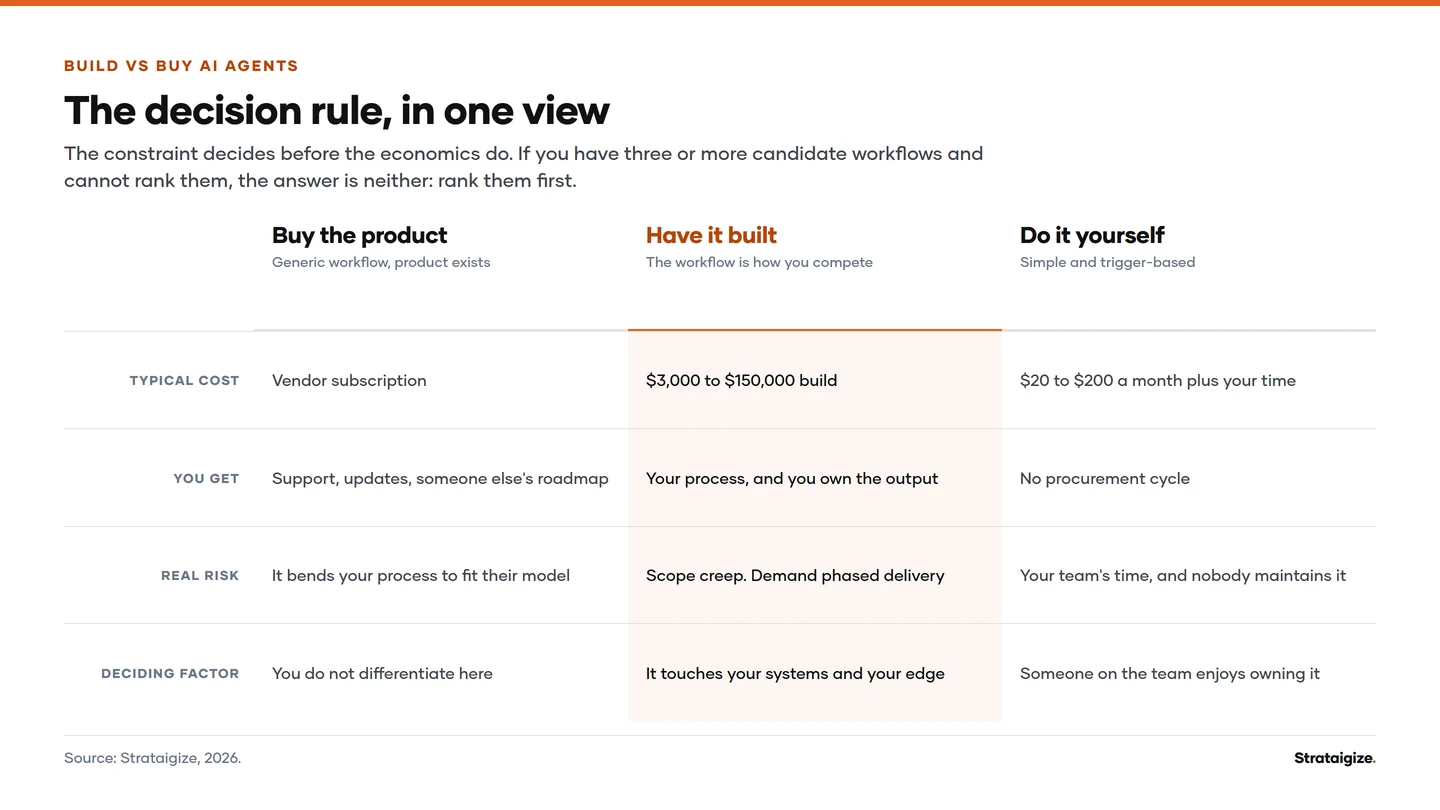
| Situation | The right move | Why |
|---|---|---|
| The workflow is generic and a product already does it | Buy the product | Support, updates, and someone else’s roadmap are worth more than your differentiation here |
| The workflow is how you compete, and it touches your systems | Have it built, and own the output | Nobody sells your process. Vendor products bend it to fit their model |
| The workflow is simple, trigger-based, and someone on the team enjoys owning it | Do it yourself on Zapier, Make, or n8n | $20 to $200 a month plus your time, and no procurement cycle |
| The data cannot leave your control, or the regulator has an opinion | Build, or build with a partner inside your boundary | The constraint decides before the economics do |
| You have three or more candidate workflows and cannot rank them | Neither yet. Rank them first | Building the wrong thing well is the most expensive outcome available |
What the evidence says
MIT’s Project NANDA studied more than 300 publicly disclosed AI initiatives, interviewed 52 executives, and surveyed 153 senior leaders for The GenAI Divide: State of AI in Business 2025. Two findings matter for this decision. The first is famous: 95 percent of pilots delivered no measurable P&L impact. The second is more useful: initiatives run with external vendors succeeded 67 percent of the time, while in-house builds succeeded 33 percent of the time.
That is an argument about focus and pattern exposure. Internal teams are not worse engineers. A team that has shipped fifteen agents has hit the integration failures, the prompt drift, and the month-nine maintenance problem already. A capable internal team hits each one for the first time, on your timeline, while also doing their day job.
Gartner reaches the same place from the other direction. It expects over 40 percent of agentic AI projects to be canceled by the end of 2027, for escalating costs, unclear business value, or inadequate risk controls. All three are a scoping and governance problem that follows you down either path.
The cost comparison nobody runs in full
Buy-side costs are easy to compare because vendors publish them. Build-side costs get underestimated in the same three places every time.
Integration, not intelligence. An agent that reads one inbox and writes to one sheet is a week. An agent that touches your CRM, your calendar, your billing system, and your phone system multiplies authentication, error handling, and breakage surface. Integrations are where the budget goes, on any path.
The data cleanup nobody quoted. If your customer records live in three systems that disagree, the build starts with reconciliation. Internal teams discover this in week two. Good external partners walk your data before they quote.
Permanent maintenance. This is the one that decides the comparison. Model behavior changes, connected tools ship breaking changes, and your process evolves. Plan on 15 to 25 percent of the build cost per year, forever, on either path. In-house, that is a standing claim on an engineer, not a line item you can cut.
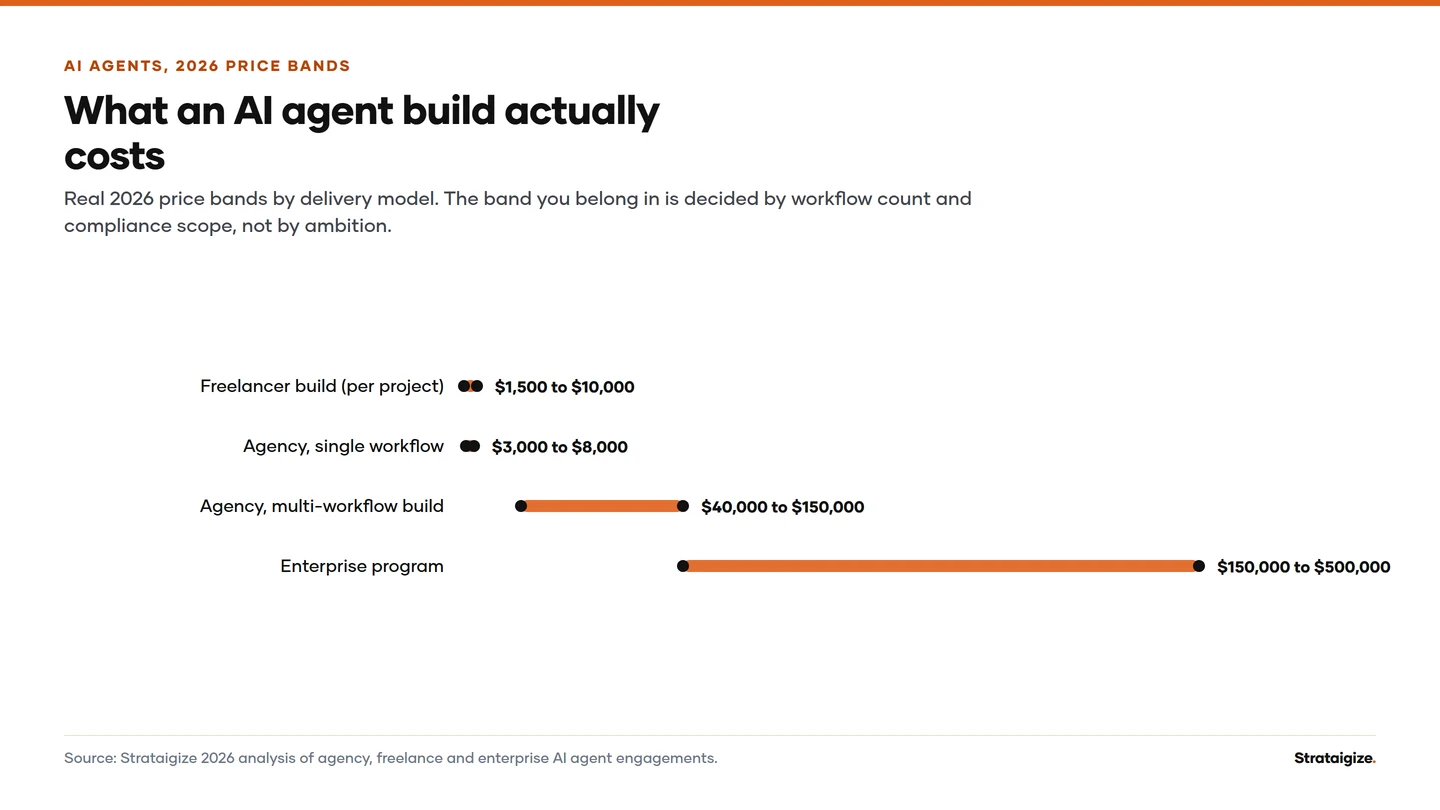
For the outside path, our published AI agent cost bands give you the comparison numbers: $3,000 to $8,000 for a simple single-workflow automation at a small shop, $25,000 to $60,000 fixed for a bounded-workflow pilot with shadow mode and a kill threshold (our own published price), $40,000 to $150,000 for most multi-workflow builds, and $150,000 and up for enterprise programs carrying security review and compliance. Put your internal engineer-months next to those before the debate starts, and include the maintenance year.
Where each path wins
Buying wins when the job is customer support triage, meeting notes, invoice extraction, or any workflow that ten thousand other companies run the same way. You get a roadmap, a support desk, and somebody else’s incident response. Trying to out-build a funded product team on a commodity workflow is a hobby, not a strategy.
Building wins when the workflow encodes your judgment. The pricing exception rule, the intake qualification logic, the way your best operator sequences a renewal conversation. That is not in any product because it is not generic, and it is precisely the part where an agent creates advantage rather than parity.
The hybrid wins most often, and it is what the 67 percent number is really describing. Buy the model access and the platform layer. Have the workflow-specific agent built by people who have done it before. Own the prompts, the code, the configuration, and the evaluation set so you can take it in-house later. That last clause is the one to negotiate hardest; see the ownership questions for the exact wording to ask for.
The five-question version
If you need a decision this week, answer these:
- Does a product already do this workflow well? If yes, buy it.
- Would a competitor gain anything by seeing how we do this step? If yes, do not buy a generic product.
- Can we name the engineer who owns this in month nine? If no, do not build in-house.
- Can the data legally and practically go where the vendor keeps it? If no, the constraint has decided.
- Do we have a written success metric and a number that stops the project? If no, do not start either way.
Question 5 is the one that fails most often, and it is the one that predicts cancellation. It is also the cheapest to fix.
Whichever you choose, run it like a pilot
The structure is identical on both paths: one bounded workflow, run on real data, with a success metric and a kill threshold agreed in writing before anything gets built. That discipline is what separates the 5 percent of pilots that produce measurable value from the 95 percent that do not. We wrote the full structure up in the AI agent pilot that survives procurement, including what your security team will want and what to put in front of them.
FAQs
Is it cheaper to build AI agents in-house?
Rarely, once you count the maintenance year. The build itself can look cheaper because internal engineering time is already on the payroll, but the 15 to 25 percent annual maintenance becomes a permanent claim on a person rather than a renewable line item. Count engineer-months at loaded cost, add the maintenance, then compare.
Can we start by buying and move to building later?
Yes, and it is often the smartest sequence. Buy a product to prove the workflow is worth automating, then build the version that encodes your specifics once you know what those are. Just make sure your data is exportable before you depend on the product.
What about building on Zapier, Make, or n8n ourselves?
Good for simple, trigger-based work at $20 to $200 a month. It stops working when the workflow needs judgment, when it touches four or more systems, or when the person who built it leaves. Those are the three transition signals.
How do we know if our workflow is generic or differentiating?
Ask whether you would be comfortable describing the exact steps to a competitor. If yes, it is generic and you should buy. If the answer makes you hesitate, it is differentiating and it belongs in something you own.
Get a decision on your workflow
We will tell you when to buy a product instead of hiring us, because a build we should not have taken is worse for both of us. Book a growth audit, or see how our AI agent development engagements are scoped and priced.
Talk to us