Custom AI solutions
Eleven AI systems we build, most of them running our own company.
Each one is described the same way: who it is for, what it does, how it is built, what a person still approves, where we run it ourselves, and what it costs. No workshop, no slideware.

The short version
The question every buyer asks and most vendors dodge.
"What would AI actually do for us?" deserves a list. This is the list: eleven systems with a page each, built the same way our own company is run. 9 of the eleven are in production at Strataigize today, and the two that are not say so on their own pages rather than borrowing proof from the others.
If you have not yet decided what to build, start with AI consulting, which is the first two weeks of every build sold as a standalone audit. If you know the workflow, the AI agent development page describes the engagement, and the pages below describe the thing you would get.
The catalogue
Pick the workflow.
Sales and intake
Runs Strataigize today
Lead qualification agents
An AI lead qualification agent reads each inbound lead, enriches it from public sources, scores it against rules your team wrote, and routes or books it. The judgment calls stay with a person. The sorting does not.
Explore →Runs Strataigize today
Outbound sales agents
An AI sales agent finds companies showing they can pay and need what you sell, finds a real decision-maker with a lawfully usable address, and drafts outreach a founder would answer. Sending stays inside the law and inside a daily budget.
Explore →Service and operations
New line, pilot first
Customer support agents
An AI customer service agent answers from your documentation and account data, cites the source for every answer, takes the routine actions your systems allow, and escalates anything irreversible to a person with the whole thread attached.
Explore →Runs Strataigize today
Document processing agents
An AI document processing agent reads invoices, contracts, applications and forms, extracts the fields your process needs, checks them against your rules, writes the record into your system, and sends anything it cannot resolve to a person with the page highlighted.
Explore →Runs Strataigize today
Internal knowledge assistants
An internal knowledge assistant answers questions from your documents, policies, tickets and meeting notes, cites the file and the passage, and says when it does not know. Built for the question a new hire asks three times a day.
Explore →Runs Strataigize today
Always-on operations agents
An always-on operations agent runs the scheduled jobs a business needs done every day, answers the team's questions in Slack, monitors the systems it is responsible for, and keeps a complete record of what it did and why. Ours runs the agency.
Explore →Marketing and growth
Runs Strataigize today
Ad optimization systems
An AI ad optimization system reviews your Meta and Google accounts on a schedule, confirms the date range and attribution window before it judges a number, moves budgets by bounded steps, and escalates anything outside its authority to a person. It runs our client accounts every day.
Explore →Runs Strataigize today
Client reporting automation
A reporting system collects the facts from every platform a client runs on, publishes them to a private page per client behind a login, and sends the interpretation to a person for approval before a client reads it. Facts are autonomous. Judgement is not.
Explore →Runs Strataigize today
Content engines
A content engine picks topics from search and AI-answer demand, drafts under a written standard, fails its own drafts on unverified claims, publishes at a paced cadence, and measures every article to the qualified leads it produced. Volume is capped. The goal is long-term clients.
Explore →Research-led
New line, pilot first
Computer vision systems
Custom computer vision systems, led by our Chief AI Scientist, whose doctoral research showed how much a large pretrained model can do for a new visual task before anyone labels an example. That research is now the way we scope inspection, document, video and measurement systems.
Explore →Runs Strataigize today
MCP servers and agent-callable surfaces
An MCP server, tool API and machine-readable surface let ChatGPT, Claude and the agents your customers use query your catalogue, check availability, get a quote or start a booking, with every tool scoped, rate-limited and logged. We run one for our own business.
Explore →How every one is built
Four rules, no exceptions.
Gartner expects more than 40 percent of agentic AI projects to be cancelled by the end of 2027, for scoping, measurement and governance reasons rather than modelling ones. These four rules are the scoping, the measurement and the governance.
One bounded workflow
A system is scoped to one job with a clear input and a checkable output. The platform, if there is one, comes from stacking workflows that proved out, never from buying it first.
Evaluation before time saved
A hand-labelled set of your real leads, documents, tickets or images is agreed first, and the system is measured against it before anyone claims an hour saved.
A person approves the irreversible
Refunds, sends, budget moves outside bounds, records written to a system of record: each starts behind a human step, and the approval rate decides when the step can move.
Logged and reversible
Every action carries its reasoning and can be undone. Anyone on your team can read why the system did what it did, and revoke its access in minutes.
Who builds them
Research on one side, production on the other.
Every system is signed off by two people: the scientist who decides what a model can and cannot be trusted to do, and the operator who has run bounded automations on live client accounts every day since 2022.


Government and public sector
Mapped to the way departments buy.
Public Services and Procurement Canada buys AI through its Artificial Intelligence Source List, which sorts AI into three categories by business outcome and qualifies suppliers in bands by contract value. Every system here falls in one of the three categories, and our public-sector page covers the rest of what a review will ask: the Directive on Automated Decision-Making, the Algorithmic Impact Assessment, Canadian data residency and a Canadian supplier.
Insights and predictive modelling
ad optimization systems, client reporting automation, computer vision systems
Machine interactions
customer support agents, internal knowledge assistants, mcp servers and agent-callable surfaces
Price
Published, not gated.
Every build starts with a $7,500 AI Opportunity Audit over two weeks, credited toward the build if you proceed. A pilot is one bounded workflow on your real data over 30 to 90 days at $25,000 to $60,000 fixed, with a written success metric and a kill threshold. Running a system in production is a retainer from $8,000 per month, which covers monitoring, maintenance and expansion. Enterprise programs carrying security review and compliance run higher, and the ad optimization system runs inside our paid media retainers.
The full list is on the pricing page. Bring a competitor's quote to the call and we will tell you whether it is fair.
Case studies
The systems that run us, documented.
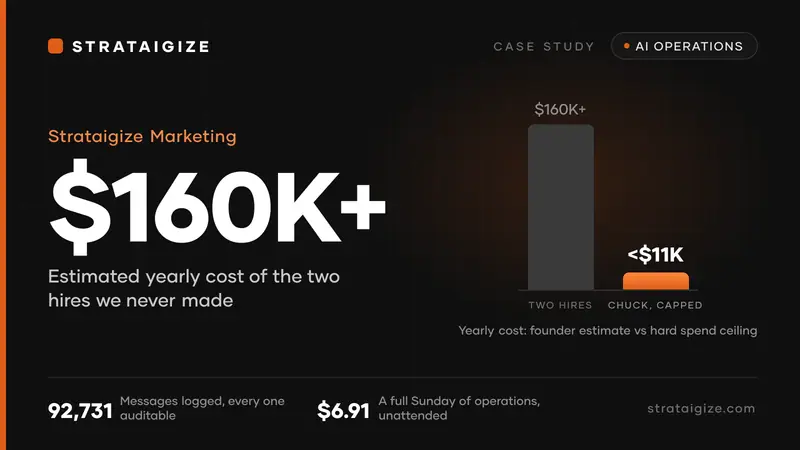
Strataigize Marketing
AI Agents for Business: The Operator Running Our Agency
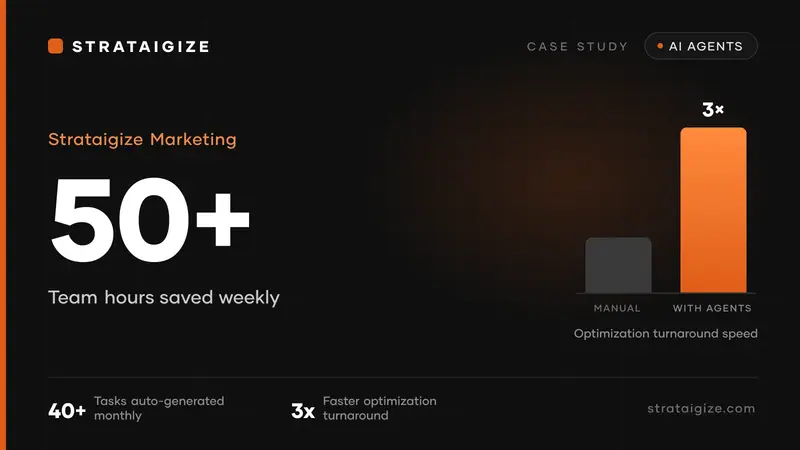
Strataigize Marketing
How Our Marketing Agency Uses AI Agents to Automate Busywork
Questions
Custom AI systems, answered.
What is a custom AI solution?
How do you decide which system to build first?
Do you build on OpenAI, Anthropic or open models?
Teams that hand us the number








Audit $7,500, pilot builds $25K to $60K fixed, production retainer from $8K per month
Real ranges, published. Ad spend stays in your own accounts.
See the full pricing table →Where this fits: see the Strataigize Growth System, the ladder every engagement runs on.
Talk to the build team
Name the workflow you want a system to run and we reply within 24 hours with whether it is a fit, which of the eleven it maps to, and the payback math.
Start with one workflow.
A free 30-minute audit call with the senior team names your highest-value workflow and what it should cost to automate, whether you build it with us or not.
Book your growth audit →Canadian and looking at funding? How the BDC LIFT program works.
Rated 5.0 on Clutch