Top 7 RevenueCat Alternatives for SaaS & App Monetization
RevenueCat alternatives serve different jobs. Adapty, Superwall, Qonversion, and Purchasely focus on mobile subscriptions and in-app experiences. Chargebee and Recurly combine web billing with app-store subscription integrations; Paddle provides merchant-of-record web checkout. Compare purchase flows, entitlements, paywall experiments, migration work, and the revenue each vendor bills on. A lower percentage alone does not tell you whether a platform replaces the features your
What Is RevenueCat and Why Look for Alternatives?
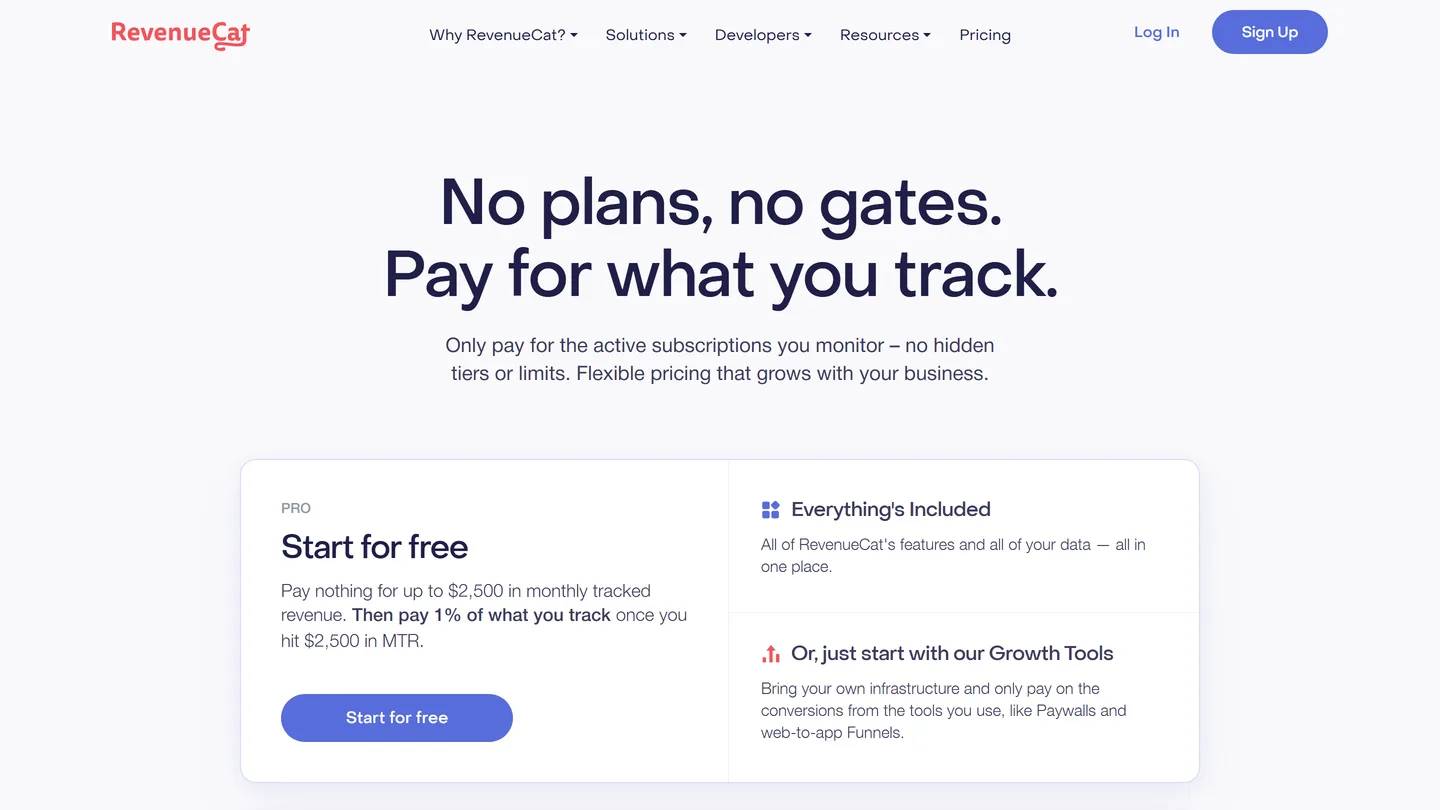
A 1% fee feels small until it compounds. An app tracking $500,000 a month hands RevenueCat $5,000 every month for infrastructure it may have outgrown. RevenueCat is the default subscription plumbing for thousands of mobile apps: it wraps in-app purchases (IAP), receipt validation, entitlements, and subscription analytics into one software development kit (SDK) for iOS and Android. RevenueCat’s pricing is free up to $2,500 in monthly tracked revenue (MTR), after which the Pro plan charges 1% of tracked revenue, with custom Enterprise plans above that (as of August 2026). Keep in mind that MTR is gross store revenue, counted before Apple or Google take
Price is not the only reason to move, and for plenty of teams it is not even the main one. Teams also switch because they need deeper paywall experimentation, more customization, stronger web and SaaS billing, or a merchant of record that handles global sales tax
Consider the key factors when looking
- Pricing model and how it scales with your revenue
- Paywall building and A/B testing depth
- Analytics, attribution, and integration options
- Web, desktop, and cross-platform billing support
- Global payment, tax, and compliance coverage
The right choice depends on where your revenue flows: through the app stores, through the web,
RevenueCat vs. the Alternatives: 2026 Comparison
We compared each platform on the factors that move subscription revenue: mobile IAP support, paywall experimentation depth, and what it costs at
| Tool | Best for | Mobile IAP | Paywalls & A/B testing | Published pricing |
|---|---|---|---|---|
| RevenueCat | Default subscription infrastructure for mobile apps | Yes (unified SDK, receipt validation) | Native paywalls and experiments | Free to $2.5K MTR, then 1% of tracked revenue |
| Adapty | Paywall experimentation and conversion optimization | Yes | Native builder with strong A/B testing | Free under $5K MTR, then 1% of revenue |
| Superwall | Rapid paywall iteration | Yes (infrastructure added in late 2025) | Deepest pure paywall testing | Free to $10K monthly attributed revenue, then usage tiers |
| Qonversion | End-to-end subscription growth stack | Yes | Advanced paywalls and experiments | Free to $10K MTR, then 0.6% to 0.8% of revenue |
| Purchasely | Enterprise in-app journey personalization | Yes | No-code paywalls, onboarding, win-back flows | Quote-based |
| Chargebee | SaaS billing with app-store integrations | App Store and Google Play integration; subscriptions remain store-controlled | Compare mobile purchase and experiment requirements | Flow: $0 + 0.80%, or $99/mo + 0.65% of invoicing volume; add-ons extra |
| Recurly | Recurring billing across web and apps | Store-data sync and entitlements through paid App Management | Compare App Management with a dedicated paywall tool | Starter: $249/mo; 0.9% above $40K monthly volume; App Management extra |
| Paddle | Merchant-of-record billing and tax compliance | No store IAP processing; sells an external web checkout for mobile apps where linking out is allowed | Checkout experiments | 5% + $0.50 per checkout transaction |
Chargebee and Recurly pricing and mobile capabilities were checked against their official documentation on September 5, 2026, and Paddle’s on September 6, 2026. Other rows retain their August checks. Confirm add-ons and the billable revenue definition before comparing
One note before the deep dives: if you are migrating from Glassfy, it is no longer an option. Glassfy ceased operations at the end of 2024 (its own announcement is gone with its domain, but RevenueCat’s August 2024 migration guide records the shutdown, and Adapty and Qonversion published their own guides). We dropped it, along with other stalled tools, from this
Key Features to Consider in Subscription Management Tools
First, consider user interface and ease of use. A complicated interface can slow down operations and impact user experience. A simple, intuitive design is ideal for managing
Next, look at analytics and reporting features. Comprehensive insights help track performance and guide strategic decisions. Strong reporting capabilities allow you to optimize
How cleanly it plugs into what you already run is another key factor. The tool should work with your existing systems and tech stack rather than around them. Flexible integration is what keeps a migration from eating
If you’re tying subscription revenue back to paid acquisition, use this Appsflyer integration guide to improve campaign measurement
Here are some features to
- Analytics and reporting you will actually act on
- Easy user interface
- Flexible integration options
- Custom pricing models
- Global payment support
Whichever tool you use, cross-platform data alignment is critical, our security app case study is a detailed example of what happens when RevenueCat and Google Ads report different purchase signals, and how we fixed it to produce real
Top RevenueCat Alternatives for Mobile App Monetization and SaaS Billing
Effective subscription management is key for SaaS billing platforms too. With the right tools, managing recurring payments stops being a monthly fire drill. Here are the top alternatives to RevenueCat, tailored for mobile app and SaaS
1. Adapty
Adapty stands out for its paywall builder and experimentation speed. You can design, target, and A/B test paywalls remotely without shipping app updates, which is where most subscription revenue gains
In February 2026, Adapty reworked its pricing: the Pro plan is now free under $5,000 in monthly tracked revenue, then 1% of revenue, and the old $99 per month minimum is gone. Enterprise plans
Key features of
- No-code paywall builder with remote configuration
- A/B testing for paywalls and pricing
- Predictive analytics and lifetime value (LTV) forecasting
- Native integration with iOS and Android
If you plan to test paywalls, start from a baseline: our paywall conversion benchmarks show what good numbers look like before
2. Superwall
Superwall is the paywall specialist. It began as an A/B testing layer that sat on top of tools like RevenueCat, then expanded into full subscription infrastructure in late 2025, so you can now run purchases, entitlements, and analytics on
Its pricing is unusual in a good way: Superwall bills on monthly attributed revenue (MAR), meaning only revenue generated through its paywalls counts, and it is free up to $10,000 MAR (as of
Key features of
- Hundreds of templated, remotely editable paywalls
- Granular experiments on price, copy, and design
- Pricing tied to attributed revenue, not all revenue
3. Qonversion
Qonversion offers a full subscription growth stack: infrastructure, no-code paywalls, experiments, and revenue analytics in one place. Integrations with major analytics and attribution platforms keep your acquisition
Qonversion’s pricing is free up to $10,000 MTR, then Starter at 0.6% and Growth at 0.8% of tracked revenue, with custom Enterprise plans (as of August 2026). Those percentages undercut both RevenueCat and Adapty
Key features of
- Easy in-app subscription management
- Real-time revenue tracking and cohort analytics
- A/B experiments for paywalls, prices, and onboarding
4. Purchasely
Purchasely positions itself as an in-app experience platform rather than a billing SDK. Teams at apps like Headspace, Le Monde, and The Times use it to build and test paywalls, onboarding, and win-back journeys
It is the most enterprise-leaning mobile option on this list. Purchasely does not publish pricing; plans are quote-based through a sales demo (as of
Key features of
- No-code paywall, onboarding, and win-back builders
- Audience targeting across the whole user lifecycle
- Enterprise-grade security and compliance
5. Chargebee
Chargebee combines SaaS billing with App Store and Google Play subscription integrations. Its Omnichannel Subscriptions model synchronizes store events into a shared customer view. Apple and Google retain control of the store subscriptions; compare purchase flows and entitlement handling before treating it as a direct
Chargebee Billing Flow offers no fixed monthly fee plus 0.80% of monthly invoicing volume, or $99 per month plus 0.65%, with custom Enterprise pricing. Mobile purchase management and other add-ons can cost extra. These are invoicing-volume fees, so compare their basis with your mobile platform’s tracked-revenue definition (checked September
Key features of
- Multi-currency support
- Custom billing cycles
- An invoicing system that survives complex billing
6. Recurly
Recurly supports recurring billing across web and apps. Its separately priced App Management synchronizes Apple, Google Play, and web subscription data, handles entitlement checks, and centralizes lifecycle notifications. Check the integration and migration requirements against the RevenueCat features your
Recurly Starter costs $249 per month, including the first $40,000 of monthly billing volume, with a 0.9% charge above that allowance. App Management costs extra; larger implementations use custom plans (checked September
Key features of
- Automated billing workflows
- Advanced analytics and reporting
- Support for multiple payment gateways
7. Paddle
Paddle simplifies global sales for SaaS, web, and desktop products by acting as your merchant of record. It handles payments, sales tax, and invoicing under its own entity, so you never have to register for value-added tax (VAT) in dozens
Paddle’s pricing is a flat 5% + $0.50 per checkout transaction (checked September 6, 2026). It does not process App Store or Google Play in-app purchases; what it now sells to app developers is an external web checkout for markets where apps may link out to third-party payment, which makes it a complement to a mobile IAP stack rather than
Key features of
- Integrated payment processing
- Comprehensive tax management as merchant of record
- Subscription billing for web and desktop, handled end to end
How to Choose the Right Subscription Management Platform
Start with where your revenue lives. For mobile subscriptions and paywall experiments, compare the mobile-focused tools against RevenueCat. If you also need web billing and a shared view of store subscriptions, investigate Chargebee and Recurly’s app integrations. Evaluate Paddle separately when merchant-of-record web checkout is
Then evaluate platforms on specific criteria. Look at ease of use, scalability, and customer support. Ensure the platform aligns with your
Key factors
- Feature compatibility with your app
- Integration with existing tools
- Pricing model and effective cost at your revenue level
- Support for global currencies, taxes, and payments
Before you commit to any platform’s fees, know your own unit economics. Our free calculator for customer acquisition cost (CAC) and the LTV to CAC ratio takes four numbers and shows whether your subscription funnel clears the 3:1 bar those fees have to
FAQ
Is RevenueCat free to use?
Yes, in any month you stay under the line. You pay nothing in a month where tracked revenue does not reach $2,500. Cross it and the Pro plan bills 1% of your full monthly tracked revenue, not 1% of the amount above the threshold: RevenueCat’s own billing documentation works the example, where $2,600 in a billing period produces a $26 charge (RevenueCat account management). Because tracked revenue is measured before store commissions, model the effective fee against your net revenue
Is Glassfy still a RevenueCat alternative?
No. Glassfy announced in mid-2024 that it was ceasing operations by the end of 2024, and the glassfy.io domain no longer resolves to the company (as of September 6, 2026 it redirects to an unrelated site). RevenueCat’s migration guide (August 2024), Adapty’s, and Qonversion’s all document the shutdown and the migration paths, which is where former Glassfy customers
Which RevenueCat alternative is best for paywall A/B testing?
Adapty and Superwall are the two strongest options. Superwall is the deepest pure paywall experimentation tool and only bills on revenue its paywalls generate, while Adapty pairs strong testing with broader analytics and
Can Chargebee, Recurly, or Paddle replace RevenueCat for a mobile app?
Chargebee and Recurly offer app-store subscription integrations, but neither should be assumed to replace every RevenueCat feature. Check purchase flows, entitlements, experiments, and migration requirements. Recurly App Management costs extra. Paddle serves a different role as a merchant of record for
What to Weigh Against the Fee
A percentage of revenue is easy to compare and easy to over-weight. The better question is what the platform hands back for it: paywall tests you will run, analytics your team will open, billing that reaches every place your money arrives, and support that answers when receipt
The cheapest percentage is not automatically the cheapest platform. Run your shortlist against your own revenue mix before you migrate, because flexibility, integration, and reliable support are what you feel every week after the switch, and none of the three show up in a
Know what you are optimizing for before you shortlist. Once that is written down, the choice between these seven usually
If you want hands-on help connecting acquisition, attribution, and subscription growth, explore our mobile app marketing services. Subscription apps have their own industry page: subscription app marketing.
Talk