The Word “Map” Attracts the Wrong Buyer
Backroad Mapbooks is Canada’s most trusted source for adventure and backcountry maps, covering everything from hiking and fishing hotspots to all-terrain vehicle (ATV) trails, topographic maps, and GPS-compatible backroads guides. Decades of loyal fans meant brand recognition was never the problem. Reaching new buyers was, because the searches those buyers use sit in a category cluttered with queries that have nothing to do with the product.
The Adventure-Based ad group launched into a search category where the word “map” can mean anything from navigation apps to downloadable PDFs to educational tools. Three core challenges defined the early phase: the keyword universe for “maps” is enormous and largely unqualified; seasonal and regional specificity (British Columbia, Alberta, Ontario, Vancouver Island) meant broad-match keywords required constant supervision; and the campaign had to serve a dual purpose, driving direct sales of physical mapbooks and building awareness for the online maps app.
If you sell into a category with a common word in its name, you already know this problem. Half the traffic you pay for was never yours.
Blocking the Wrong Searches Did the Heavy Lifting
We ran the Adventure-Based Keywords ad group as a living system, tended weekly. The strategy unfolded in three phases across Q1 2026, each building on the last.
1. Keyword architecture: casting the right net. The campaign launched with a carefully constructed portfolio targeting buyers already in-market for Canadian adventure maps. We went after intent instead of volume: activity-specific map terms, brand and product terms, and regional and destination terms. Branded terms were included to capture high-intent searchers and protect search real estate, and they turned out to have some of the highest click-through rates in the campaign, up to a 47.64% CTR.
2. Negative keyword management: filtering out irrelevant traffic. The single most useful action was an aggressive, systematic negative-keyword build-out: academic and educational queries, navigation tools, free-content and discount seekers, competing marketplaces, off-season activity terms, and geographic irrelevance, all blocked proactively and refined as real search-term data accumulated. As the campaign matured, broad-match exclusions were upgraded to phrase and exact match, tightening control without over-excluding.
That list is the part worth copying. Most accounts have a keyword plan and no exclusion plan, and the exclusion plan is what decides how much of your budget reaches a buyer.
3. Active keyword testing and rotation. The campaign was never static. Keywords were enabled, paused, added, and removed based on real performance signals throughout the quarter, preventing budget from pooling in underperformers and giving high-potential keywords room to prove themselves.
4. Ad creative aligned to buyer intent. Creative was treated as a conversion lever. The winning Responsive Search Ad spoke directly to the transactional intent of someone searching for Canadian adventure maps. It named the full range of outdoor pursuits and presented the brand as the Canadian source for serious outdoor adventurers.
364% Return on Ad Spend in Q1 2026
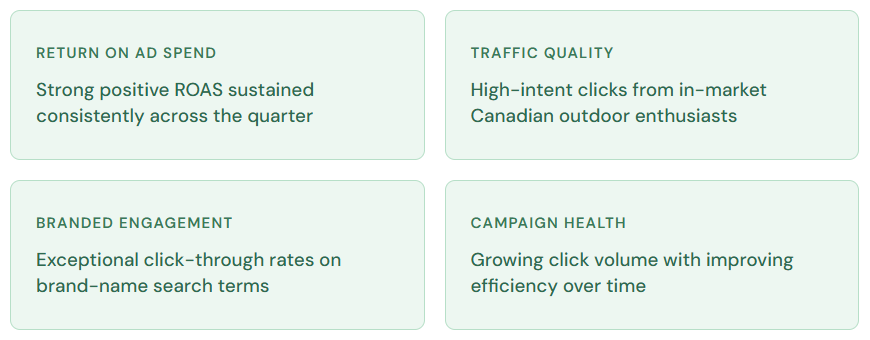
The Adventure-Based Keywords ad group delivered across Q1 2026. Activity-specific keywords attracted qualified traffic. The negative-keyword work improved traffic quality steadily over the quarter, and the creative refresh matched the message to what buyers were after.
The account-level picture is the one the homepage quotes. Across the six months from November 2025 to May 2026, paid revenue ran 107% above the same months a year earlier and paid orders ran 124% above, measured across every paid channel we manage for Backroad Mapbooks in our six-month report to the client. The ad group above is one engine inside that number.
The campaign also surfaced a clear buyer profile: an established outdoor enthusiast, predominantly male, mobile-first, and engaged across weekdays and weekends, a high-value segment that responds well to specific, activity-relevant messaging and a trusted Canadian brand. That profile is a result in its own right. It tells the next campaign who to talk to before a dollar is spent.
“The Adventure-Based Keywords ad group is one of the clearest examples of what disciplined paid search management looks like in practice. We built the keyword architecture with intent at the center, and the 364% ROAS is a direct result of that. Every negative keyword added, every creative refresh, every keyword rotation was a deliberate decision.”
Abbey Dela Cruz, Strategic Director, Strataigize
Treat Negative Keywords as Half the Job
This is what happens when Google Ads gets managed as a discipline. Intent-first keyword architecture, relentless negative-keyword management, active creative testing, and data-led optimization together built a clean traffic stream to the Backroad Mapbooks store.
Three principles carried it, and all three transfer. Branded terms deserve their own budget and attention. Negative keywords matter as much as positive ones. And iteration is the strategy, so a campaign nobody has touched in a month is a campaign that is drifting. If you open your own search-terms report this week and cannot fill a page with exclusions, you have not looked hard enough. The commercial page is Google Ads.