Why We Test Emerging Channels Before They're Obvious
Emerging marketing channels are cheapest and least competitive right before they go mainstream, and the brands that test early compound an advantage that is expensive to catch later. Our Innovation Lab continuously pilots new platforms, ad units, and AI tools, measures them against real outcomes, and operationalizes the winners. The point is not novelty for its own sake. It is owning a channel, and the cheap attention inside it, before your competitors notice
Almost everyone arrives at a new marketing channel at the wrong moment: after the case studies, after the conference talks, after the channel is “proven,” which is precisely when it stops being cheap. This page is the argument for arriving earlier, with the history that proves the pattern and a 30-day pilot method you can
The pattern: every channel is cheapest before it’s obvious
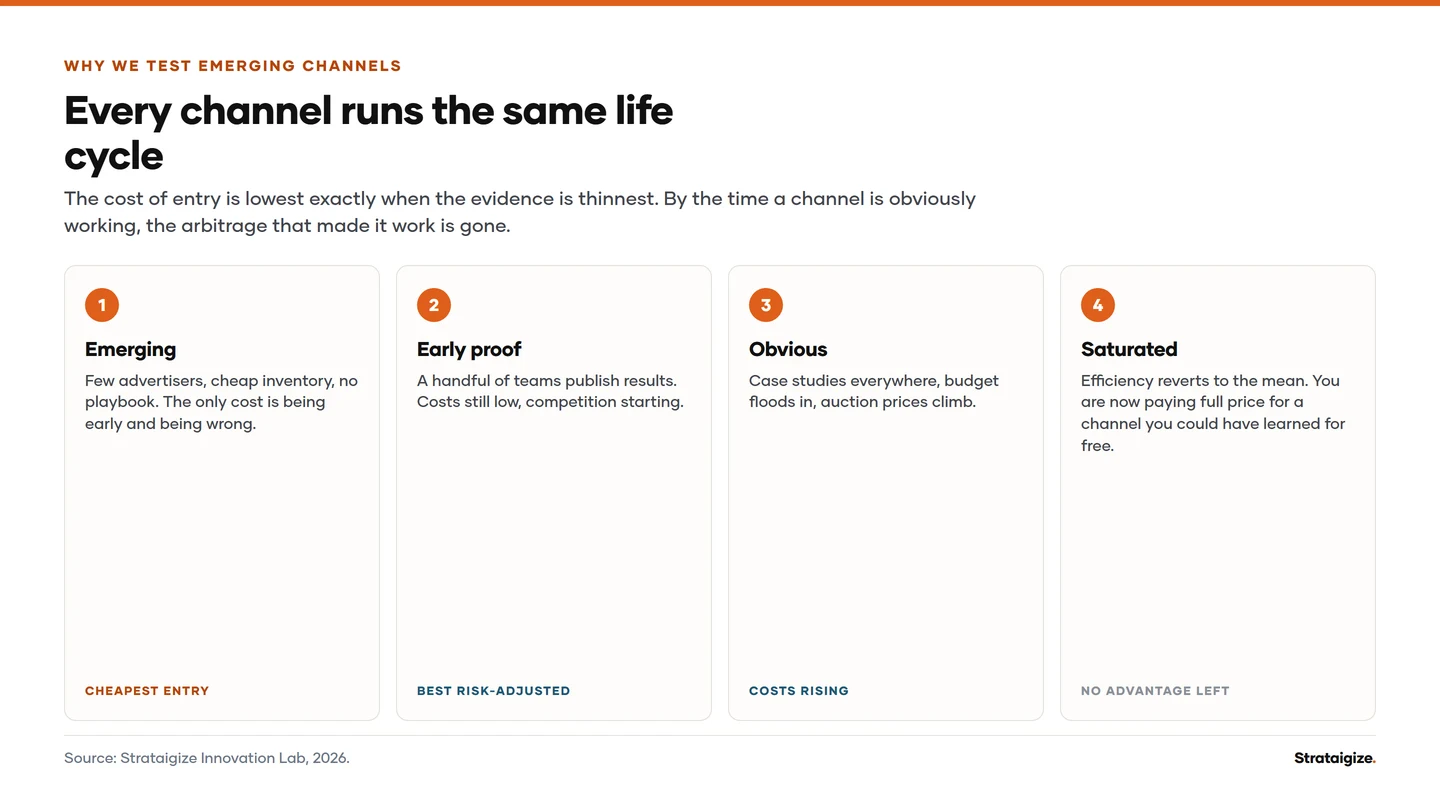
The single most reliable pattern in performance marketing is that a channel’s cost is lowest when its competition is thinnest, which is always early. This is the history of the entire industry
Google Ads in 2003, Facebook Ads in 2008, TikTok Ads in 2019: in every case, the advertisers who showed up early paid a fraction of the eventual equilibrium price and built an edge that compounded, per analysis of digital advertising history. Early Google cost-per-click prices were a sliver of what they became. Early Facebook reach was almost free relative to today. New platforms like Threads opened at $2 to $5 per thousand impressions simply because few advertisers
The reason is mechanical, not magical. When a channel is new, demand is low and inventory is abundant, so attention is cheap. The marketers who move then are simply earlier, and earlier is a strategy you can choose. The discomfort of being early, the unproven metrics, the missing playbook, is the exact thing that keeps your competitors out and keeps the attention cheap
Why the early window closes
Global social media CPMs climbed roughly 35 to 45% between 2020 and 2024 as advertiser demand intensified, and platforms that were once bargains now price like utilities. That is the whole mechanism in one number: more advertisers show up and bid the price up, and every channel that gets “discovered” follows the same arc from cheap and weird to expensive and crowded. As TikTok matured, its CPM patterns began to mirror Meta’s, the same convergence every maturing channel shows. More bidders chasing the same impressions automatically pushes costs up, and there is no version of the future where a popular channel
That is why “wait until it’s proven” is such an expensive instinct. By the time a channel is unambiguously proven, the proof itself has attracted the crowd that erased the margin. Waiting traded the risk of being early for the certainty of paying more. The window closes the moment everyone agrees it
What’s emerging right now in 2026
Right now, the cheap-attention frontiers are AI search, retail media, and connected TV, all channels that barely existed five years ago. These are the 2026 equivalents of early Facebook, and the early-mover math is
AI search is the headline. OpenAI launched ChatGPT Ads on February 9, 2026, the first new advertising category since social media. A company spokesperson told Reuters it crossed a $100 million annualized run rate within six weeks, and by August 31, 2026, under 200 days after launch, Digiday and then Sensor Tower reported the business had passed a $1 billion annualized run rate (roughly $83 million a month multiplied by twelve) as it expanded across 31 European markets. That is the same shape as Google Ads between 2002 and 2005, when costs were a fraction of where the auction settled, and it is our comparison, not a published one. Retail media is the fastest-growing channel at about $62 billion globally in 2026, prized for closed-loop attribution that ties ad to purchase. And connected TV reached $33.5 billion in the US, up 28% year over year, outpacing every established digital channel, according to Digital Applied’s 2026 statistics roundup.
The pattern holds: each of these is still learning its auction dynamics, still under-competed relative to where it is heading, and that is the window. The brands testing them now are buying skills and position at a discount that will
How our Innovation Lab works
Our Innovation Lab is a disciplined process, not a hobby, which is the only thing that separates testing emerging channels from gambling on them. The structure is deliberately repeatable: pilot, measure,
We pilot new platforms, ad units, and AI tools in small, controlled tests, sized so a failure is cheap and a win is legible. We measure every pilot against real outcomes, leads, revenue, qualified pipeline, not vanity engagement, because a channel that produces likes and no customers is a trap dressed as an opportunity. We operationalize only the winners, building the repeatable playbook for the ones that clear the bar. And we document everything, so the knowledge becomes a durable asset and the next test starts smarter than the last. You can read more about that mindset on our Innovation Lab page.
The discipline is what makes early testing safe. Because each pilot is small and measured, we can afford to be wrong often, which is the price of being right early. Most experiments do not graduate. The few that do pay for all the ones that did not. And the discipline shows up as much in what we decline as in what we test: plenty of emerging channels are bad fits or too immature to measure, and walking away from those, on data rather than vibes, is half
How we proved it on ourselves
We ran the play on our own business, and it worked. When AI search began citing brands inside answers, we treated it as exactly the kind of early, under-competed channel the lab is built for, and we moved before it
The result: a late-2025 push on the previous site, published 2025-12-10, took ChatGPT-attributed sessions from 38 to 474, with real attributed leads from AI engines. The full breakdown is in our AI-SEO case study, and that early bet is now a managed Generative Engine Optimization (GEO) service we run for clients, with a foundational explainer on how GEO works for anyone starting out. We were early to AI search for the same reason we will be early to the next one, because the advantage is in
How to run your own channel pilot in 30 days
Testing a channel well takes discipline and a small budget, so here is the whole method on one page. The goal is a test small enough that being wrong is cheap and structured enough that being right
Start by picking exactly one channel, the one with a real, growing audience and a visible early-mover cost gap, and resist the urge to test three at once. Set a hard budget cap that would not hurt if you lost it entirely, the cost of a nice dinner out, not a chunk of the quarter, because the early test is for learning. Then define a single success metric tied to revenue before you spend a dollar: a qualified lead, a booked call, a sale, never impressions or follow count, which are the vanity numbers that make dud channels
Run it small and controlled for two to four weeks, long enough for signal, short enough to stay cheap, and do not touch the budget mid-flight chasing an early spike. When the window closes, let the data make the call. If it cleared your revenue bar, write down exactly what worked and scale deliberately. If it did not, write down why and kill it without sentiment. Either way you walk away with documented knowledge, which is the real output of every pilot, win
Repeat that loop a few times a year and you build something most competitors never will, a standing habit of finding cheap attention early, on purpose, before the crowd arrives and prices
Common mistakes operators make with emerging channels
“Show me the case studies first” feels prudent and is quietly the most expensive position in marketing: waiting for a channel to be proven guarantees you arrive after the cheap attention
The others compound it. Testing without a real measurement bar, so you cannot tell a genuine winner from novelty and either scale a dud or kill a gem. Going all-in on an unproven channel instead of piloting small, turning a smart early test into a reckless bet. Chasing every new platform indiscriminately, which is just a more expensive way to lack focus. And failing to document, so each experiment starts from zero and the organization never compounds what it learns. Early plus undisciplined is a faster way to
Frequently asked questions
Isn’t testing unproven channels risky?
Testing them carelessly is. Testing them in small, measured pilots is the opposite, it is how you cap downside while keeping access to the biggest upside in marketing, cheap early attention. The real risk is waiting until a channel is proven and paying the
Can we run our own innovation testing in-house?
The mindset is learnable: pilot small, measure against revenue, document, scale only winners. The hard part is the discipline to keep tests small and honest, and the bandwidth to monitor many channels at once, which is exactly the work a dedicated lab is built
Talk