Google Play External Payments and Fee Changes (2026)
As of September 6, 2026, Google Play has split its old commission into a service fee plus a separate 5% billing fee across the US, UK, and EEA, effective June 30, 2026. Auto-renewing subscriptions pay a 10% service fee on every payment route. Non-recurring purchases pay 20% from users who installed on or after June 30 and 25% from users who installed before it, which makes acquisition date a permanent input to lifetime value. Google's US external-links and alternative-billing service fees, and the transaction and download reporting that goes with them, start on October 1, 2026 under Google's July 22, 2026 update.
Most coverage of the Google Play changes is either a legal recap or a headline about the 30% cut dying. Neither tells you what to change in your model. We run paid user acquisition (UA) against these economics, so this is the version for publishers and growth teams: what is confirmed as of September 6, 2026, what the fee math actually works out to, and what breaks in your lifetime value (LTV) assumptions if you leave them alone.
Correction, September 6, 2026. The first version of this article (August 1) said the widely cited “October 1, 2026” start date for US external-payment fees and reporting was not on any Google page and that Google’s documentation said the opposite. That was true of the pages we read on August 1. Google’s program pages now state, citing a July 22, 2026 update, that enrolled developers must report transactions and downloads and pay the service fee from October 1, 2026. The October section and the calendar below reflect the current pages.
Key takeaways
- Google separated the service fee from the billing fee on June 30, 2026 in the US, the UK, and the European Economic Area (EEA). Using Google Play Billing now adds a 5% billing fee on top of the service fee (Google Play Help).
- Auto-renewing subscriptions are 10% service fee on every route, so a subscription app that leaves Play Billing saves the 5% billing fee and nothing more.
- Non-recurring purchases split by cohort: 20% from installs on or after June 30, 2026, and 25% from installs before it. Newer users are now cheaper to monetize than legacy users, which inverts a common LTV assumption.
- Third-party US app stores got your Play listing on July 22, 2026 by default, but downloads still complete through Google Play and Play’s service fee still applies. It is a discovery change, not a monetization change.
- The US external content links and alternative billing programs switch their fees on October 1, 2026. Google’s program pages now say enrolled developers must report transactions and successful downloads and pay the relevant service fee from that date (external content links, US alternative billing).
What actually changed, and when
Four separate things happened, and conflating them is where most analysis goes wrong. Two are court-driven anti-steering changes, one is a voluntary business-model change, and one is a distribution change.
The court track starts with Epic. On September 12, 2025 the Ninth Circuit upheld the injunction entered by a US District Court, and to comply by October 29, 2025 Google stopped prohibiting developers from telling US users about outside pricing, stopped prohibiting links to outside downloads and transactions, and stopped requiring Google Play Billing (Google Play Help). On December 9, 2025 Google launched the programs that operationalize that: the external content links program and expanded alternative billing for US users, with a January 28, 2026 deadline to be enrolled if you were already linking out (policy announcement).
Then the settlement track. On March 4, 2026 Google entered a new settlement agreement with Epic and the parties asked the court to enter a revised Modified Injunction (Google Play Help). The business model changes announced that day are what actually landed on June 30, 2026, and they are the ones that change your spreadsheet.
The fee math, before and after
The structural change is that one commission became two charges. Google now bills a service fee on every transaction regardless of how the money is collected, plus a billing fee of 5% in the US, UK, and EEA only when the transaction runs through Google Play Billing (Google Play Help). Alternative billing and external web links do not carry the billing fee, but you then pay your own processor.
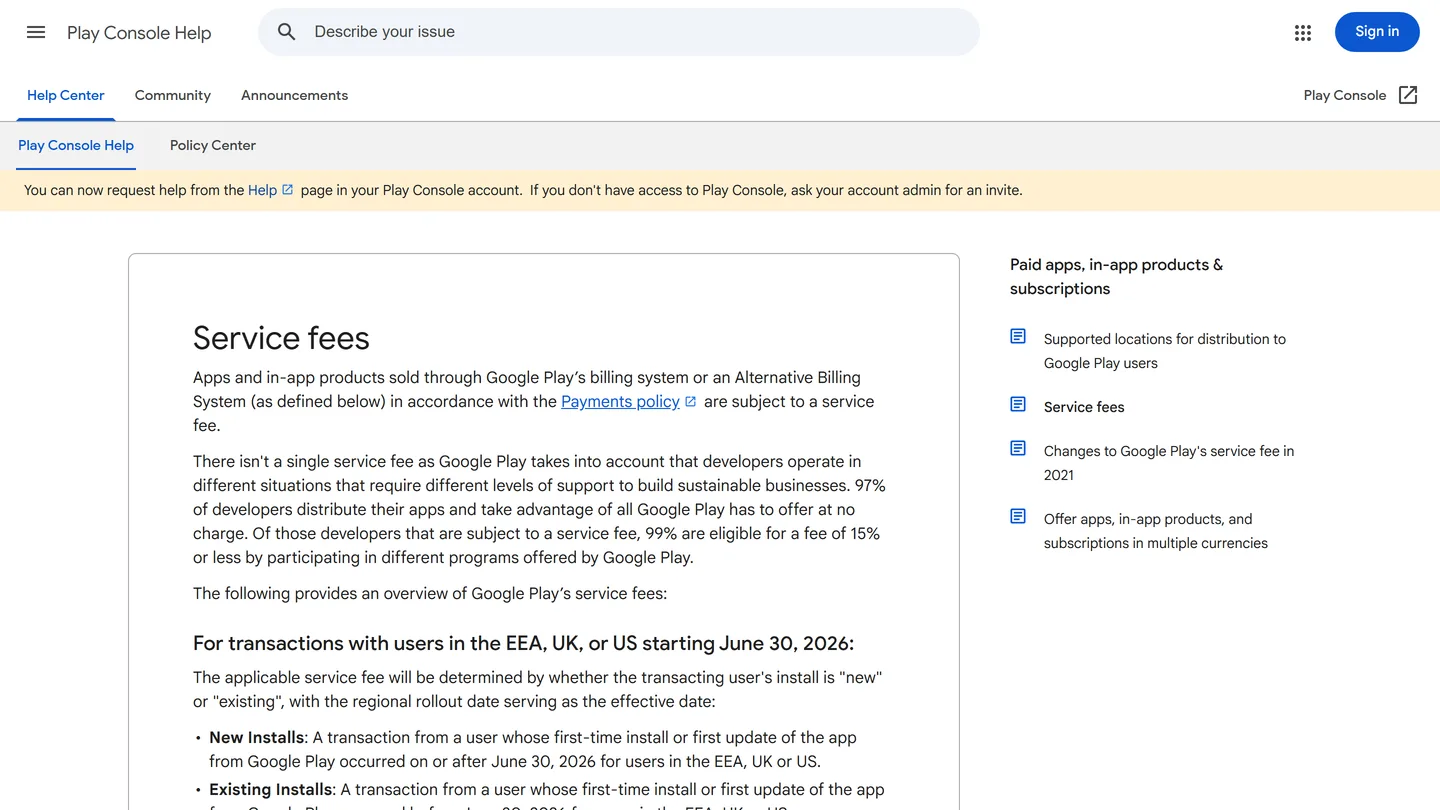
The service fee also depends on when the user installed. Google defines a new install as a user whose first install, or first update from Play if the app did not come from Play, happened on or after the rollout date in their region. That date is June 30, 2026 for the US, UK, and EEA.
Here is what a publisher over the $1M annual threshold pays on standard rates:
| Transaction | Route | New install (on or after Jun 30, 2026) | Existing install (before Jun 30, 2026) |
|---|---|---|---|
| Auto-renewing subscription | Google Play Billing | 10% + 5% = 15% | 10% + 5% = 15% |
| Auto-renewing subscription | Alternative billing or external web link | 10% | 10% |
| Non-recurring in-app purchase | Google Play Billing | 20% + 5% = 25% | 25% + 5% = 30% |
| Non-recurring in-app purchase | Alternative billing | 20% | 25% |
| Non-recurring purchase | External web link | 20% | 20% |
| Initial paid app purchase | Play Store | 20% + 5% = 25% | 25% + 5% = 30% |
All rates from Understanding Google Play’s lower service fees. Your first $1M in annual earnings is charged at a 10% service fee across every row, plus the billing fee where it applies.
Work it through on $100
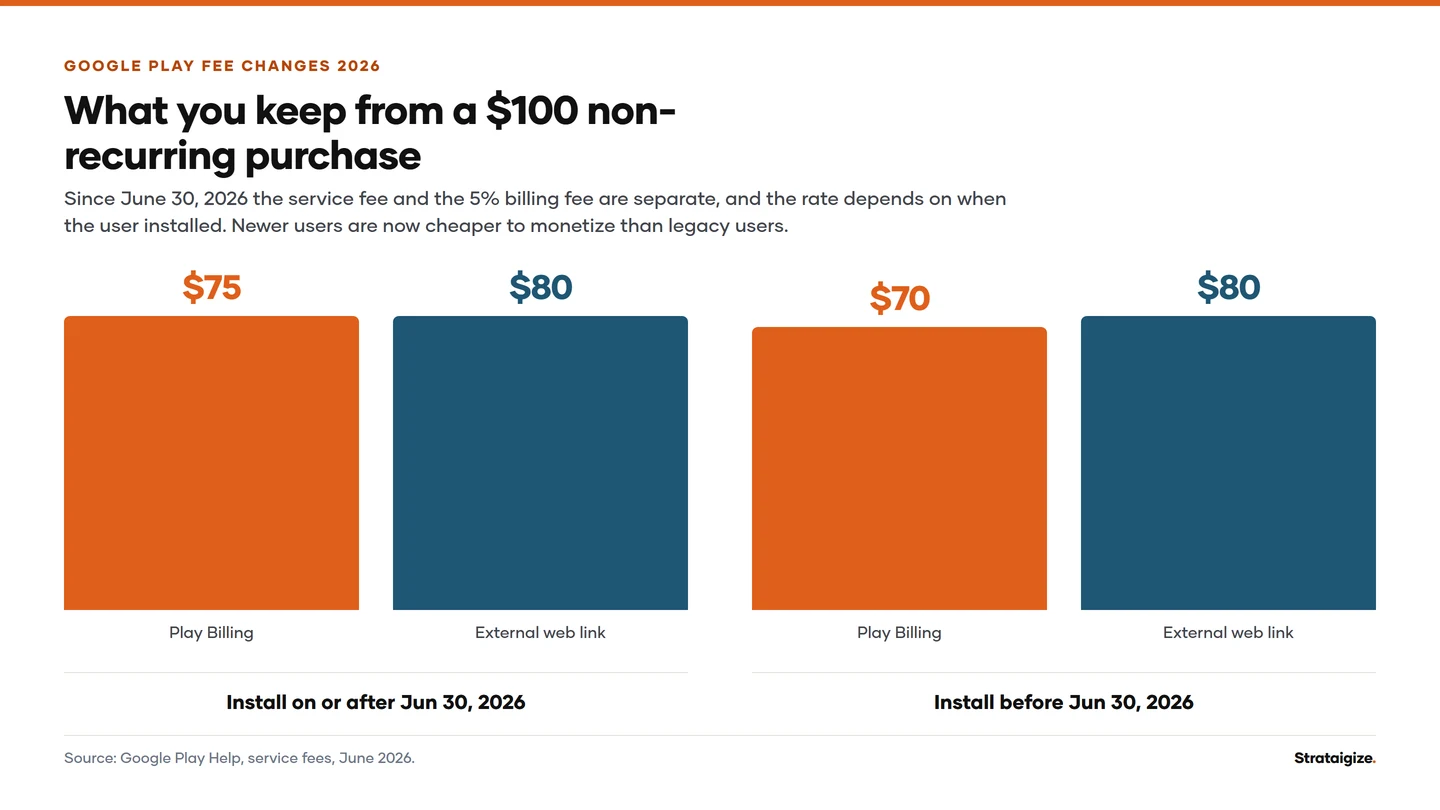
Take a $100 non-recurring purchase, a coin pack, from a user who installed in 2024, at standard rates:
- Google Play Billing: 25% service + 5% billing, you keep $70
- Alternative billing in-app: 25% service, you keep $75 before your own processing costs
- External web link: 20% service, you keep $80 before your own processing costs
That 10 point spread between Play Billing and an external web link is the single biggest number on the board, and it exists only for non-recurring purchases from users who installed before June 30, 2026.
Now the same $100 coin pack from a user who installed last week:
- Google Play Billing: 20% + 5%, you keep $75
- External web link: 20%, you keep $80
The spread collapses to 5 points, because the new-install service fee is the same 20% either way. And on a $100 annual subscription, any route, any cohort, the spread is also 5 points: 15% through Play Billing, 10% outside it.
So for most publishers, you are playing for 5 points, not 20. Five points is the billing fee, and you only keep it if your true all-in cost of collecting money yourself, meaning processing, chargebacks, refunds, US sales tax compliance, and the support load, comes in under 5%. For a subscription business under the $1M threshold, that is a tight race. The 10 point prize exists only on non-recurring revenue from your legacy install base.
The lower rates almost nobody is planning for
Google is also opening two programs that cut the non-recurring service fee by a further 5 points: the revamped Games Level Up and the new Apps Experience program. Participating developers get 15% on new installs and 20% on existing installs for non-recurring transactions (Google Play Help). The program rate cards become available on September 30, 2026 in Australia (AU), the EEA, Japan (JP), the UK, and the US, with Korea following on December 31, 2026 (Android Developers Blog, June 24, 2026, regional schedule).
For a non-recurring-heavy app, that 5 points is the same size as the external-link prize on new installs, and you get it without building a payments stack, taking on chargebacks, or breaking your attribution. It deserves at least as much of your September as the link-out question does.
The October 1 date: now confirmed by Google
Developers in the US external content links and alternative billing programs must begin reporting transactions and paying service fees on October 1, 2026. When we checked on August 1, 2026, Google’s pages said the fees were not being assessed and reporting was not required, and we said so. The pages have since changed.
Here is what Google’s own pages say as of September 6, 2026:
- The external content links program page states: “Per the July 22, 2026 update, developers enrolled in this program must report transactions and successful downloads, as well as pay the relevant Play service fee, starting October 1, 2026.”
- The US alternative billing page carries the same October 1, 2026 language for that program.
- The billing choice program FAQ still says “there are no changes to the US programs at this time” but defers to those two program pages, which carry the date. Where the pages disagree, the program page you enrolled under is the one Google will bill against.
So treat October 1 as confirmed and plan for it as a line item, not a contingency. Reporting runs through the external links and alternative billing APIs, and the first fee period starts with October transactions.
For the record, the US rates that switch on are: 10% on auto-renewing subscriptions and 20% on other in-app digital purchases for external content links, 10% and 25% respectively for US alternative billing, with the first $1M of annual earnings at 10% in both. External content links also carry a fixed fee per app download event, $3.65 for games and $2.85 for apps, applied to installs completed within 24 hours of following the link.
Third-party app stores: a discovery change, not a revenue change
On July 22, 2026, Google began making US app and game listings, including names, icons, descriptions, screenshots, and videos, available to third-party US Android app stores (Google Play Help). If you took no action, you were opted in by default.
Google states that downloads sourced this way “will be completed through Google Play on the same terms as any other download that is made directly through the Google Play store,” and that “Google Play’s service fee will continue to apply to apps downloaded in this manner.” Your unit economics on those installs are unchanged. What changed is where your store listing appears.
That has three consequences worth planning for:
- Your creative is now syndicated into surfaces you cannot test. Your icon and screenshots render inside storefronts with their own layouts and their own competitive sets. The variant that won your Play store listing experiments was optimized against Play’s UI, not theirs, and you have no experiment framework in those stores.
- Third-party stores are not bound by Play’s content policies. Google says so explicitly. Your listing can appear next to inventory that would not pass Play review, which is a brand adjacency question for regulated and family-facing categories.
- You can opt out, per store or entirely. Play Console under Settings, then Catalog Settings, offers publish to all, manage individually, or publish to none.
Stores joining the program pay Google a $5,000 upfront fee and the same amount annually, must refresh their catalog snapshot at least weekly, cannot charge users extra to install a Play Catalog app, and must keep malware under 1% of install attempts on a 30-day rolling window (Play Catalog Access Program). Those are real barriers, so expect a small number of serious storefronts rather than a flood.
What this does to UA modelling and LTV
Four things in a standard growth model are now wrong.
Your platform fee is no longer a constant
Most LTV models carry one blended platform-fee assumption, usually 30% or 15%. As of June 30, 2026 the correct fee is a function of four variables: payment route, install cohort, recurring versus non-recurring, and whether you are under the $1M annual threshold. If your model has one cell for it, every payback curve downstream is wrong by up to 20 points on a subset of your revenue. A fast sanity check: put your post-fee customer value and margin into our free customer acquisition cost (CAC) and LTV-to-CAC calculator and see whether the corrected numbers still clear 3:1.
Acquisition date is now a permanent cohort boundary
June 30, 2026 splits your user base forever. A user acquired in July 2026 pays you 20% on non-recurring purchases; an otherwise identical user acquired in May 2026 pays 25%. Newly acquired users are worth more net revenue than legacy users at the same gross spend, which is the reverse of the usual assumption that seasoned cohorts are your best. If you run cohort LTV curves, add the boundary as a dimension before you compare a 2025 cohort to a 2026 one, or you will read a fee change as a behaviour change.
That also means a real, if modest, tailwind on new-user payback. Moving a $100 subscription off Play Billing takes net revenue from $85 to $90, a 5.9% lift. At a constant return on ad spend (ROAS) target that is 5.9% more you can afford to pay per install, or the same payback point reached 5.9% sooner. It is not transformational, but it is larger than most of the bid tweaks teams argue about, and it compounds across the whole install and event campaign cost base.
External links punch a hole in attribution
This is the risk we would flag hardest. An external web link purchase completes in a browser, off-device from your app session, and Google’s fee applies to transactions concluded within 24 hours of the link-out. Your mobile measurement partner (MMP) sees the install and the in-app events, but the purchase event now lands on your web property. Unless you pass a deterministic identifier through the link and post the completed purchase back into your MMP, you break the join between the paid install and the revenue it produced.
The failure mode is quiet and expensive: your paid channels look like they stopped producing revenue, your ROAS understates, and an optimizer trims budget on campaigns that are actually working. There are now also two attribution windows in play, your MMP’s and Google’s 24-hour fee window, and they do not have to agree. Before you ship a single link-out, confirm you can reconstruct install to purchase end to end, and hold your reporting to the same date-range and attribution discipline you would apply to any bidding decision.
Your paywall test backlog just changed shape
If you move checkout to the web, you are changing more than a fee. You are inserting a browser handoff into a converting flow. Every step of that handoff costs conversion, and the loss can easily exceed the 5 points you set out to save. Any link-out should be run as a measured test against your current in-app flow, with the same rigour as any other paywall experiment, and judged on net revenue per install rather than on fee percentage.
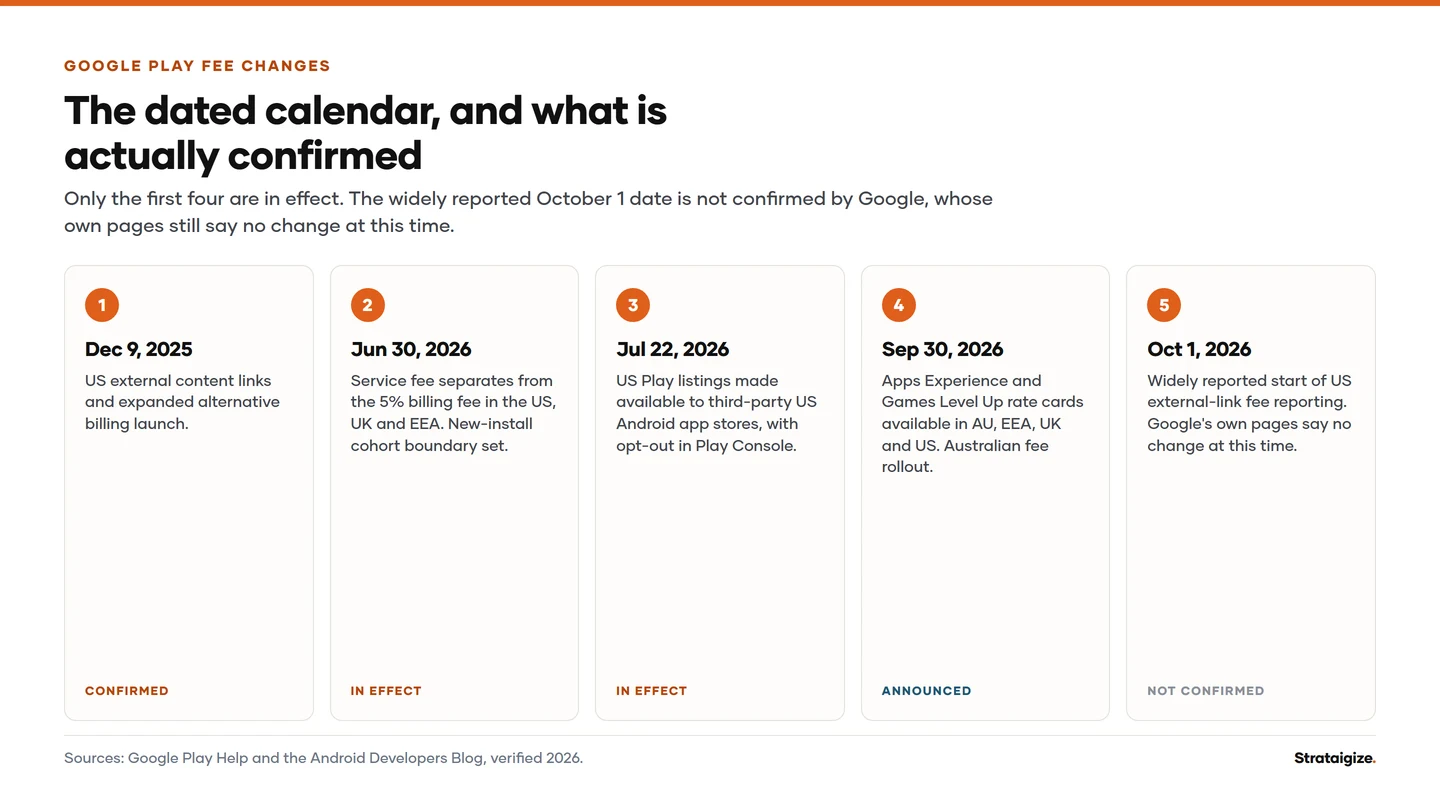
The dated calendar
| Date | What happens | Status |
|---|---|---|
| Sep 12, 2025 | Ninth Circuit upholds the Epic injunction | Confirmed |
| Oct 29, 2025 | Google drops US anti-steering and mandatory-billing rules | Confirmed |
| Dec 9, 2025 | US external content links and expanded alternative billing launch | Confirmed |
| Jan 28, 2026 | Enrollment deadline for developers already linking out or using alternative billing | Passed |
| Mar 4, 2026 | New Epic settlement; revised Modified Injunction requested; new business model announced | Confirmed |
| Jun 24, 2026 | Google publishes the rollout detail and rate cards | Confirmed |
| Jun 30, 2026 | Service fee separates from the 5% billing fee in US, UK, EEA. New-install cohort boundary set | In effect |
| Jul 22, 2026 | US Play listings made available to third-party US Android app stores, opt-out in Play Console | In effect |
| Sep 30, 2026 | Apps Experience and Games Level Up rate cards available in AU, EEA, JP, UK, US. Fee structure and expanded billing choice roll out to Australia (AU) and Japan (JP) | Announced |
| Oct 1, 2026 | US external content links and US alternative billing: transaction and download reporting required, service fees charged | Confirmed on Google’s program pages (July 22, 2026 update) |
| Dec 31, 2026 | Fee structure rollout and program availability in Korea (KR) | Announced |
| Sep 30, 2027 | Rest of world | Announced |
Dates from Google Play Help, the Android Developers Blog, and the US policy update page.
Five decisions that are not waiting for a deadline
- Make your catalog posture a decision. You were opted in on July 22 by default. Open Play Console, go to Settings then Catalog Settings, choose deliberately, and write down why.
- Re-cut the fee assumption in your LTV model. Replace the single platform-fee constant with a lookup on route, cohort, recurrence, and revenue tier. Add June 30, 2026 as a cohort boundary before anyone compares this year’s cohorts to last year’s.
- Price the 5 points in full. Get a real all-in number for collecting payment yourself: processor fees, chargebacks, refund handling, US sales tax registration and filing, and the support headcount that comes with owning billing disputes. If it lands above 5%, Play Billing is still your cheaper route for subscriptions and for all new-install revenue, and the link-out question is settled.
- Do not ship a link-out you cannot measure. Prove the install-to-web-purchase join in a staging flow first. If you cannot attribute it, you cannot optimize against it, and you will be flying your paid budget blind.
- Put the US program fees in the forecast as a line item from October 1. Google’s program pages now carry the date. If you are enrolled in external content links or US alternative billing, October revenue through those routes carries the published service fee, and your Q4 net revenue should be modelled on it.
The two dates left this year: September 30 and October 1
- Decide on Apps Experience or Games Level Up before September 30. That is when the program rate cards go live in the US. For a non-recurring-heavy app, 5 points off the service fee with no payments engineering is the best risk-adjusted move available this year. Read the requirements before the rate cards land, so the decision is a yes or a no rather than a research project.
- Have transaction and download reporting working before October 1. Both US programs require it from that date, through the external links and alternative billing APIs. A team that instruments in October is reporting late on fees it already owes.
- Re-baseline Q4 UA targets on post-June-30 net revenue. Going into your heaviest spend quarter with a 2025 fee assumption is how a profitable campaign gets read as unprofitable, or worse, the other way around.
- Audit your listing assets as syndicated creative. Your icon and screenshots are now rendering in storefronts you do not control. Check they still read at small sizes and without Play’s surrounding chrome.
FAQs
Did Google’s 30% commission actually go away?
For the transactions most publishers care about, the old headline rate is no longer the operative number. Auto-renewing subscriptions are 10% service fee plus a 5% billing fee if you use Play Billing. Non-recurring purchases are 20% or 25% service fee depending on install cohort, plus 5% if you use Play Billing. The first $1M of annual earnings is 10% plus the billing fee.
Is it worth leaving Google Play Billing?
For subscriptions and for new-install revenue, you are competing against a 5% billing fee. Once you count processing, chargebacks, tax compliance, and support, most publishers will not beat it. The case is strongest for apps with heavy non-recurring revenue from users who installed before June 30, 2026, where the spread reaches 10 points.
Do I lose Play’s service fee protection if users install from a third-party store?
No, and that cuts both ways. Google states downloads sourced through third-party stores complete through Google Play on the same terms, and Play’s service fee still applies. You do not save the fee, and you do not lose Play’s billing infrastructure.
Does any of this apply outside the US?
The June 30, 2026 fee restructure covers the US, UK, and EEA. Australia and Japan follow on September 30, 2026, Korea on December 31, 2026, and the rest of the world on September 30, 2027 (Google’s regional schedule). The external content links program and the third-party catalog access change are US-only. Canadian publishers are affected only through their US user base, which is a point we cover with the teams in our Canadian app marketing roundup.
What is the single most common modelling mistake right now?
Treating the platform fee as one number. It is now four variables, and the install-date boundary in particular is invisible unless you go looking for it.
Get your model corrected before Q4
If your LTV and payback models still carry a single platform-fee constant, your Q4 budget is being sized against the wrong net revenue. Book a growth audit and we will re-cut your fee assumptions by route and cohort, pressure-test whether a link-out is worth it for your revenue mix, and check that your attribution survives it. That work sits inside our mobile app marketing practice, where the payback math is the whole job. Most of the fee change hits consumer apps.
Talk to us