The Costs of Mobile App Install and Event-Based Campaigns
Most mobile app install campaigns in 2026 cost between about $1.50 and $5.00 per install, with iOS averaging around $5.84 and Android around $1.92 globally as of early 2026. Event-based (CPA) campaigns cost more because they pay for deeper actions: expect roughly $5 to $20 for sign-ups and $20 to $80 or more per paying user. Platform, geography, app category, and creative quality drive the biggest swings.
Budgeting a mobile app campaign in 2026 means pricing two different things: the install itself, and the in-app actions that make money. Costs moved meaningfully over the past year, especially on iOS, so we have refreshed every benchmark in this guide as of August 2026 and linked the sources. Here is what install and event-based campaigns cost today, plus the costs beyond media spend that most budgets miss.
The Basics of Mobile App Install Campaigns
Cost Per Install (CPI) Rates in 2026
The Cost Per Install (CPI) model is the most common pricing structure for mobile app marketing: advertisers pay for each install their campaigns generate. As of early 2026, global average CPI sits around $5.84 on iOS (up 19 percent year over year) and $1.92 on Android, roughly a three-to-one gap between the platforms. Regionally, current benchmarks put North America at about $2.50 to $5.00 per install, Europe, the Middle East and Africa (EMEA) at $2.00 to $4.00, Asia Pacific (APAC) at $1.50 to $3.00, and Latin America at $0.50 to $2.00.
Typical network-level CPIs, per recent benchmark reports from Business of Apps and Mapendo:
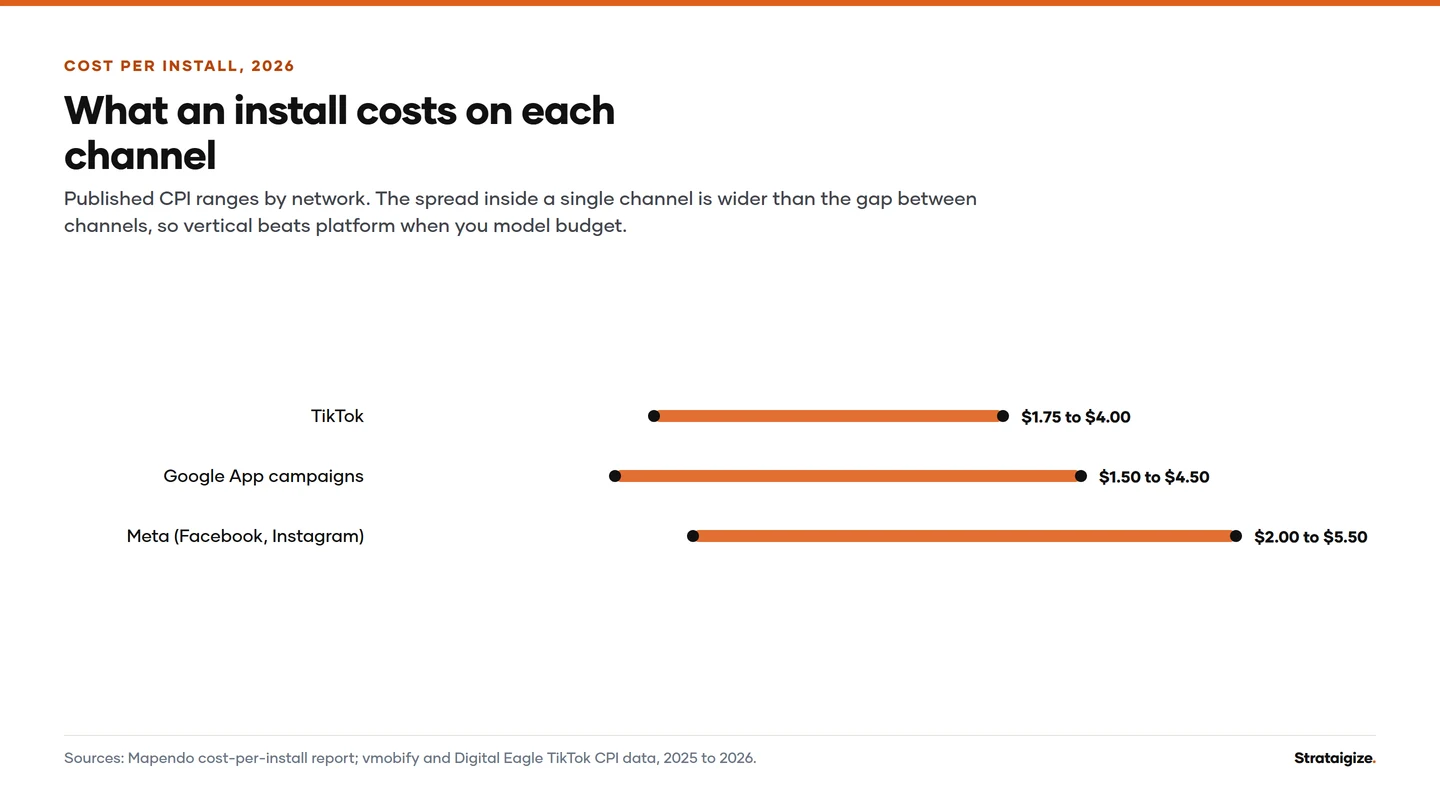
- Google App campaigns: roughly $1.50 to $4.50 per install.
- Meta (Facebook, Instagram): roughly $2.00 to $5.50 per install.
- TikTok: anywhere from $0.70 to $4.50 by vertical in 2025 data, with global averages clustering between $1.75 and $4.00.
Category moves the number as much as the channel does: category benchmarks show casual games around $3 to $8 per iOS install, while fintech and insurance apps often pay $10 to $25.
Factors Influencing CPI
Several key factors can impact your CPI:
- Ad Creatives: Engaging, high-quality ads lower CPI by improving click-through and conversion rates; creative is the biggest lever we control on mature ad platforms.
- Targeting Precision: Narrow, high-demand targeting often increases CPI but delivers higher-quality installs.
- Platform and Operating System Mix: iOS installs cost more but often monetize better, so judge CPI against downstream value rather than in isolation.
Event-Based Campaign Costs
Cost Per Action (CPA) Campaigns
Event-based campaigns use the Cost Per Action (CPA) model, where advertisers pay when users complete a specific action, such as an in-app purchase, registration, or trial start. CPA runs higher than CPI because these actions carry real business value. As a planning range, we typically see shallow events like sign-ups and registrations land between $5 and $20. Deeper events cost several times that: subscription app benchmarks put the cost of acquiring a paying user at roughly $20 to $80, because the average freemium app converts only 2 to 5 percent of installs into payers. Broader user acquisition cost research shows the same pattern: the deeper the funnel event, the higher the price.
Strategies for Event-Based Campaigns
To optimize event-based campaign costs:
- Retargeting: Re-engage users who have shown prior interest in your app, reducing overall CPA.
- In-App Messaging: Use push notifications and in-app messages to encourage event participation, lowering reliance on external advertising.
- Pick events with volume: Optimizing toward an event that rarely fires starves the algorithm; choose an upstream event with steady volume and filter for quality afterward.
Platform-Specific Advertising Costs
Google Ads
Google App campaigns (formerly Universal App Campaigns) use machine learning to optimize ad performance across Search, YouTube, Google Play, and the Display Network. The automation simplifies campaign management, but costs fluctuate with competition.
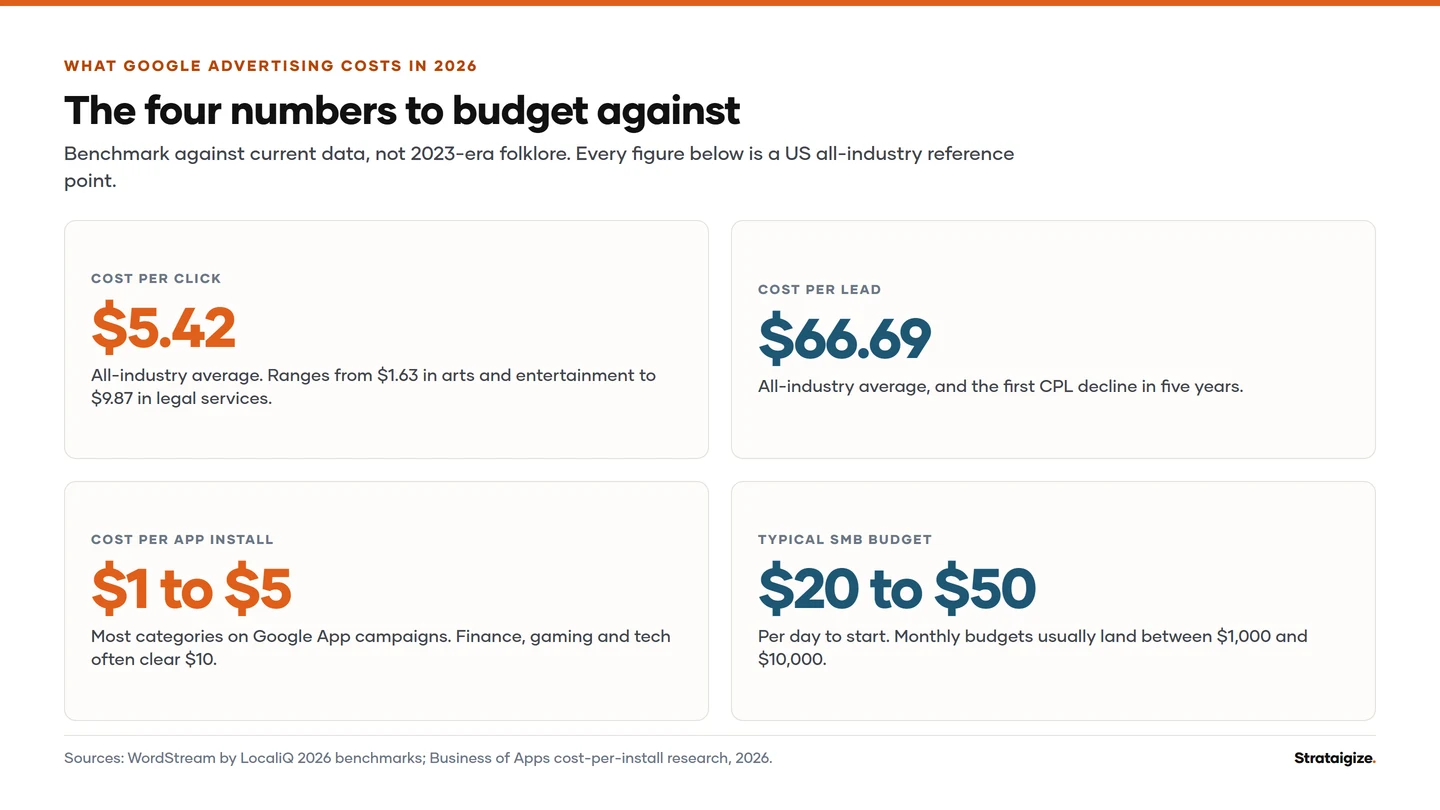
- Cost Range: roughly $1.50 to $4.50 per install, on average.
Meta Platforms (Facebook, Instagram, Threads)
Meta offers extensive targeting plus Advantage+ automation for app campaigns, and Threads inventory is now part of the placement mix:
- Cost Range: roughly $2.00 to $5.50 per install across Facebook and Instagram, with Instagram often pricing at the upper end thanks to its younger, highly engaged audience.
TikTok
TikTok’s short-form video format fosters high engagement, and its Smart+ automated campaigns now handle much of the optimization heavy lifting.
- CPI: roughly $1.75 to $4.00 globally, with vertical-level results from $0.70 to $4.50.
Snapchat
Snapchat’s augmented reality (AR) ad formats are effective for engaging younger audiences, and pricing is usually quoted as cost per thousand impressions (CPM) rather than CPI:
- Cost Range: median CPM for app install campaigns is about $23.40 as of 2026, so your effective CPI depends on how well your creative converts impressions into installs.
Apple Ads
Apple Ads (renamed from Apple Search Ads in April 2025) now sells placements across the App Store, including the Today tab, the Search tab, search results, and product pages. Pricing is auction-based per tap, and because App Store search intent is high, it is often the most efficient iOS channel for apps with clear keyword demand.
Additional Costs of Mobile App Marketing
App Store Optimization (ASO)
ASO ensures your app ranks higher in app store searches, which drives organic installs and lowers your blended acquisition cost.
- Cost Range: most agencies charge about $2,000 to $15,000 per month for ongoing ASO retainers as of 2026, with top-end programs reaching $25,000 or more depending on portfolio size and market coverage.
Measurement and Attribution
A mobile measurement partner is a real budget line now. AppsFlyer’s pricing as of 2026 starts with a free Zero plan that includes 12,000 free conversions in your first year, then moves to pay-as-you-go Growth pricing at $0.07 per conversion, so measurement costs scale with install volume.
Influencer Marketing
Partnering with influencers can reach new users through authentic recommendations. Budgets scale with reach: nano and micro creators may cost a few hundred dollars per post, while top-tier creators command five and six figures per campaign. We also treat creator content as a creative sourcing channel, since whitelisted creator ads often outperform studio-produced assets.
Content Creation and Management
Plan a few thousand dollars per month for a comprehensive program, and if you run ASO or paid user acquisition (UA) seriously, budget an additional $1,000 to $5,000 per month for creative production to fight creative fatigue.
Budgeting for Long-Term Success
Retainer Models
Many app developers work with marketing agencies on a retainer basis. Dedicated ASO retainers alone run about $2,000 to $15,000 per month; full-service growth retainers that add paid UA management, creative production, and analytics scale up from there based on channels and spend under management.
Post-Launch Support
Ongoing marketing efforts, such as ad refreshes, ASO updates, and fresh content, are essential to maintain momentum. Treat this as a standing monthly line item rather than a one-time launch budget: customer acquisition costs have risen roughly 60 percent over the past five years, so efficiency work compounds year after year.
Pro-tip: If you’re running app install campaigns on Meta only, you might want to consider launching install campaigns on Google Ads as well. This complete Google Ads Statistics for 2026 shows why. And before you commit budgets, run your targets through our ad spend calculator to sanity-check what your CPI and CPA goals leave for media.
FAQ
What is a good CPI in 2026?
It depends on platform, region, and category. As of early 2026, global averages are about $5.84 on iOS and $1.92 on Android, and North American campaigns typically pay $2.50 to $5.00 per install. A good CPI is one comfortably below what a new user is worth to you, so benchmark against your own lifetime value (LTV) rather than industry averages.
Why do event-based campaigns cost more than install campaigns?
Because far fewer users complete deep actions than install the app. With typical freemium apps converting 2 to 5 percent of installs into paying users, cost per paying user lands at a multiple of CPI, commonly $20 to $80. You are paying for proven value instead of raw volume.
How do privacy changes affect campaign costs?
iOS measurement runs on SKAdNetwork and Apple’s newer AdAttributionKit framework side by side in 2026, while Google retired its Privacy Sandbox on Android initiative in October 2025, leaving Android measurement on the Play Install Referrer and permitted identifiers. Noisier iOS data makes true CPA harder to read, which is why attribution setup and conservative assumptions matter before you scale budget.
How much should I budget to test a new channel?
Enough to exit the learning phase and read matured data: in practice, that means committing several weeks and enough daily budget to generate around 50 conversions per week per ad set or campaign. Use our growth calculator to model how install volume translates into revenue before you commit. The case for running that test early, while the auction is still under-competed, is in why we test emerging channels before they are obvious.
Price the Install and the Action Separately
Build the 2026 budget from two numbers. Use CPI to price the install, use CPA to price the action that makes you money, and let ASO and influencer work pull the blended figure down over the following quarters. Set up a mobile measurement partner before you scale, because a channel you cannot attribute is a channel you cannot confidently cut. Everything after that is discipline: benchmark against your own economics, keep targeting tight, and keep the creative moving before fatigue sets in. And if you would rather not run this alone, our mobile app marketing program covers the store listing and the paid side together, including paid advertising.
Talk to us