Home / Services / AI systems / Internal knowledge assistants
Service and operations
Answers from your own documents, with the source attached.
An internal knowledge assistant answers questions from your documents, policies, tickets and meeting notes, cites the file and the passage, and says when it does not know. Built for the question a new hire asks three times a day.
Who it is for
Built for the team that does this by hand.
Firms where the answer exists in a document nobody can find in under ten minutes
Operations teams onboarding people faster than the documentation can be read
Departments whose policy, procedure and precedent live in three systems and a shared drive
What it does
Internal knowledge assistants, by the job.
Indexes with permissions
Documents, tickets, wikis and chat are indexed inside your tenancy, and the permissions of the person asking are carried through to what can inform their answer.
Answers with citations
Every answer quotes the passage it came from and links to the document. A reader can check it in one click instead of trusting it.
Refuses when the corpus is silent
A question with no source in your documents gets "not in our documents" and a suggested owner, rather than a fluent guess.
Stays current
When a document changes, its entries update. When a session or a process creates a new document, it is indexed before the day ends, not on a nightly rebuild that may not run.
How it is built
The build, in order.
Every system here is scoped as one bounded workflow with a written success metric and a kill threshold agreed before the build. The steps below are the ones specific to this one.
Census the corpus
Which systems hold the knowledge, who may see what, how stale each source is, and which questions your team asks most. The scope is set by the questions, not the documents.
Build the index and the gates
Retrieval with permissions, citation to the passage, and the refusal rule. An evaluation set of real questions with known answers is written with your team before anything is tuned.
Pilot with one team
A team that asks the most questions uses it for a month. Every wrong or missing answer is logged, and each one is either a corpus gap or an index defect, fixed as such.
Widen and maintain
More sources, more teams, and a weekly report of unanswered questions, which is the most useful list a documentation owner ever gets.
In production at Strataigize
We run this ourselves.
Our own company runs on this. A set of knowledge graphs covers our code, our knowledge base, our operating files and this website, one connector serves all of them, and every working session queries the graph before it opens a file. When a session changes a file, it updates the graph before it closes, which is what keeps the assistant current without a nightly rebuild. A graph that cannot answer something it should is logged as a defect and repaired.
Governance
What a person still approves.
- Answers respect the permissions of the person asking; a document they cannot open cannot inform their answer
- Every answer cites its source, and a question with no source in the corpus is refused rather than guessed
- Your documents are indexed inside your tenancy and never used to train a shared model
The rest of the posture is published on trust and security: client-granted access you can revoke, credentials in managed stores, an AI governance summary aligned to the NIST AI Risk Management Framework, our subprocessors, and a DPA on request. We do not hold SOC 2 and we say so there.
Price
Published, not gated.
Pilot builds $25,000 to $60,000 fixed, production retainer from $8,000 per month. Every AI build starts with a $7,500 AI Opportunity Audit over two weeks that is credited toward the build if you proceed, and a pilot is one bounded workflow on your real data over 30 to 90 days with a written success metric and a kill threshold.
The full price list is on the pricing page, and the cost drivers, with the questions that expose a padded quote, are in how much AI agents cost in 2026.
Case studies
The work behind it, documented.
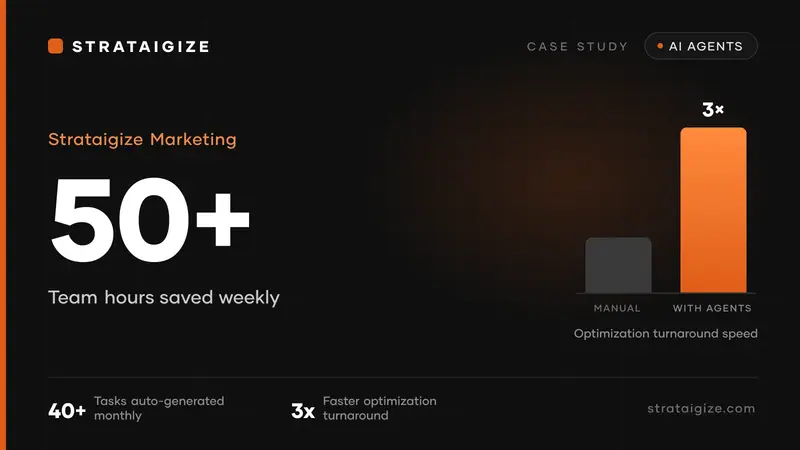
Strataigize Marketing
How Our Marketing Agency Uses AI Agents to Automate Busywork
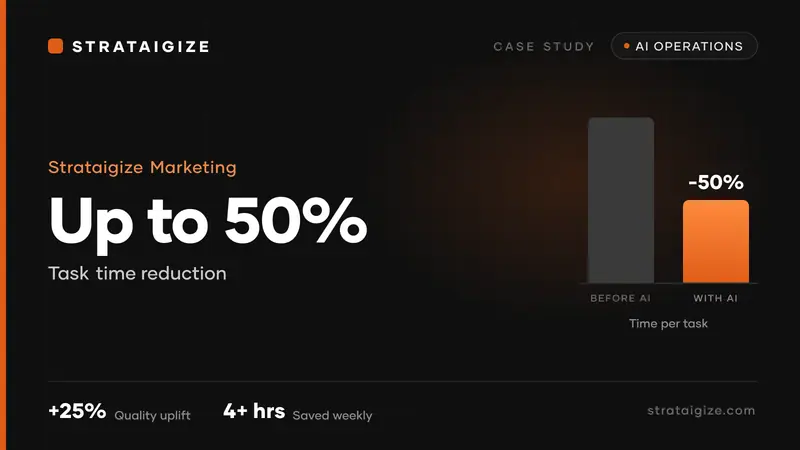
Strataigize Marketing
Our AI Productivity Journey: Research & Case Study
Questions
Internal knowledge assistants, answered.
What is an AI knowledge base?
Is this retrieval-augmented generation?
Which systems can it read from?
Related
Where this connects.
AI consulting · Customer support agents · Document processing agents
The other systems in the catalogue: lead qualification agents, outbound sales agents, customer support agents, document processing agents, ad optimization systems, client reporting automation, content engines, computer vision systems, mcp servers and agent-callable surfaces, always-on operations agents.
Teams that hand us the number








Pilot builds $25,000 to $60,000 fixed, production retainer from $8,000 per month
Real ranges, published. Ad spend stays in your own accounts.
See the full pricing table →Where this fits: see the Strataigize Growth System, the ladder every engagement runs on.
Talk to the build team about internal knowledge assistants
Name the workflow you want it to run and we reply within 24 hours with whether it is a fit, the bounded scope we would propose, and the payback math.
Start with one workflow.
A free 30-minute audit call with the senior team names the workflow this system should run first and what it should cost, whether you build it with us or not.
Book your growth audit →Canadian and looking at funding? How the BDC LIFT program works. Public sector? How we build for government.
Rated 5.0 on Clutch